Car problem guides
Work through symptoms, safety questions, diagnostic codes and the difference between recalls, bulletins and warranty extensions.
Read the problem guidesCar research lab
Eleven reports explain why a local labor rate, an exact vehicle version, a manufacturer procedure or a contract payment rule can change a decision. Each report leads with its conclusion, shows the evidence, and explains the reasoning. Charts, source dates and full datasets remain available for checking and citation.
Six new reports · Five existing reports expanded
Explore 22 original figures, two interactive scenario tools and eleven reproducible datasets. The cost experiments test chosen inputs; the audits describe the retained library; the manufacturer comparisons examine selected documents. None estimates the probability that a car will break down.
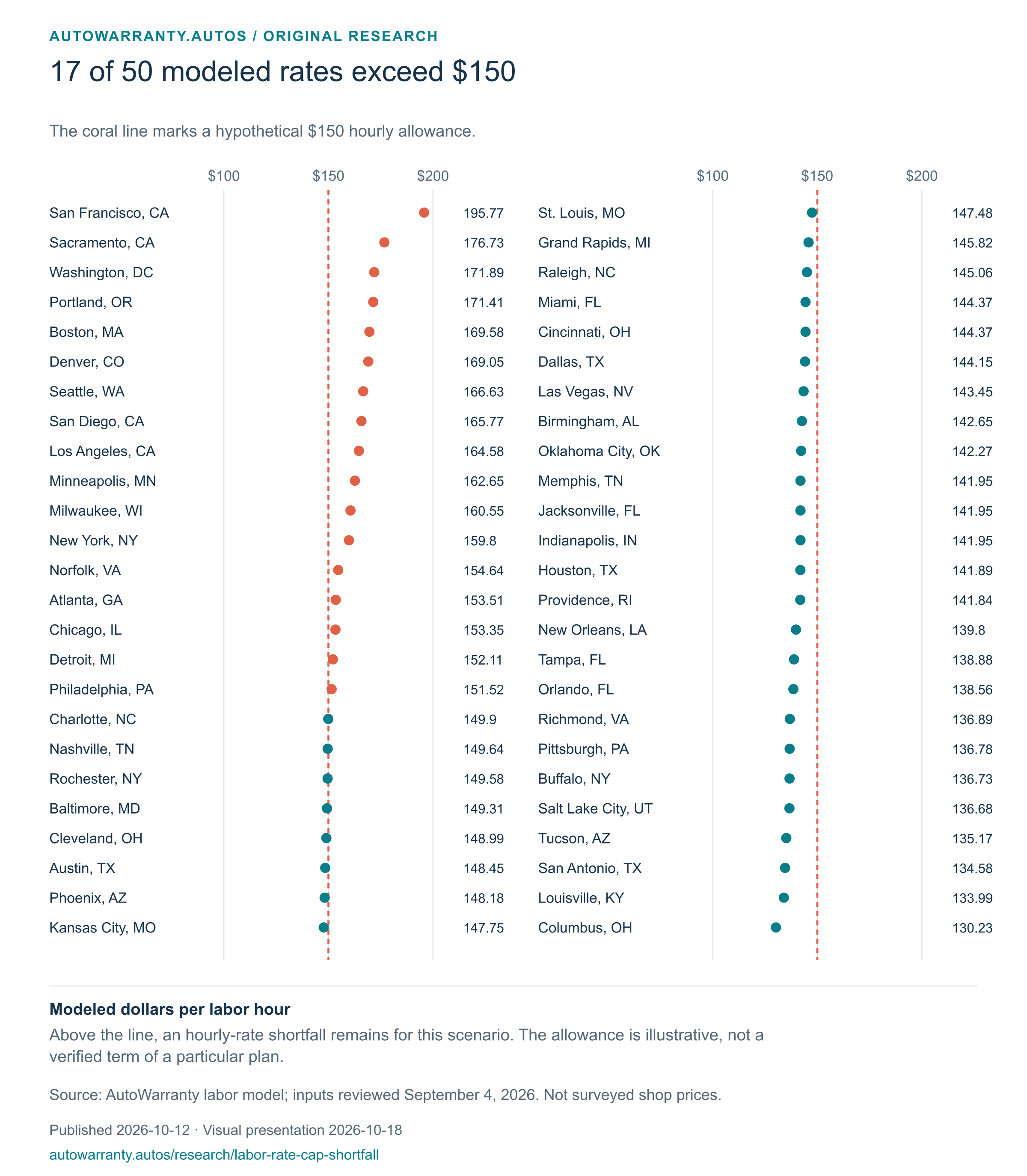
Approval of the repair does not remove a difference between the shop's hourly rate and the agreement's permitted rate. In the fixed scenario, that difference produces $366.16 over eight approved hours. This is an isolated rate-gap calculation using chosen inputs, not a verified term or outcome of a particular plan.
Read the analysis and conclusion →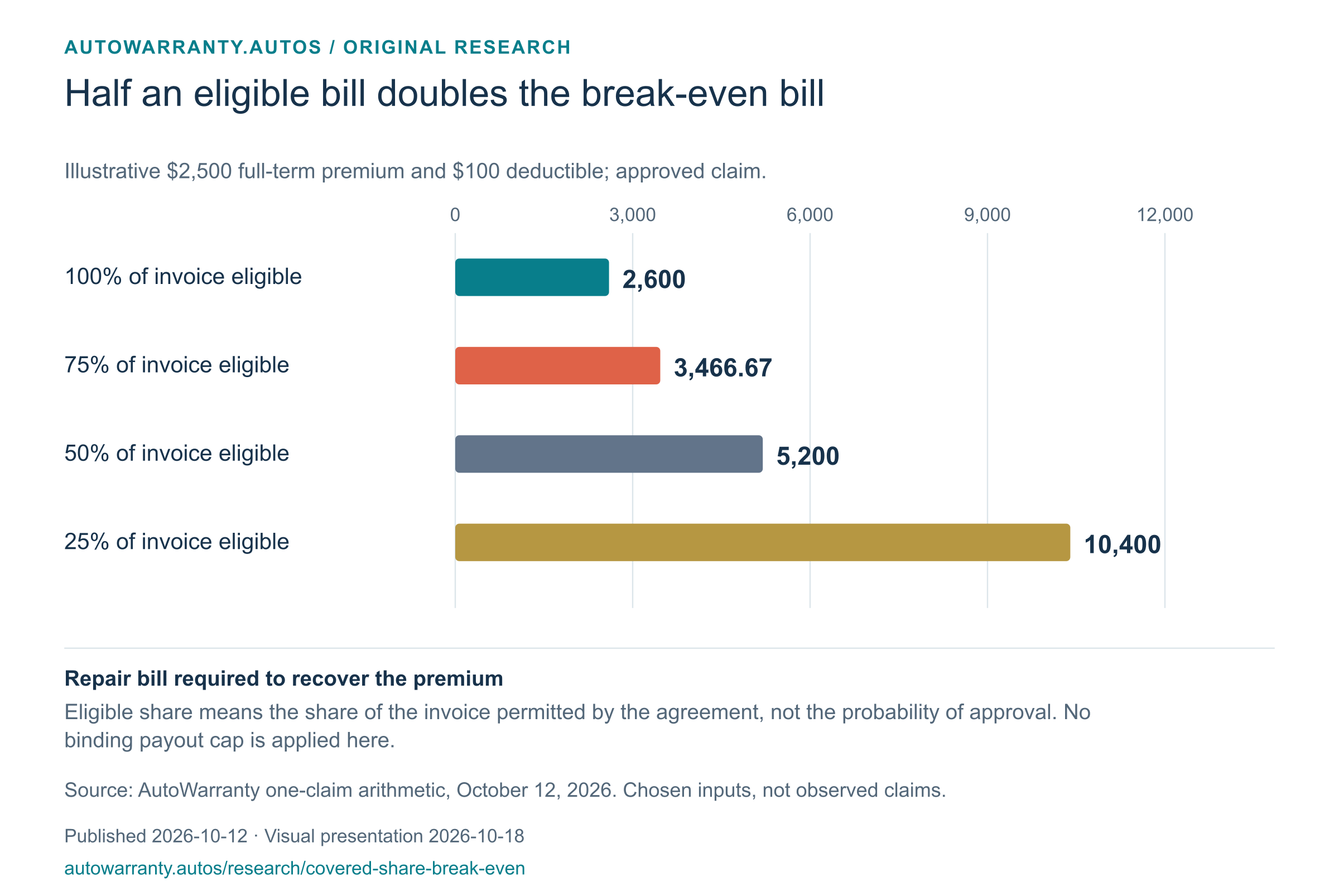
A large repair bill can produce the same payment as a smaller bill when less of it is eligible. In the fixed example, $2,600 at full eligibility and $5,200 at half eligibility both leave a $2,500 payment after the deductible. A binding cap can prevent that payment from reaching the premium at all.
Read the analysis and conclusion →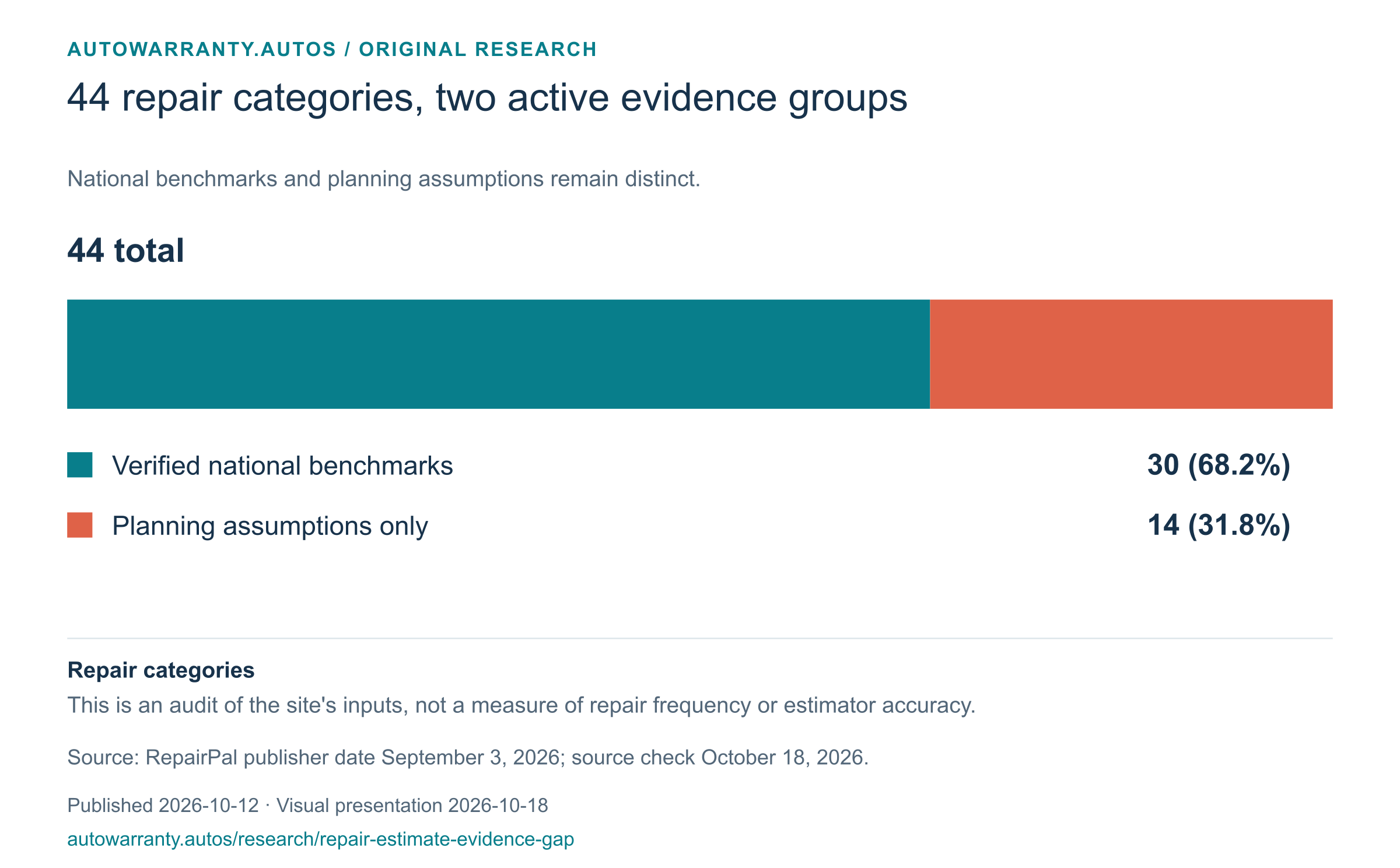
The library now contains 30 national RepairPal benchmarks checked on 2026-10-18, with the publisher's September 3, 2026 update date retained. 14 categories remain planning assumptions. No model-specific individual-repair ranges are active.
Read the analysis and conclusion →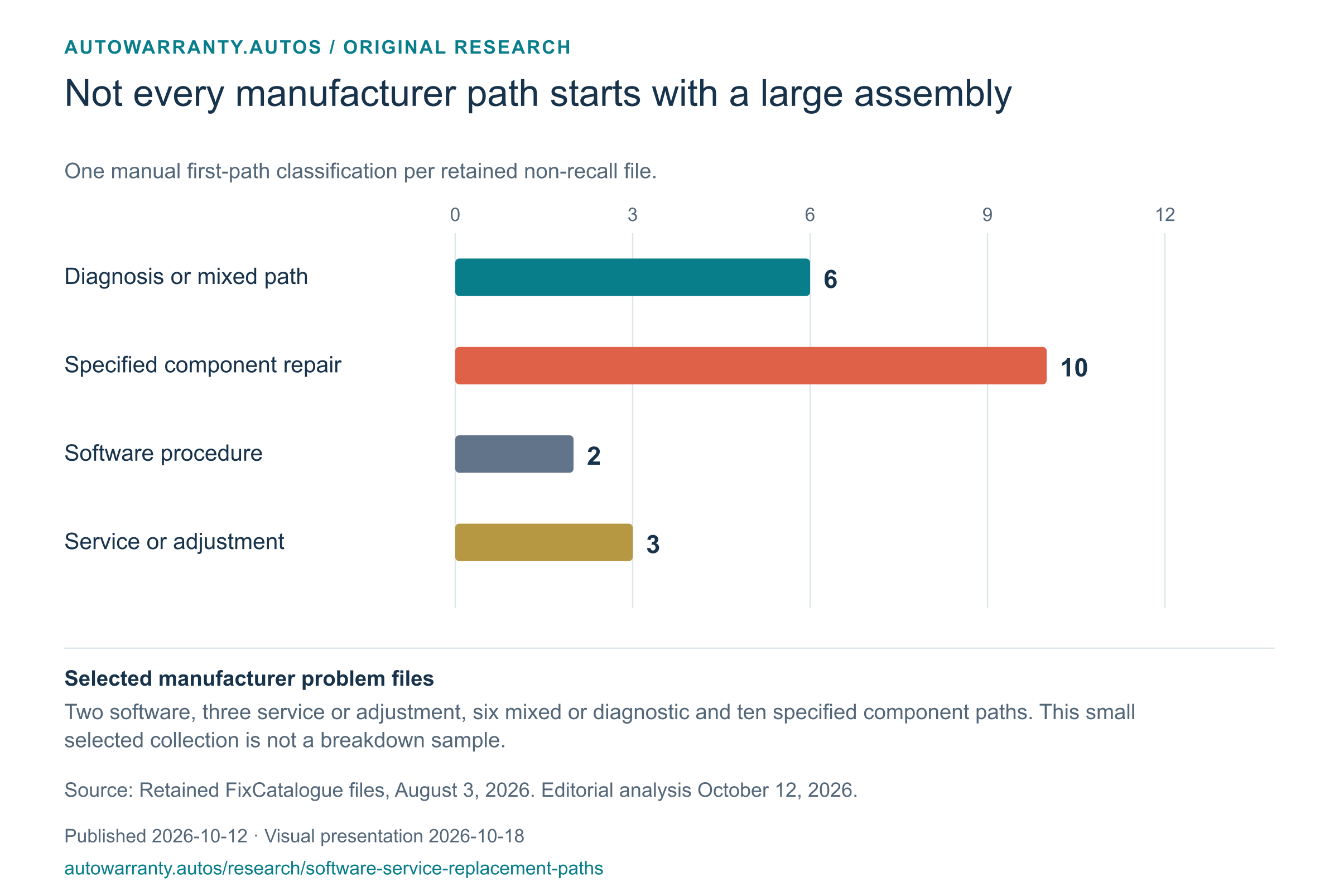
A transmission or electronic-system symptom does not automatically identify a complete assembly replacement. In these files, the first official path may instead involve software, adjustment or diagnosis of a smaller component. The inference is to establish the applicable path before applying a replacement benchmark.
Read the analysis and conclusion →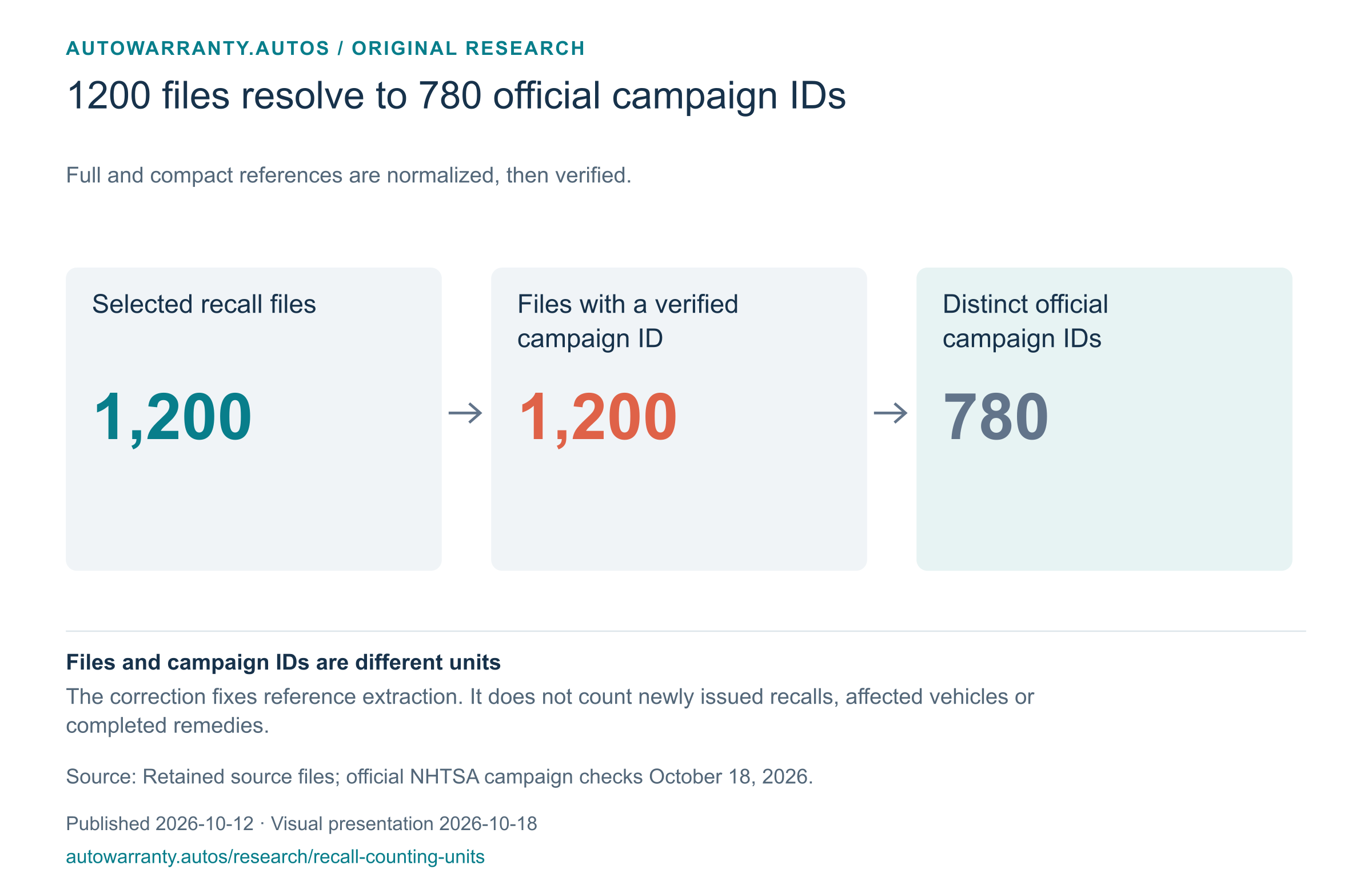
The corrected reference audit resolves all 1200 selected recall files to 780 official campaign IDs. 208 IDs appear in more than one file. The collection is selected editorial material, not the complete NHTSA recall database.
Read the analysis and conclusion →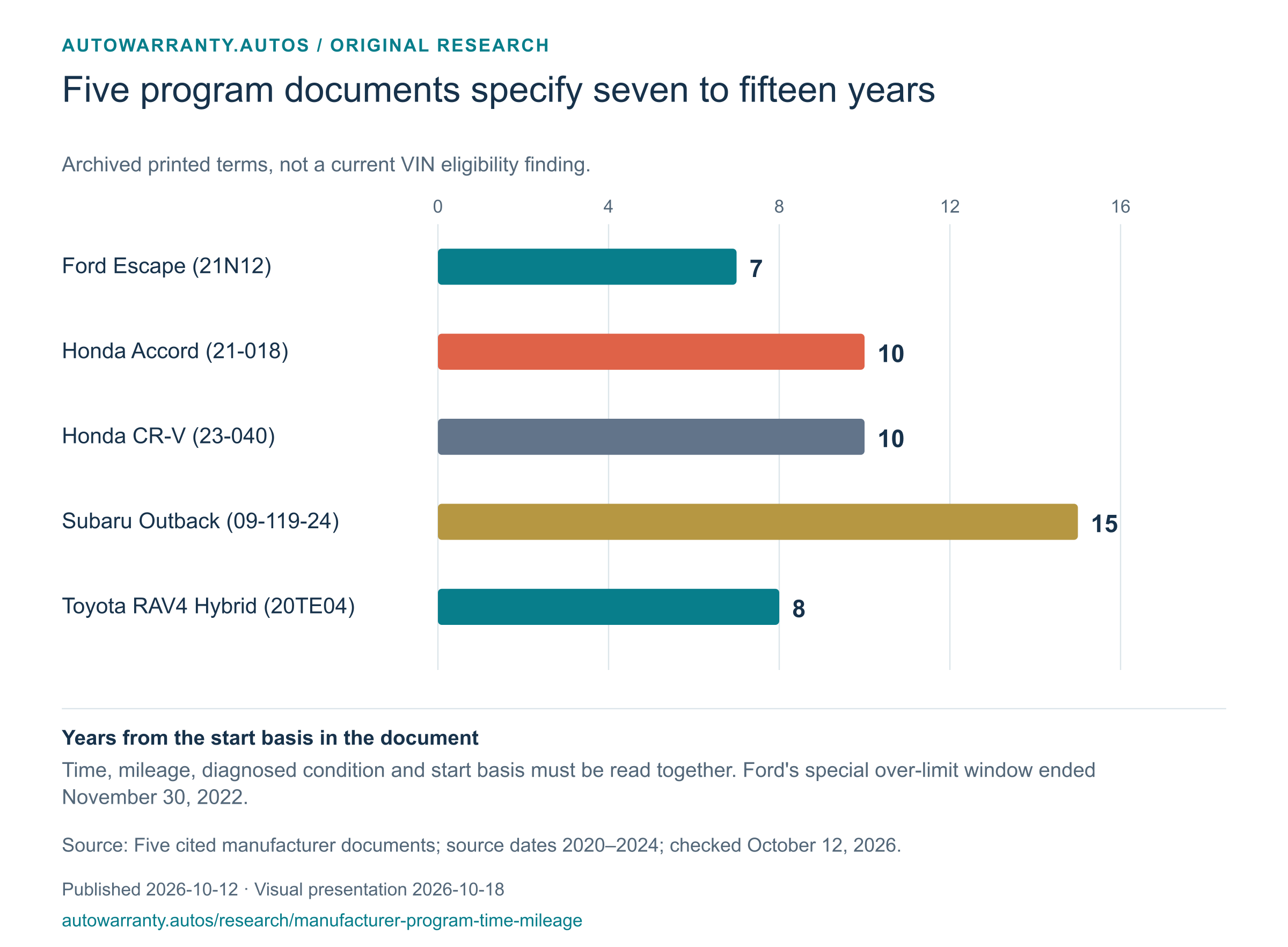
The printed year limit cannot be used on its own to judge eligibility. Two Honda documents state no mileage limit, but still restrict time and the covered condition. The other selected documents also combine years with mileage and vehicle or diagnostic boundaries. These are archived terms, not current approvals for individual cars.
Read the analysis and conclusion →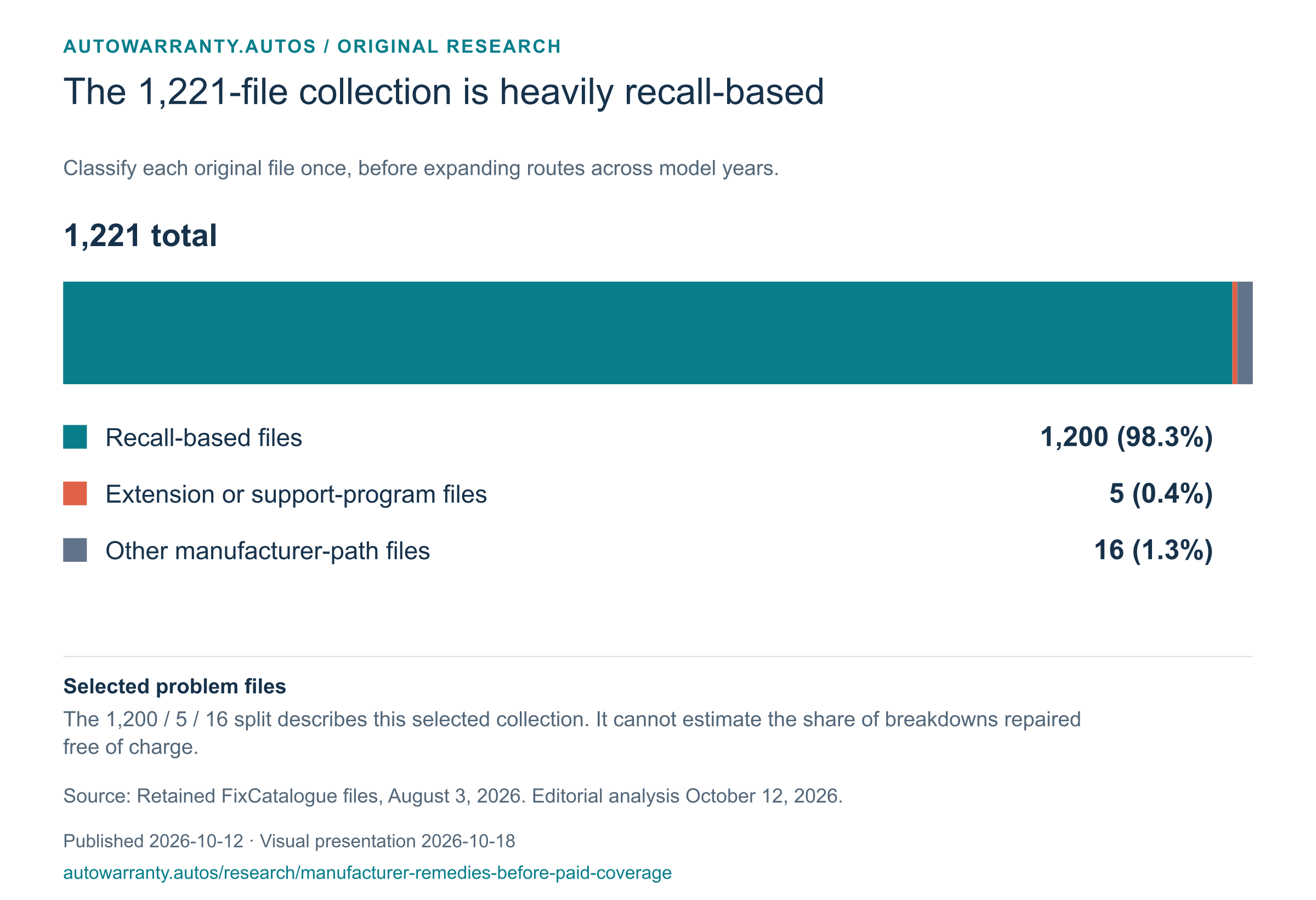
The collection contains 1,200 recall-based files, five extension or support-program files and 16 other manufacturer-path files. Their different purposes create different next steps. The recall-heavy composition reflects the imported library, so it cannot establish how often drivers qualify for a manufacturer-paid remedy.
Read the analysis and conclusion →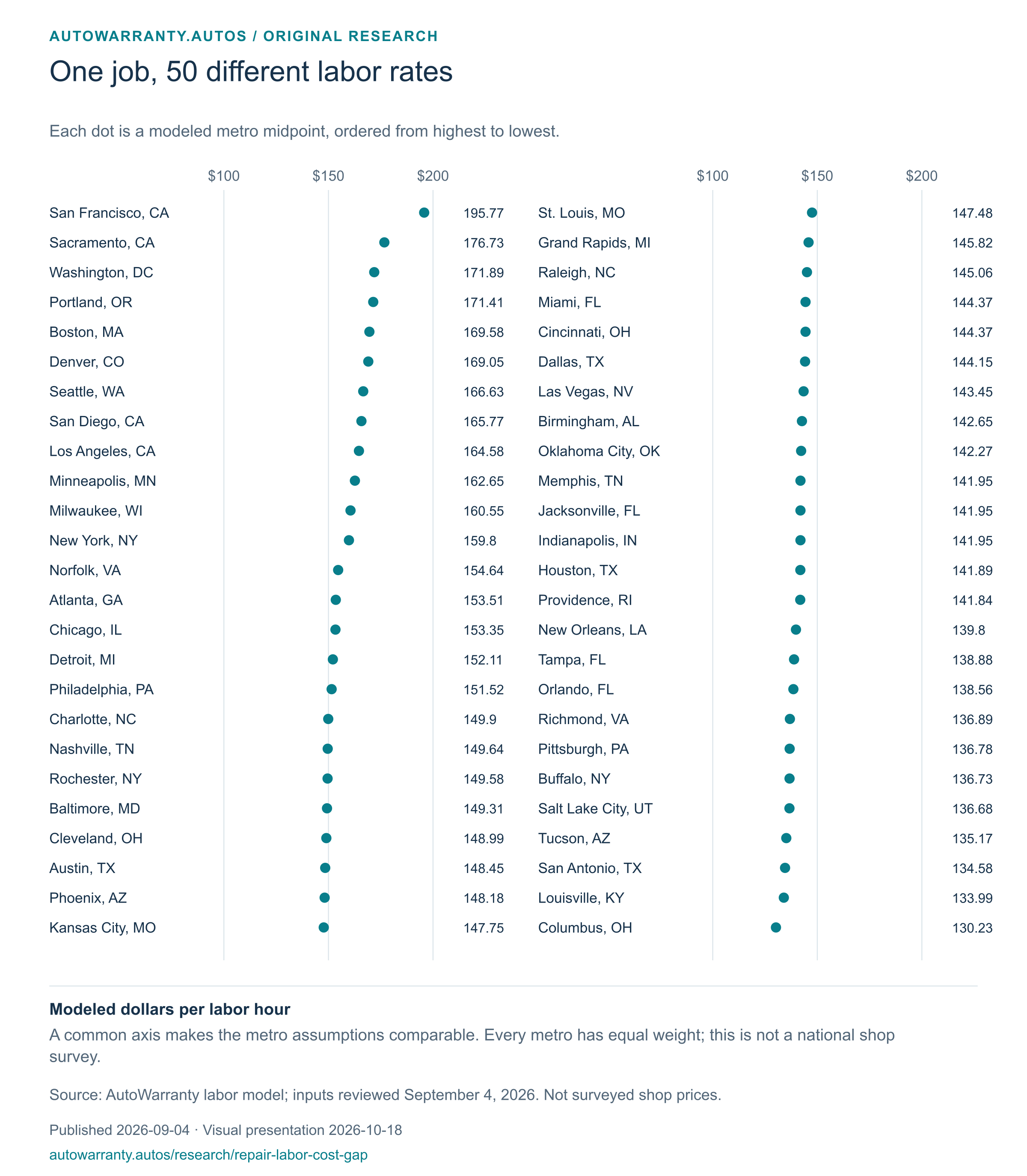
The same hours of work can produce a different planning total without any change to the broken part. In this model, location changes the labor bill by $524.32. That makes a national or model-level repair range a starting point for local budgeting, rather than a substitute for the shop's estimate.
Read the analysis and conclusion →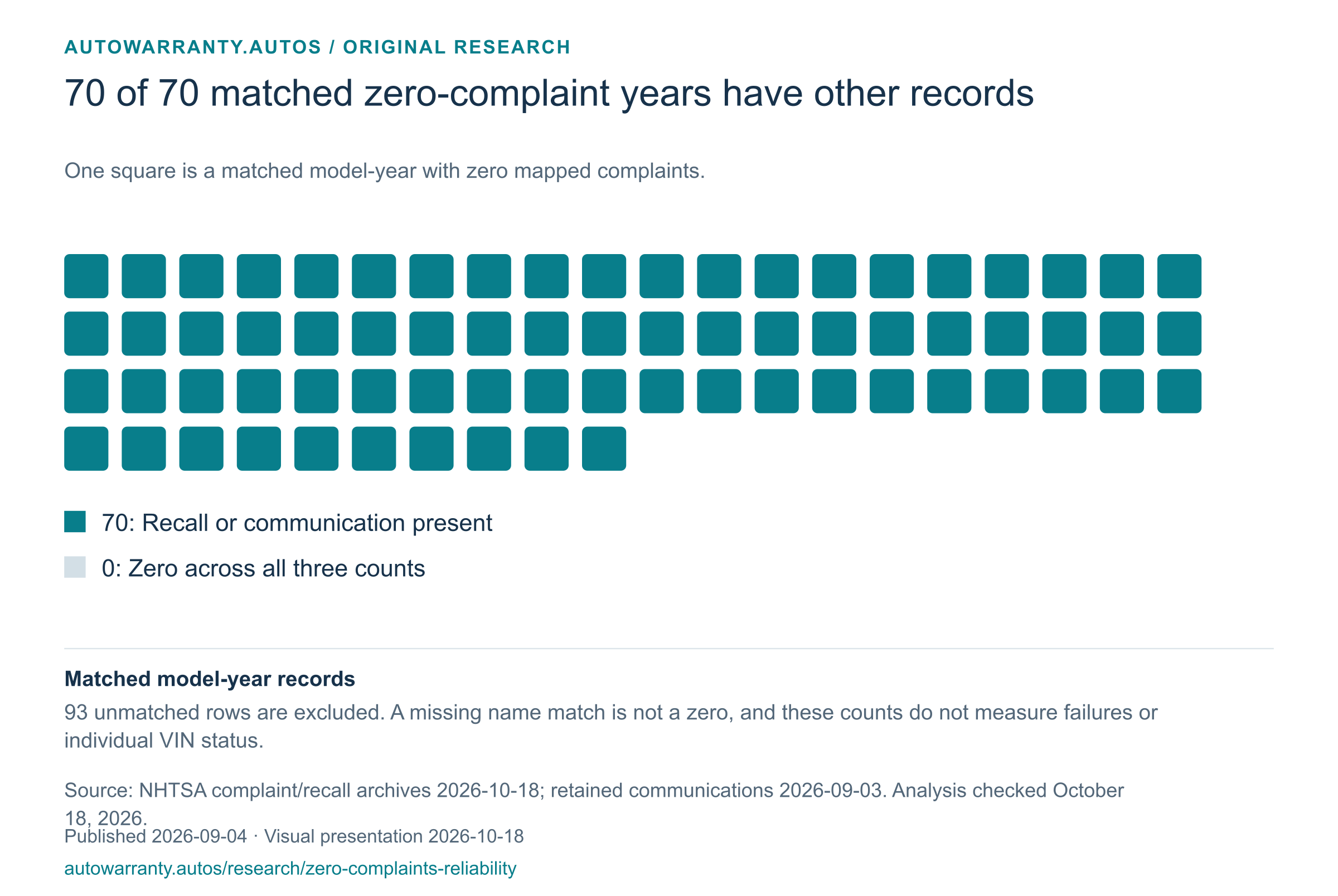
The refreshed snapshot contains 2,649 matched model-years. 70 have zero mapped complaints, and 70 of those have other public records. A missing name match is an information gap; the 93 unmatched rows are not counted as zero.
Read the analysis and conclusion →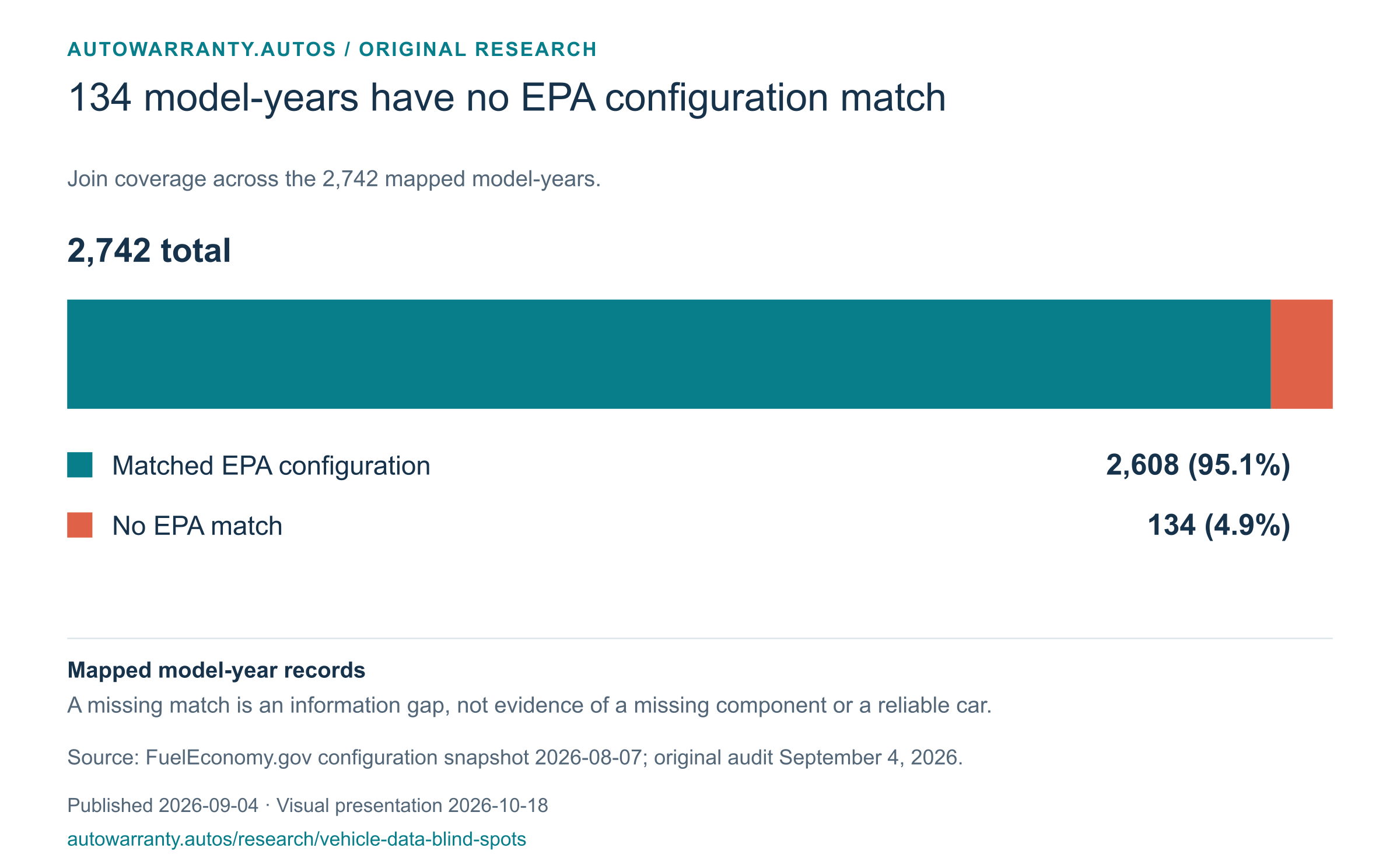
Multiple configurations are the usual pattern in the matched portion of this database: 2,336 of 2,608 model-years, or 89.6%. A model-year summary can therefore combine equipment from several possible versions. The summary helps identify what to verify; it does not identify the configuration of an individual vehicle.
Read the analysis and conclusion →Start with your car
You can look up a car before buying it, budget for a repair or check a warranty quote. Choose the question closest to your decision.
Work through symptoms, safety questions, diagnostic codes and the difference between recalls, bulletins and warranty extensions.
Read the problem guidesRequest current NHTSA records for an exact model year. Check the defect, consequence and manufacturer remedy, then confirm your VIN separately.
Search current recordsThe earlier recall awards and downloadable graphics have been withdrawn while model-name matching and campaign counts are corrected.
Read the correction noticeLook up complaints, recalls and manufacturer service information for your make, model and year. These records can point you toward questions to ask a mechanic, but they don't tell you how likely your car is to break down.
Choose a vehicleCheck repair-cost ranges for the kind of engine and drivetrain in your car. Use them to plan a budget, then get a shop estimate for any work you actually need.
Review repair researchHave a quote? Enter its full price and deductible to see how large a covered repair would need to be for one claim to pay back that cost. Check exclusions and payout limits before relying on the result.
Run the calculatorOur sources
We use different sources for reported problems, vehicle details and repair costs. Together they help you ask better questions, but they can't predict your car's next repair.
347,260 complaint/model-year records and 11,044 recall/model-year records. IDs are deduplicated within each model-year; these sums are not globally unique reports or campaigns.
Snapshot or source date: 2026-10-18
864,817 communication/model-year records, deduplicated within each model-year. This count retains the earlier communications snapshot and was not refreshed with the recall and complaint archives. A document covering several years contributes to each applicable year.
Snapshot or source date: 2026-09-03
11,636 EPA configurations cover 2,608 model-year records. Fuel type, drivetrain and equipment details help us choose repairs that fit. We do not fill gaps with specifications from another year.
Snapshot or source date: 2026-08-07
We model 44 major repairs, using published RepairPal benchmarks where we have a match. Local labor assumptions help produce broad ranges for planning.
Snapshot or source date: 2026-09-03
The imported catalogue indexes manufacturer and NHTSA documents. On October 18, 2026, 1,200 recall files were corrected against 780 cited campaigns. Original imports remain in the internal audit record; the displayed recall text uses the checked official fields. Unconfirmed model associations are labeled.
Snapshot or source date: 2026-10-18
Explore a vehicle
These profiles have records and repair examples to explore. They aren't a list of the best or worst cars. Complaint counts alone don't account for how many cars were sold, how far they were driven or how serious the reported problems were.
901 complaint reports · 8 recall campaigns
Open model-year research →20182,318 complaint reports · 18 recall campaigns
Open model-year research →20182,158 complaint reports · 5 recall campaigns
Open model-year research →20181,031 complaint reports · 19 recall campaigns
Open model-year research →20191,036 complaint reports · 3 recall campaigns
Open model-year research →20151,366 complaint reports · 9 recall campaigns
Open model-year research →Check the dates
New complaints, recalls and service information can appear after we collect a source. Each study shows the dates behind its figures. For a decision about a particular car, check its current recall status and get a current repair estimate or warranty quote.
Before you decide
Look into reported problems that could affect your car and check for open recalls by VIN. A complaint count won't tell you how often a part fails, and a recall count won't tell you whether your car has already been repaired.
If you're considering a warranty, use our repair ranges as a starting point, not a forecast. Compare the plan's full price with what it would pay toward repairs you care about. Check the deductible, waiting period, labor allowance and payout limits in the actual contract.
Our migrated FixCatalogue records provide symptoms, affected years, repair checks and primary source references directly on each covered model page. Review the record date and check whether its year, engine and VIN scope apply to your car.