Main conclusion
Read the remedy and its eligibility rules before deciding who may pay
The collection contains 1,200 recall-based files, five extension or support-program files and 16 other manufacturer-path files. Their different purposes create different next steps. The recall-heavy composition reflects the imported library, so it cannot establish how often drivers qualify for a manufacturer-paid remedy.
Evidence scope: 1,221 selected problem files; repeated campaigns across models are retained. Source snapshot: 2026-08-03T20:46:23Z. The interpretation below uses these retained inputs.
The 1,200 / 5 / 16 split describes this selected collection. It cannot estimate the share of breakdowns repaired free of charge.
Retained FixCatalogue files, August 3, 2026. Editorial analysis October 12, 2026.
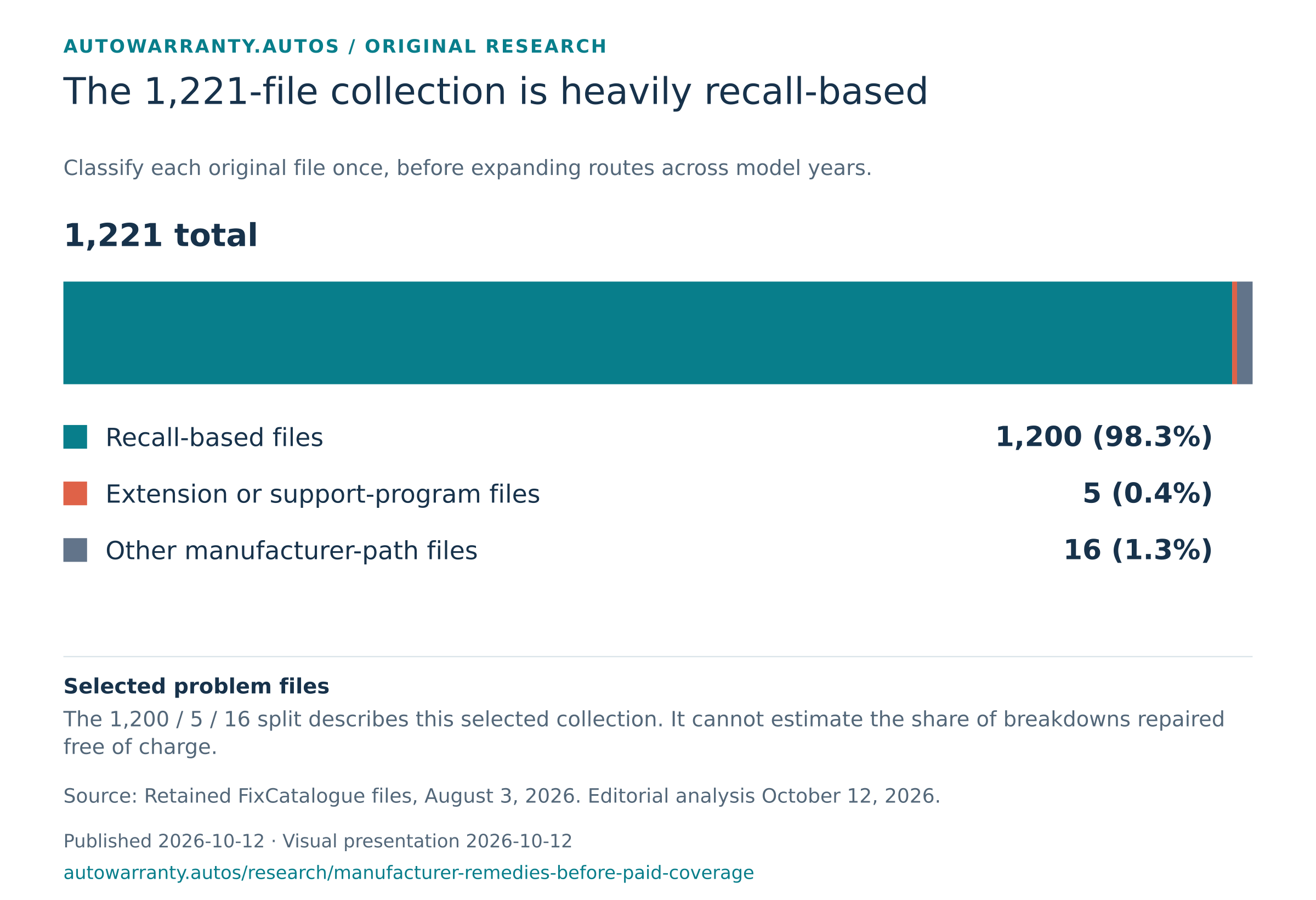
Read the chart as a table
| Record or scenario | Selected problem files |
|---|---|
| Recall-based files | 1,200 |
| Extension or support-program files | 5 |
| Other manufacturer-path files | 16 |
Analysis
Why the classification matters more than the largest count
The large recall group mainly describes how this collection was assembled. Separate model files can refer to the same campaign, and the import was deliberately recall-heavy. Turning the split into a share of breakdowns repaired by manufacturers would change both the population and the unit being counted.
The useful interpretation is at the document level. A recall creates a VIN and current-remedy question. An extension or customer program creates a question about the vehicle, diagnosed condition and printed limits. A bulletin may describe a procedure without deciding who pays for it. Treating all three labels as equivalent would lose the information that changes the next inquiry.
Existing remedies and future protection also concern different decisions. A confirmed program can change the payer for a particular fault without establishing coverage for every other repair. Understanding that boundary helps identify what remains to consider under future eligible protection, rather than treating a file count as a recommendation to buy or avoid a contract.
Finding 01
These counts describe a library, not reliability
The retained source contains 1,221 problem files. In this audit, 1,200 fall in the safety-recall group, 5 in the extension or customer-program group, and 16 in other manufacturer information. These groups are mutually exclusive under the method below.
A campaign can have separate files for several model scopes. We count those files because this is a content audit. The totals are not unique campaigns, failures, affected vehicles, or a comparison of manufacturers' reliability. The source's large recall import shapes the chart.
A technical bulletin can describe a procedure without promising payment. Program status and VIN eligibility need a separate check.
Retained FixCatalogue files, August 3, 2026. Editorial analysis October 12, 2026.
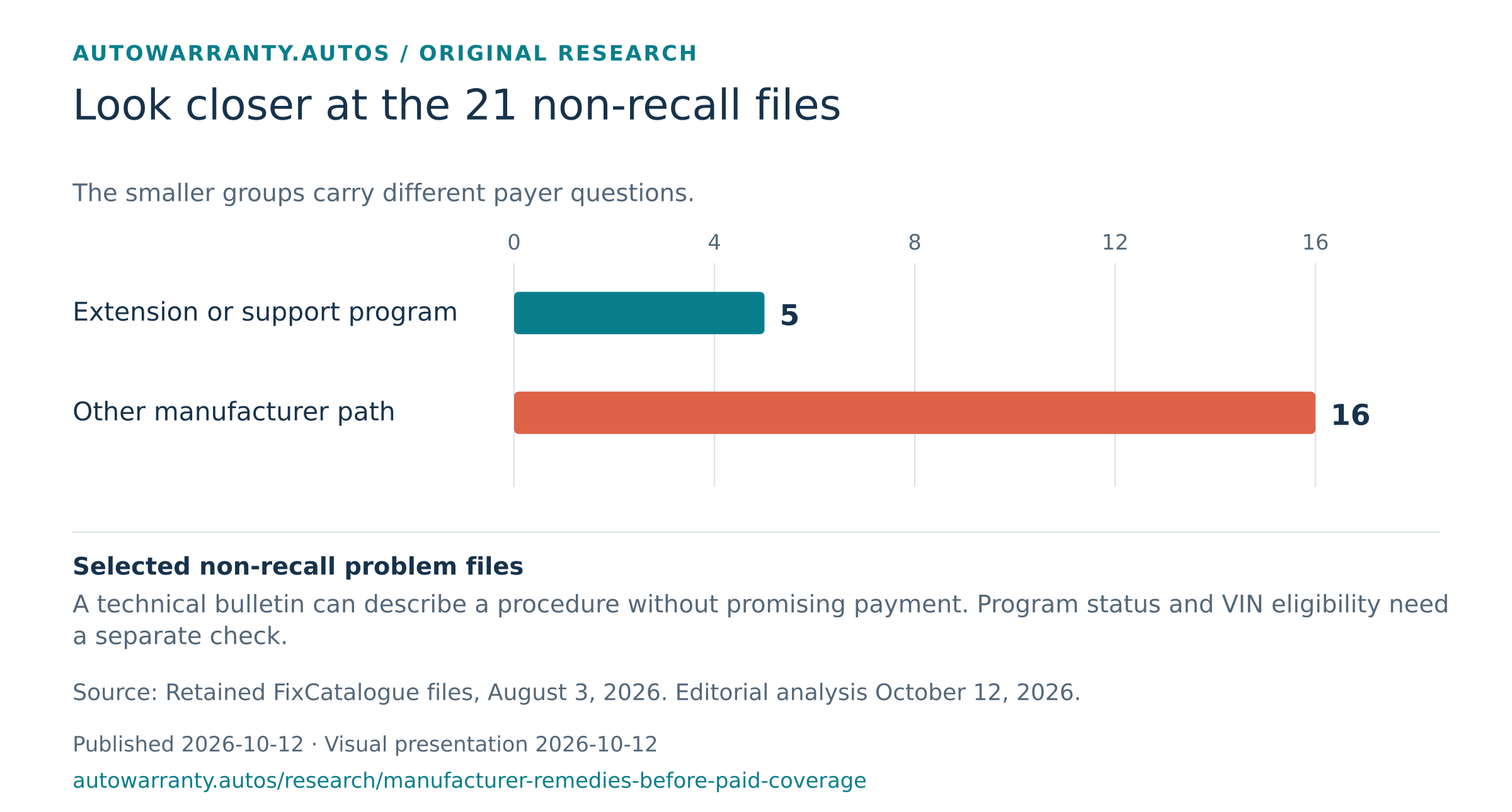
Read the chart as a table
| Record or scenario | Selected non-recall problem files |
|---|---|
| Extension or support program | 5 |
| Other manufacturer path | 16 |
Finding 02
The type of record changes the next check
For a safety recall, check the VIN and current manufacturer remedy. For an extension or customer program, ask about the eligible vehicle, covered condition, start date, mileage and program limits. For a service bulletin or other manufacturer instruction, ask whether its diagnostic procedure actually fits the car and symptom.
Honda's condenser and compressor-seal extensions address different A/C conditions. Subaru's thermo control valve extension also has its own vehicle and condition limits. Those examples can change the payer for a confirmed fault; they do not establish that every A/C or cooling repair on those vehicles is free.
Finding 03
Keep the existing fault separate from future protection
Get the diagnosis and existing manufacturer-coverage answer before buying a contract to address a present problem. Independent plans generally exclude pre-existing faults and may impose waiting periods, authorization rules and cause-of-failure exclusions.
Once the existing remedy is understood, compare the remaining coverage gap with the plan's full price, deductible, labor allowance and payout limits. This audit does not estimate claim probability or recommend a plan from the number of files.
Conclusion
Resolve the documented remedy before evaluating the remaining gap
For a present fault, get the diagnosis and ask the manufacturer whether the VIN and condition qualify under a current remedy. Keep a service instruction separate from a payment promise. Once that answer is clear, evaluate future protection for the remaining eligible systems and failures. This audit explains which inquiry to make; it cannot determine VIN eligibility or the value of a plan from the number of files.
Explore the research and press resources →For reporting and citation
An interpretation you can quote
The practical finding from AutoWarranty's selected 1,221-file audit is that record types are not interchangeable. Recalls, qualifying programs and service bulletins create different eligibility and payment questions.
AutoWarranty.Autos analysis
The numeric finding behind this interpretation
AutoWarranty's selected 1,221-file collection contains 1,200 recall-based files, five extension or support-program files and 16 other manufacturer-path files. The collection is recall-heavy, not a representative sample of breakdowns.
AutoWarranty.Autos analysis
- Population
- 1,221 selected problem files; repeated campaigns across models are retained
- Source snapshot
- 2026-08-03T20:46:23Z
- Analysis and presentation
- 2026-10-12; original publication 2026-10-12
The wording above is a suggested attributed quotation from our analysis. Link to this report and keep its population and assumptions with the finding.
Read the documented examples
Warranty extension published
A/C condenser refrigerant leak
Honda Accord · 2018, 2019, 2020
Loss of cold air can fall under Honda's condenser-leak warranty extension when the VIN qualifies and inspection confirms the source.
- Affected scope
- 2018 to 2020 Honda Accord. All trim levels. VIN status must be checked
- Manufacturer check or remedy
- Ask for VIN eligibility under Bulletin 21-018 and confirmation that the condenser, rather than another A/C component, is leaking.
Safety and eligibility limits in this source
- The compressor makes grinding noises or smoke appears
Warranty extension published
Thermo control valve warning codes
Subaru Outback · 2020, 2021, 2022
A check-engine light with P2682 or a P26A-series code appears in Subaru's thermo-control-valve diagnostic record.
- Affected scope
- 2020 to 2022 Subaru Outback. The extension also lists specified Legacy, Forester and Crosstrek model years. VIN eligibility must be confirmed through Subaru
- Manufacturer check or remedy
- Ask a Subaru retailer to read the stored codes, check the VIN for the active extension and follow the service-manual thermo control valve replacement procedure when the condition is confirmed.
Safety and eligibility limits in this source
- A red temperature warning appears, the gauge shows overheating or steam is visible
- Coolant is rapidly disappearing or leaking onto hot components
- The engine runs roughly, loses power severely or cannot maintain a safe speed
- The procedure involves the cooling system, fuel delivery pipe and one-time-use gaskets. It is intended for trained technicians.
- Never open a hot cooling system. A code match is not confirmation that the valve is the only fault.
Behind the numbers
How we worked it out
- Read every retained problem ID once from the migrated source, without expanding its multi-year routes.
- Assign safety recall first using the existing sourceKind, evidenceLevel and safety-recall evidence classification. A recall file remains in that group even if it also cites a program.
- Among the remaining files, assign extension or customer program where the evidence label or evidence kind names a warranty extension, customer support or customer program. Put all other files in other manufacturer information.
- Export every ID, assigned category, original evidence labels, citations and review date so the partitions can be checked. The audit publication date does not refresh those records.
What these figures can't tell you
- The collection is selected and includes a bulk recall import. Its composition is not the composition of all vehicle faults or manufacturer remedies.
- Different model files can cite the same campaign. Unique IDs do not imply unique campaigns.
- The classification describes source labels, not independent verification that a particular VIN qualifies for free work.
- No owner-feedback, fleet-size, cost, mileage or failure-rate data is used.
The download has 1,221 data rows plus a header, generated from the same inputs as this page. Dates and units are listed in the columns or sources below. A blank field means the information wasn't available.
CSV column definitions
source_problem_idmakemodelcovered_yearsassigned_remedy_categoryoriginal_evidence_labeloriginal_evidence_kindssource_kindoriginal_review_datesource_record_pathprimary_citations
Each row is one original problem ID, not one year route, campaign or failure. The assigned category is an audit interpretation; the original source labels and citations are exported alongside it.
Sources and corrections
- Retained source and migration method · source or review date 2026-08-03
- Recall, bulletin and extension definitions · source or review date 2026-08-02
- NHTSA VIN recall lookup · source or review date 2026-10-12
- TSB 19-2139 · source or review date Nov 21, 2019
- 21N12 · source or review date Jun 9, 2022
- Subaru Bulletin 09-119-24 · source or review date Apr 4, 2024
- Subaru Bulletin 09-80-21 · source or review date Feb 28, 2022
First published 2026-10-12. Visuals, analysis and conclusions reviewed 2026-10-12. Publication and presentation dates do not refresh the underlying snapshots. If you spot a problem, email me@autowarranty.autos with the page, data row and a source we can check.
Our calculations and explanatory charts may be cited with a link to this report. Underlying data retains its source terms. Download availability is not a grant of third-party content rights.