For journalists and editors

Original findings with the evidence attached.

Eleven reports, 22 reusable graphics and a dataset for every finding. The quotes below are suggested attributions to AutoWarranty.Autos analysis. Follow each report for methods, limitations, document dates and corrections.

How to cite the work

Credit AutoWarranty.Autos and link to the individual report when using our original calculations or graphics. Keep the study population, snapshot and modeled assumptions with the claim. Underlying government and manufacturer material retains its own source terms.

Our cost experiments use chosen scenarios, not observed claims or surveyed shop bills. Our file audits describe a selected collection, not the vehicle fleet. None of the reports supplies a breakdown probability or a guarantee of contract coverage.

AutoWarranty is a Chaiz affiliate partner. Paid-coverage links are disclosed; the hypothetical inputs in our experiments are not Chaiz product prices or contract terms.

Labor-allowance experiment

An Approved Repair Can Still Leave an Hourly Labor Gap

Main conclusion: A deductible alone may not describe the owner's contribution

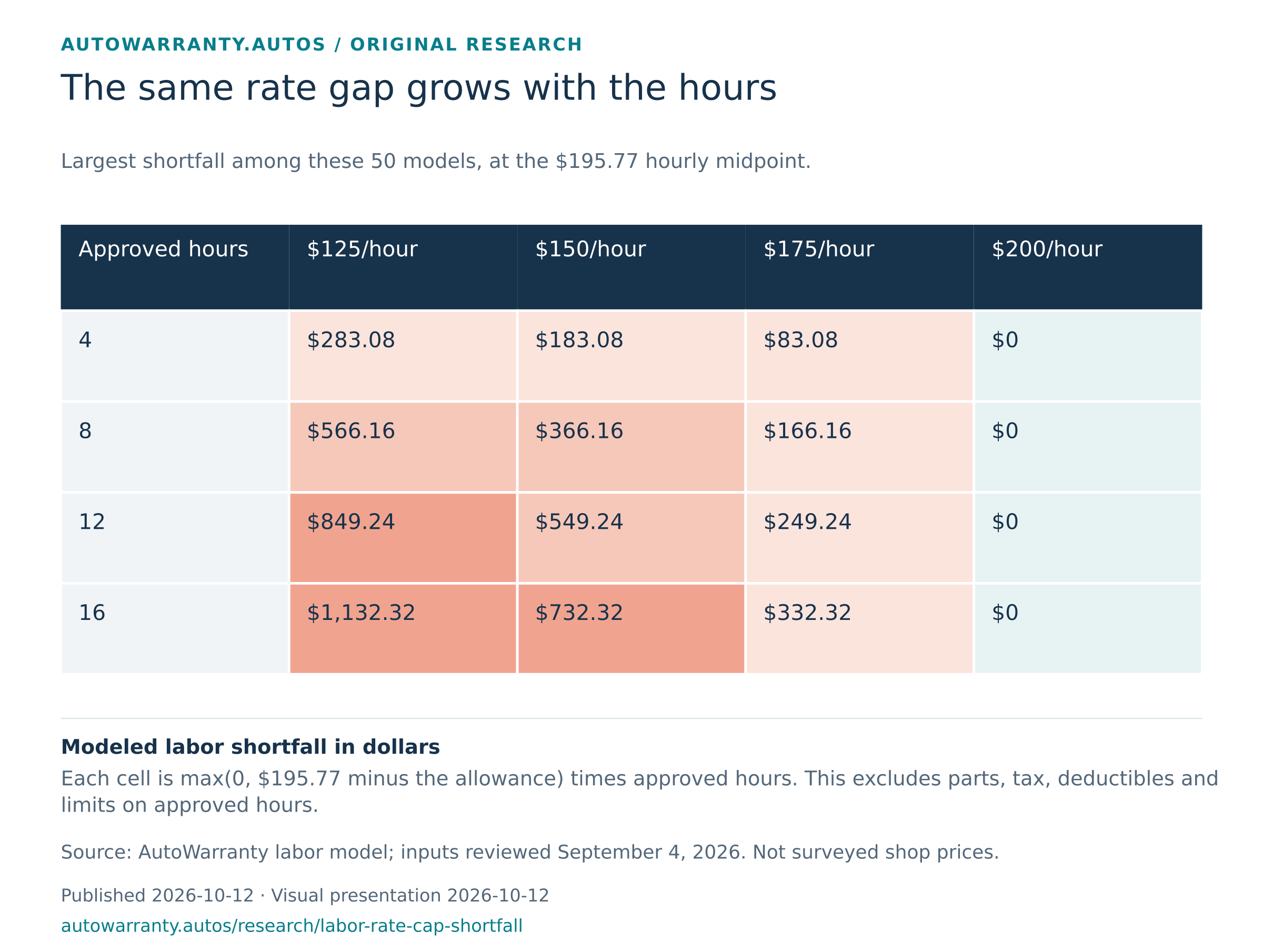
An approved repair and a fully reimbursed labor bill are different questions. AutoWarranty's hypothetical $150 allowance leaves an eight-hour rate gap of up to $366.16 in its 50-metro model, before any deductible.

AutoWarranty.Autos analysis

Population: 50 modeled metro rates; eight approved labor hours; illustrative $150 hourly allowance
Source snapshot: Labor inputs reviewed 2026-09-04
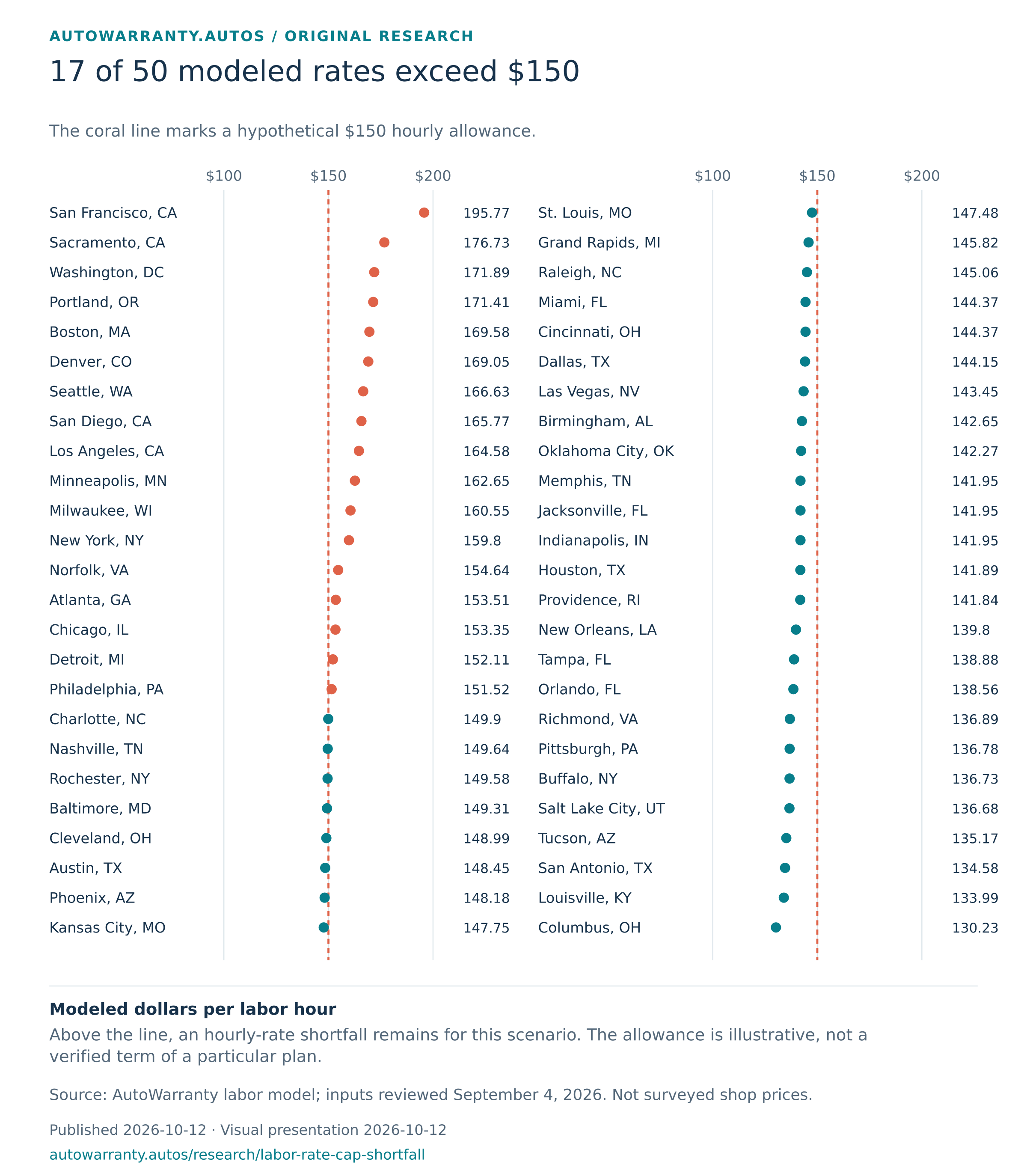
  • 17 of 50 modeled rates exceed $150SVGPNG
  • The same rate gap grows with the hoursSVGPNG
Read the reasoning and conclusion →

Contract-math experiment

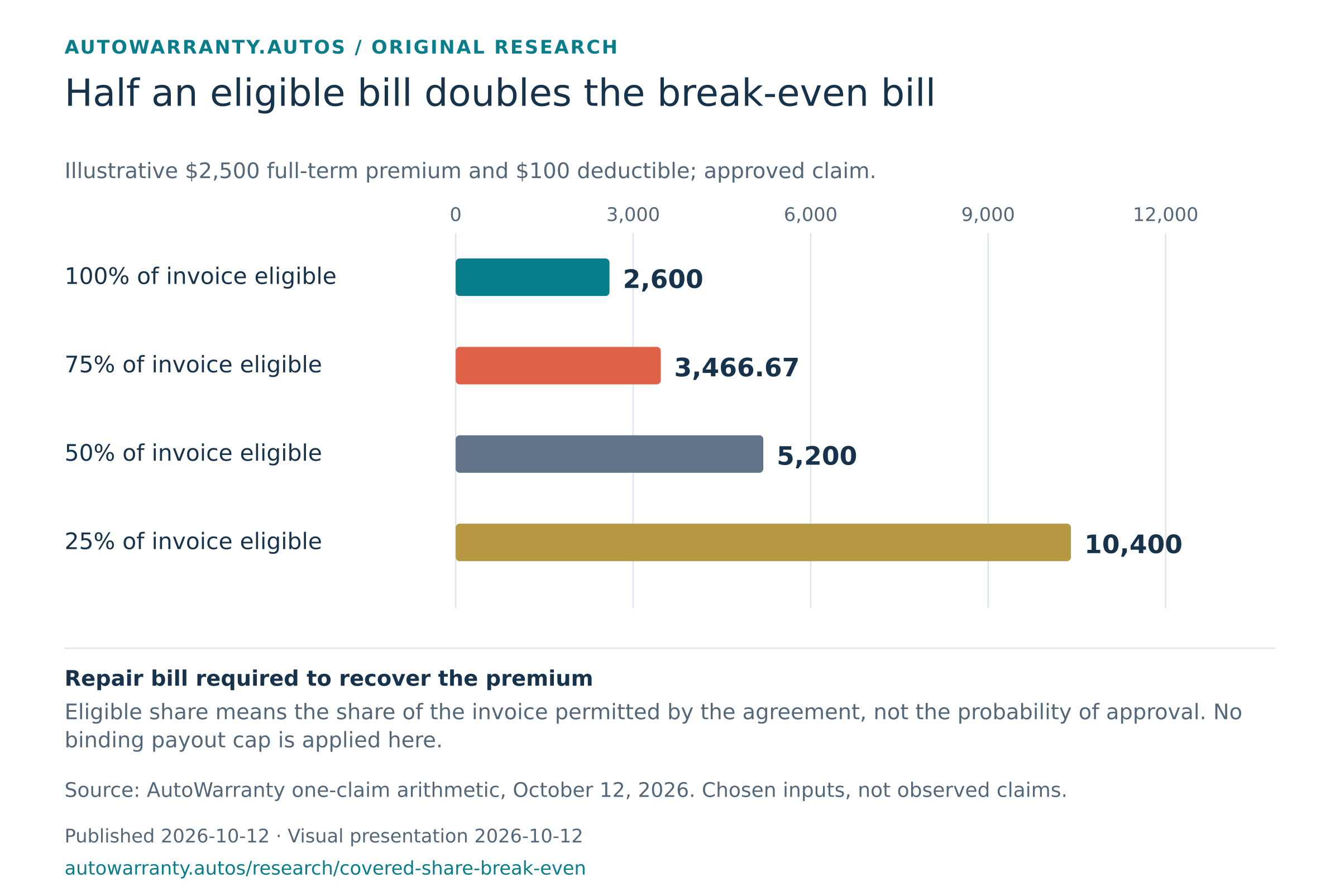
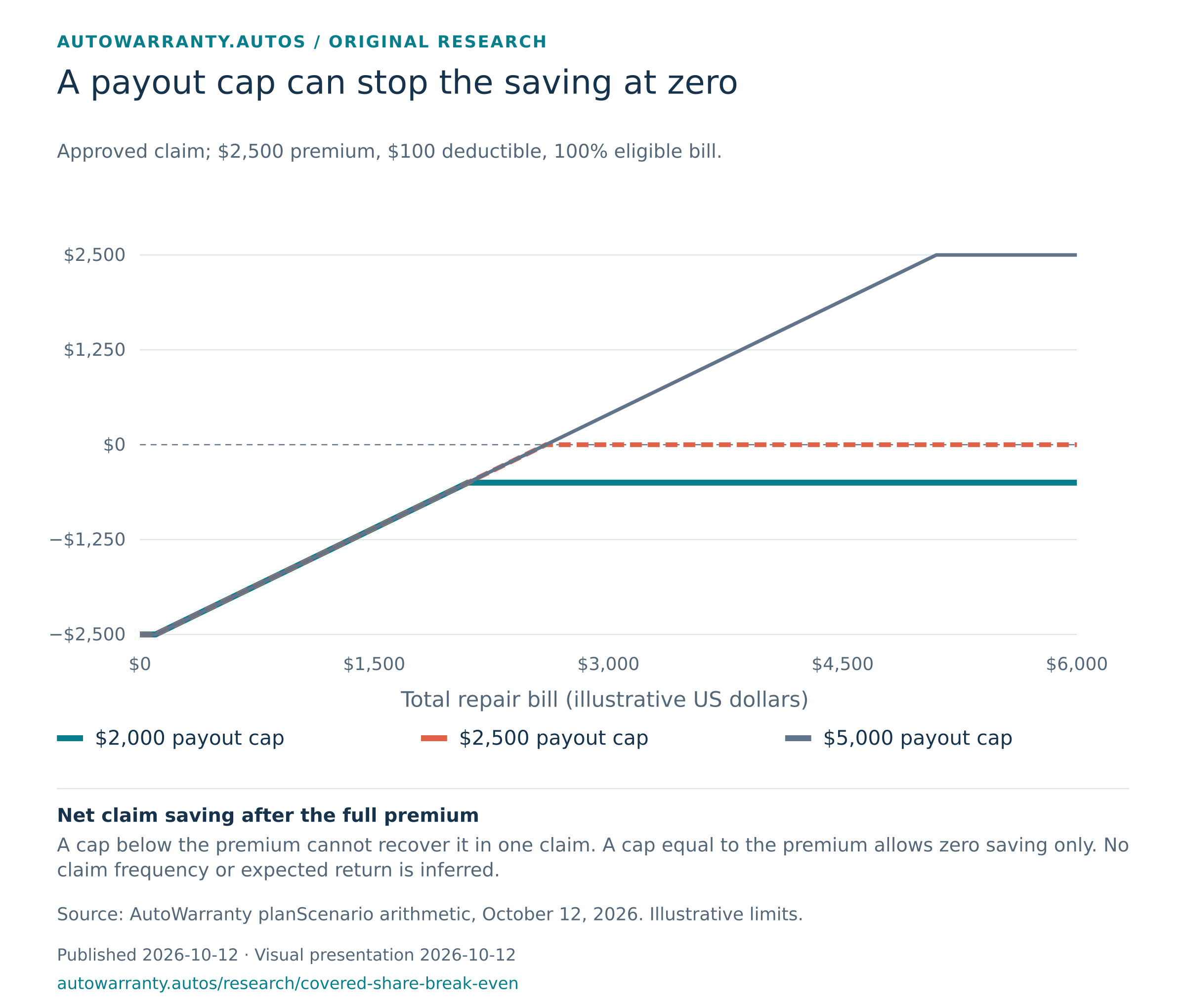
A Smaller Eligible Share Raises the Repair Bill Needed to Break Even

Main conclusion: Break-even follows the permitted payment rather than the invoice total

In AutoWarranty's illustrative one-claim scenario, halving the eligible share doubles the break-even repair bill from $2,600 to $5,200. The payment permitted by the agreement determines the comparison with the premium.

AutoWarranty.Autos analysis

Population: 48 illustrative premium, deductible and eligible-share combinations; no claim probabilities
Source snapshot: Scenario analysis published 2026-10-12

  • Half an eligible bill doubles the break-even billSVGPNG
  • A payout cap can stop the saving at zeroSVGPNG
Read the reasoning and conclusion →

Cost-library audit

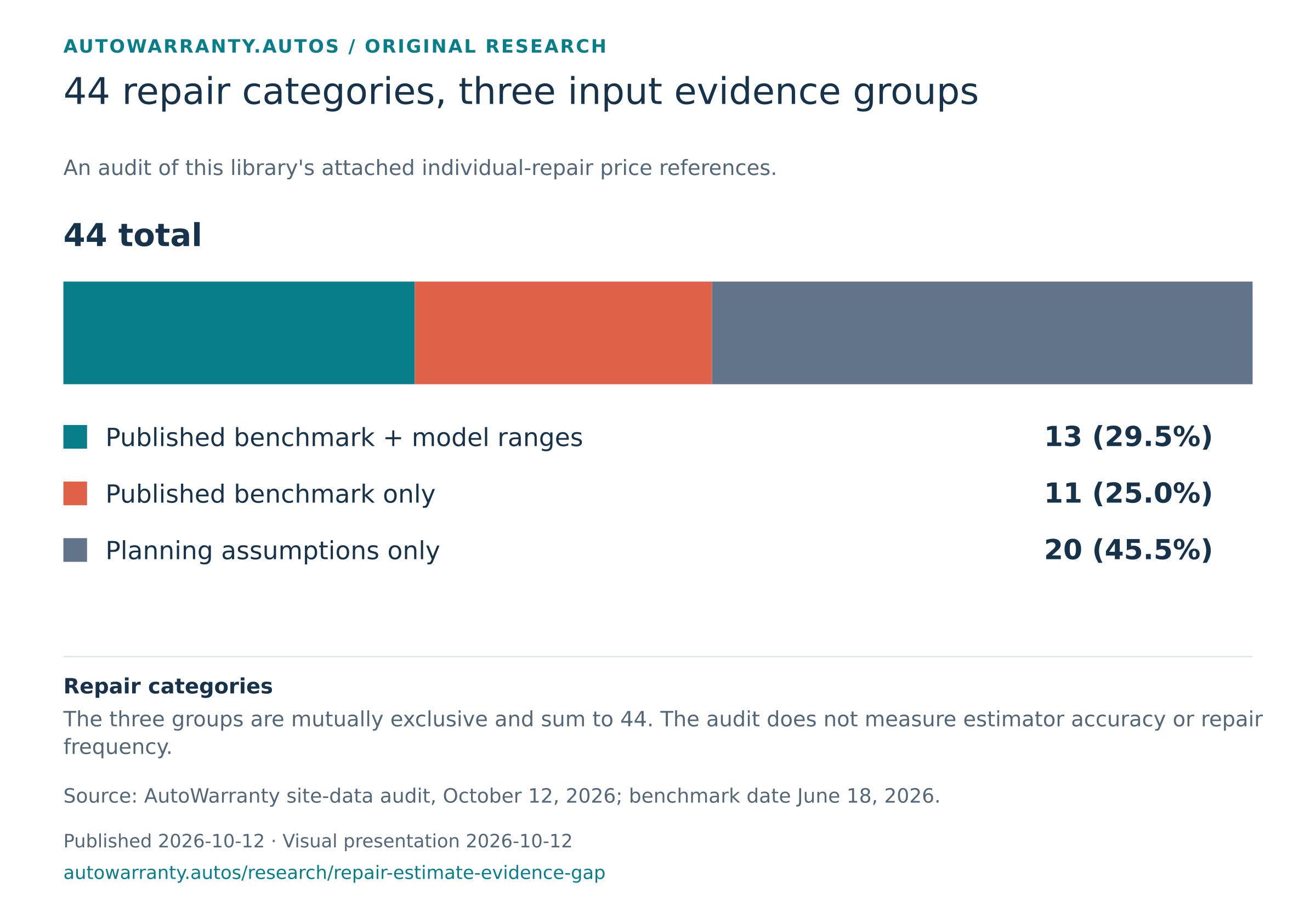
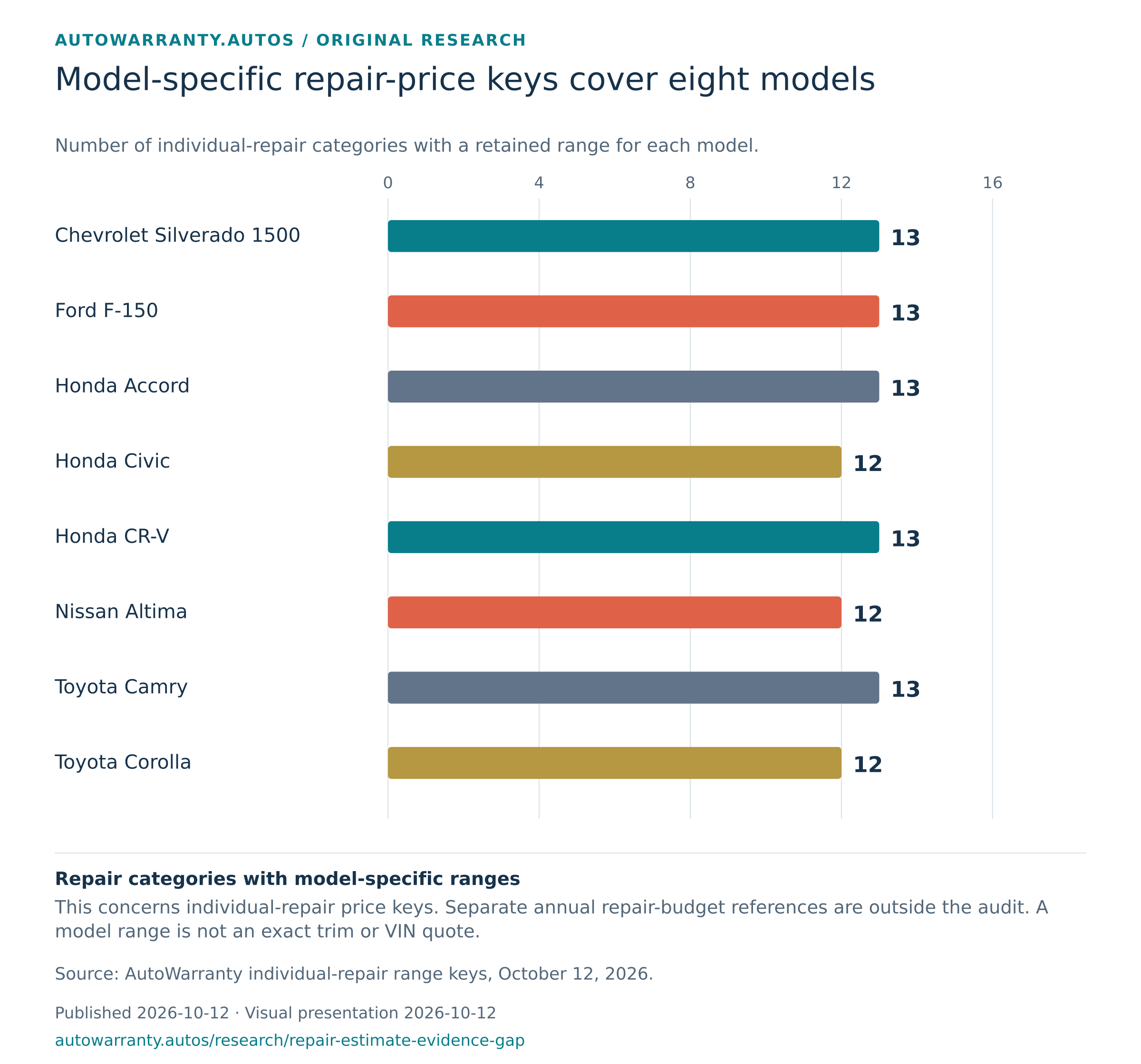
A Detailed Repair Total Can Still Depend on Broad Assumptions

Main conclusion: An estimate should be judged by its inputs and applicability

A precise-looking repair total can still be built from broad assumptions. AutoWarranty's 44-category audit finds 20 categories without an attached published benchmark, making input evidence more informative than the number of digits in the estimate.

AutoWarranty.Autos analysis

Population: 44 repair categories in our current library; a content audit, not a market survey
Source snapshot: Library audited 2026-10-12; benchmark source dated 2026-06-18

  • 44 repair categories, three input evidence groupsSVGPNG
  • Model-specific repair-price keys cover eight modelsSVGPNG
Read the reasoning and conclusion →

Manufacturer-path review

The Manufacturer's Repair Path Can Change Which Job an Estimate Should Price

Main conclusion: The system named in a complaint does not determine the replacement scope

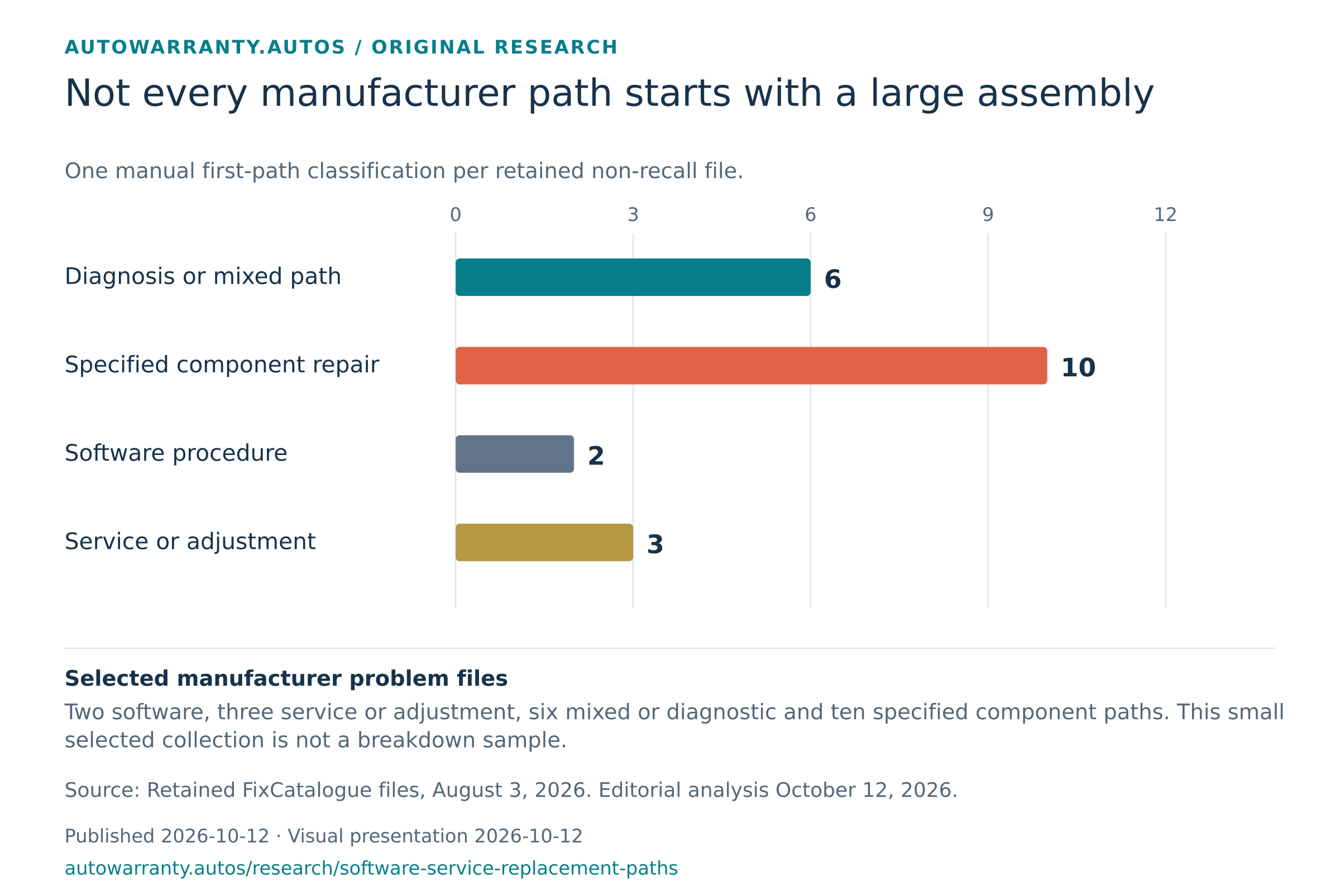
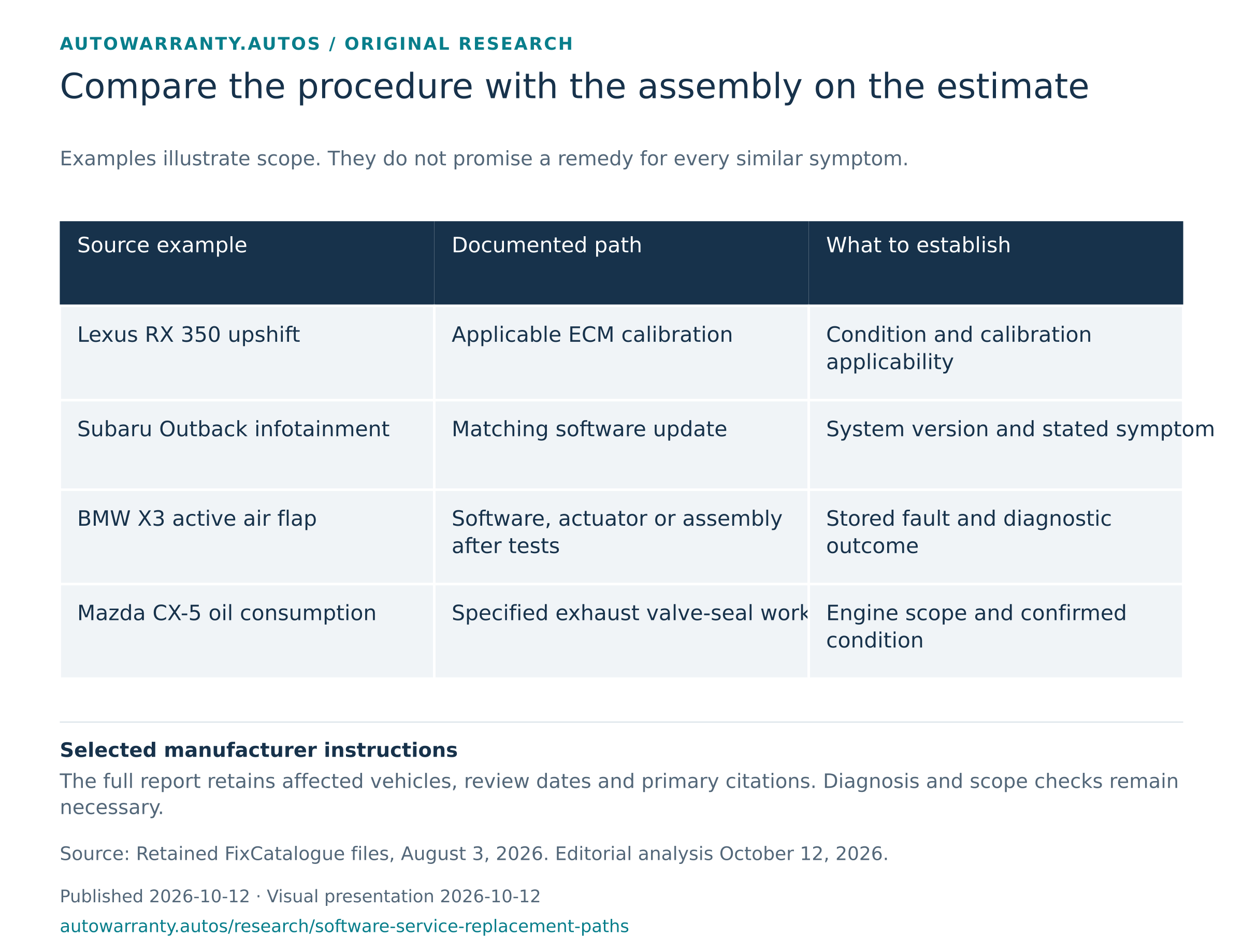
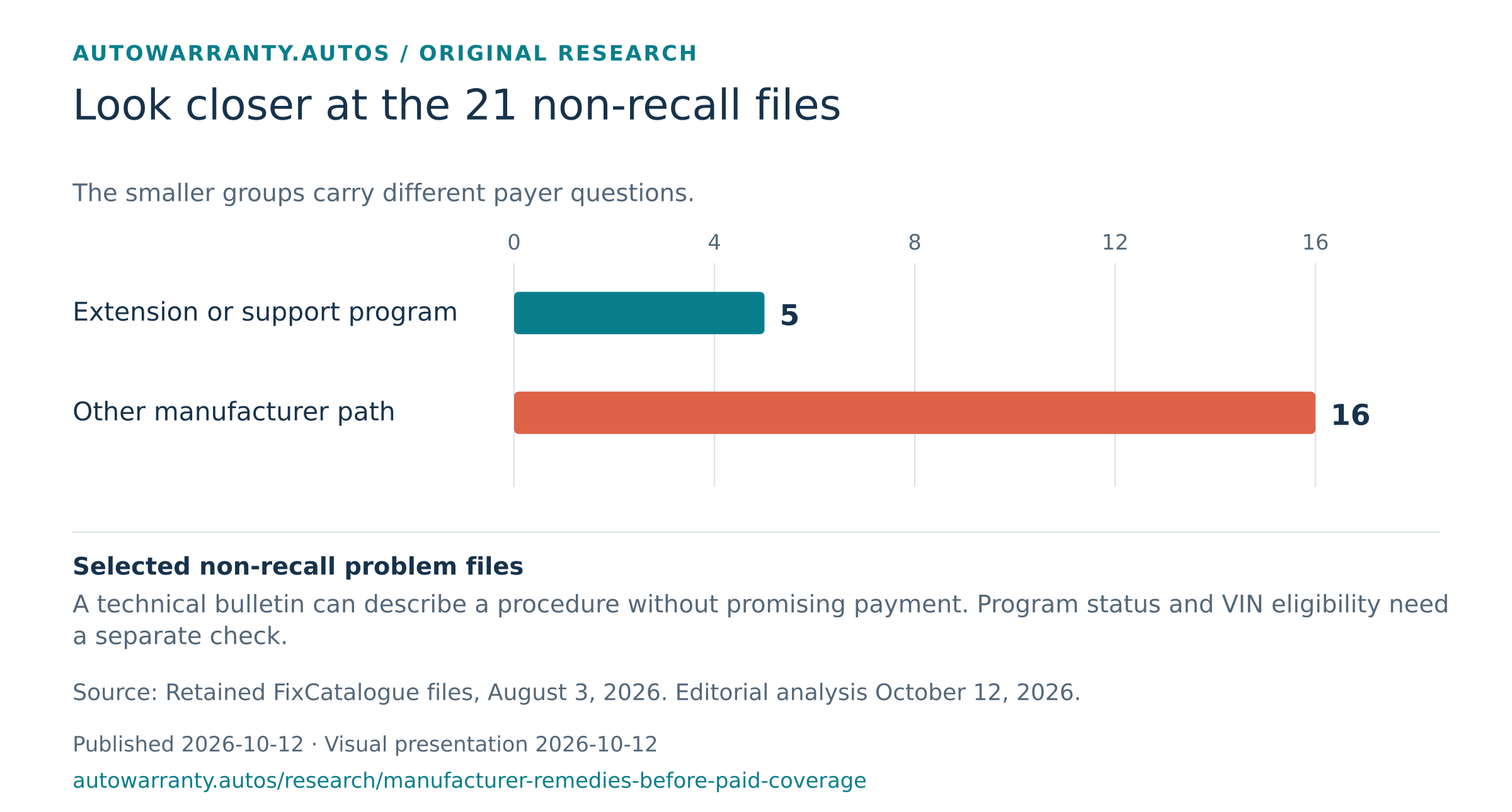
The system named in a complaint does not determine the replacement scope. AutoWarranty's review of 21 selected non-recall files shows why the confirmed condition and manufacturer procedure must identify the job an estimate prices.

AutoWarranty.Autos analysis

Population: All 21 non-recall files in the retained collection; manual editorial classification
Source snapshot: Source records reviewed 2026-08-02; classification published 2026-10-12

  • Not every manufacturer path starts with a large assemblySVGPNG
  • Compare the procedure with the assembly on the estimateSVGPNG
Read the reasoning and conclusion →

Campaign-reference audit

Counting Recall Files as Campaigns Would Repeat the Same Campaign IDs

Main conclusion: A recall headline must distinguish campaign IDs from their appearances

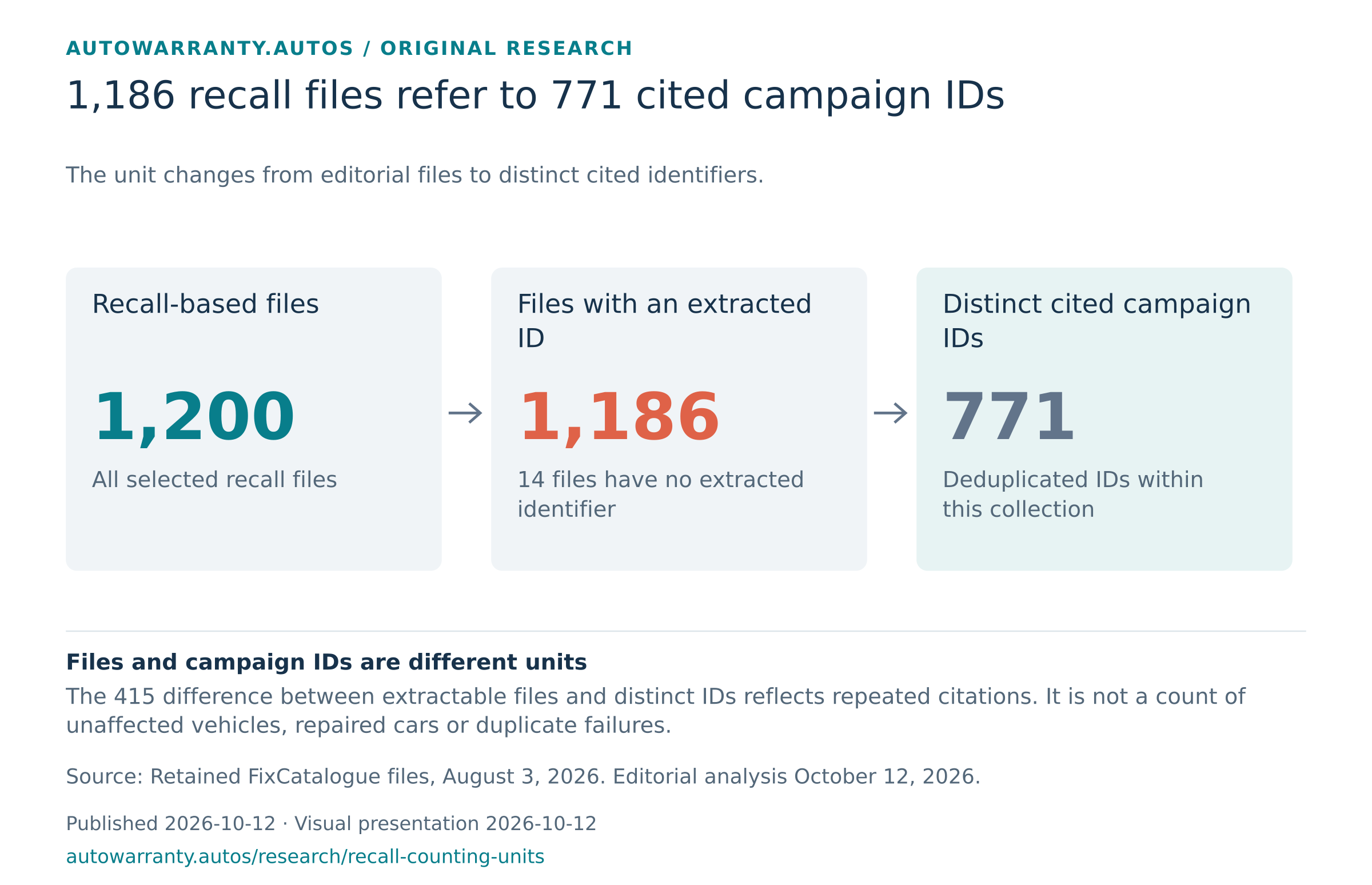
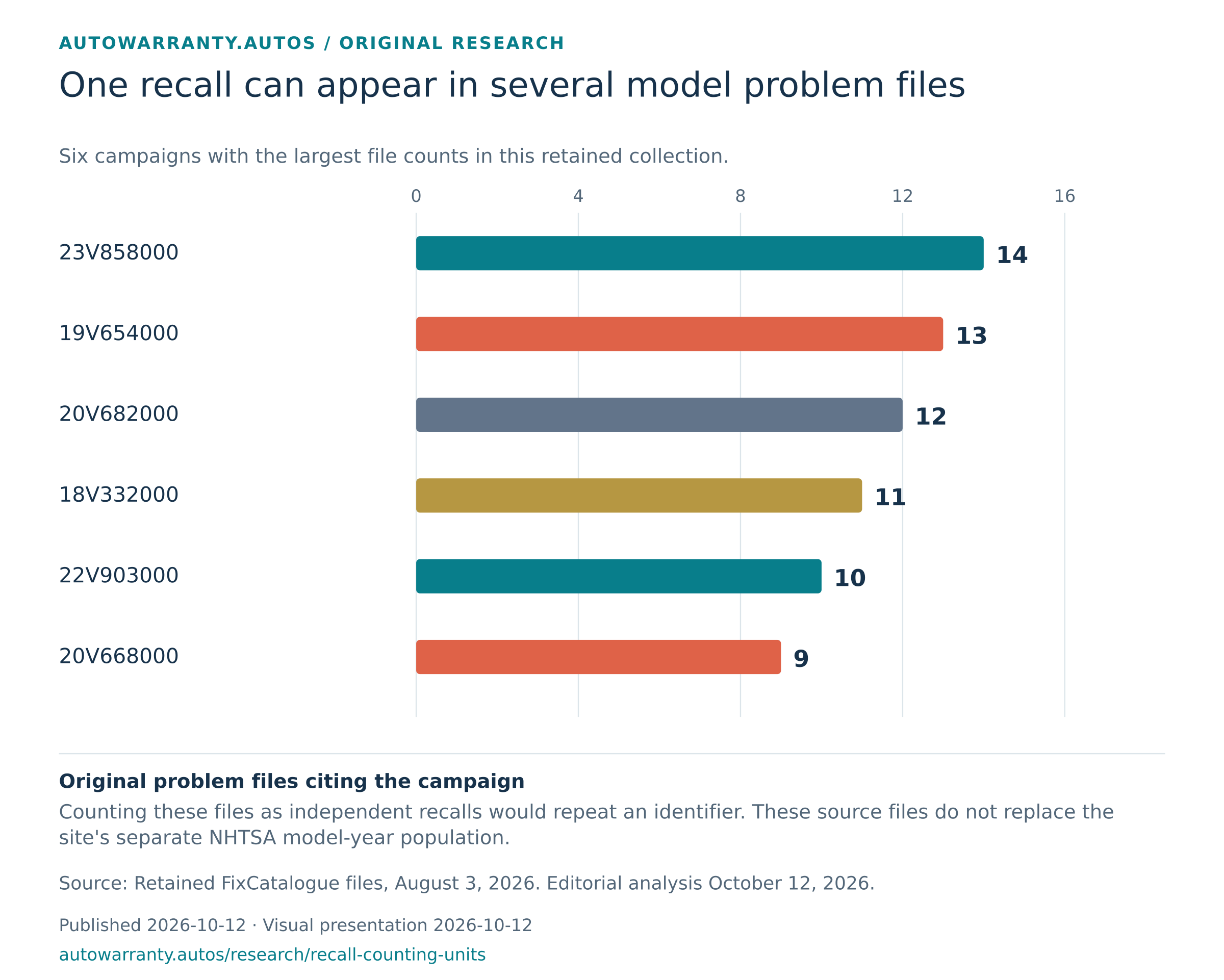
One recall campaign can produce several useful model records without becoming several recalls. In AutoWarranty's selected collection, 1,186 files with extractable identifiers refer to 771 distinct campaign IDs.

AutoWarranty.Autos analysis

Population: 1,200 selected recall files; campaign references extracted from their evidence fields
Source snapshot: Retained problem source generated 2026-08-03

  • 1,186 recall files refer to 771 cited campaign IDsSVGPNG
  • One recall can appear in several model problem filesSVGPNG
Read the reasoning and conclusion →

Published-program comparison

Years Alone Do Not Determine Eligibility for a Manufacturer Program

Main conclusion: A long time limit is one condition of coverage rather than the whole answer

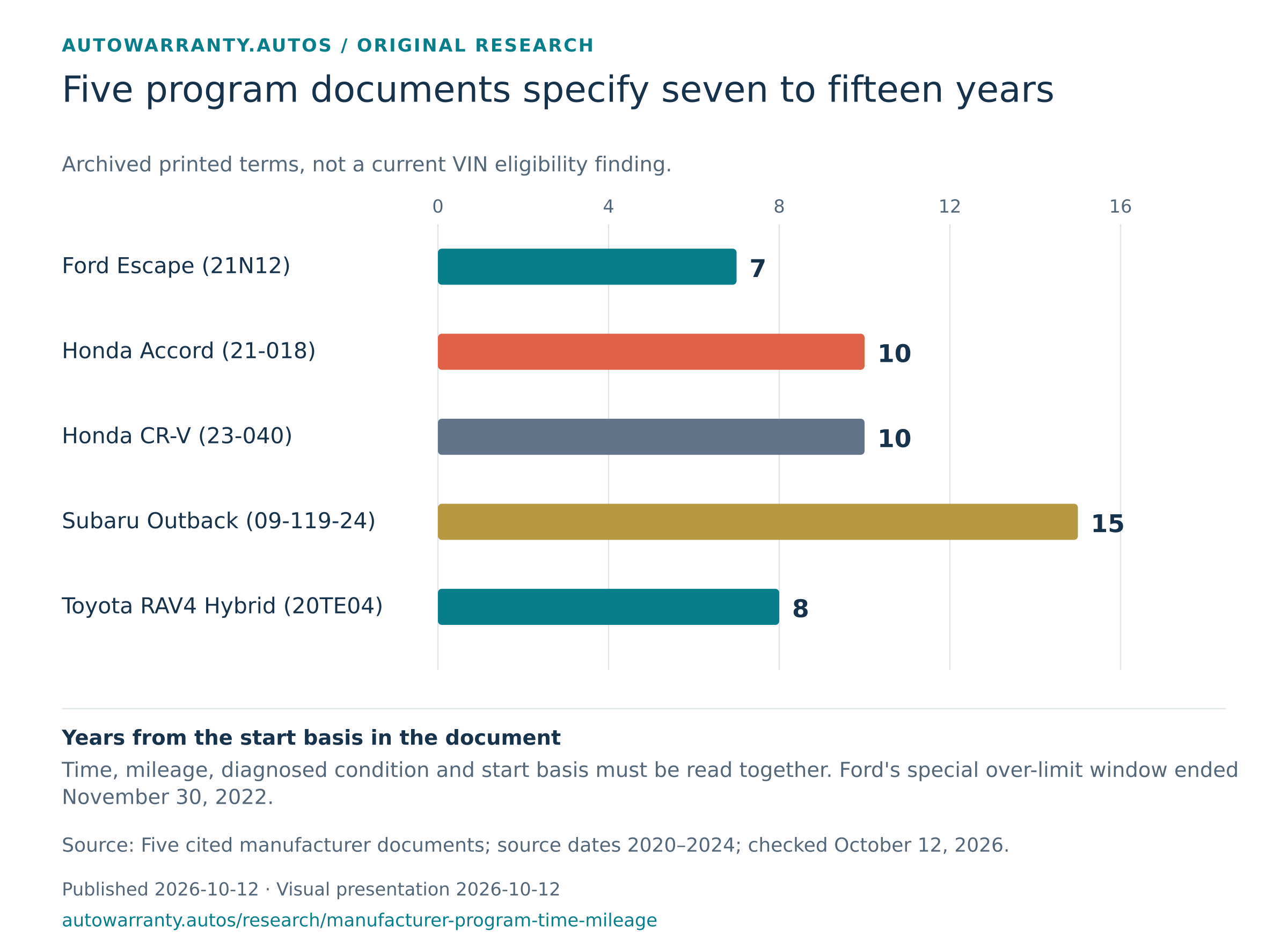
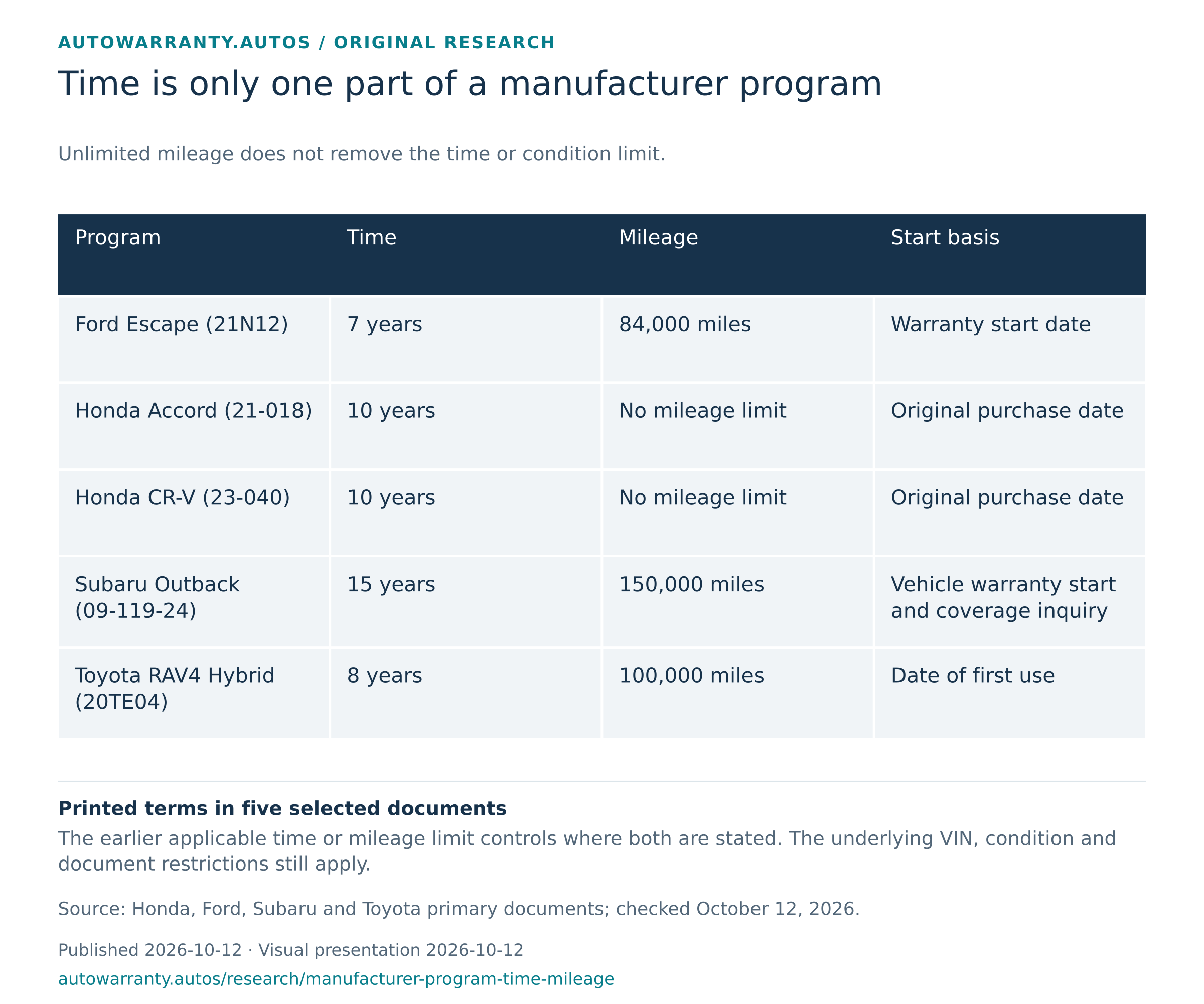
A long manufacturer-program duration is only one eligibility condition. AutoWarranty's review of five archived programs shows why the start date, mileage rule, covered fault and current VIN inquiry must be read together.

AutoWarranty.Autos analysis

Population: Five cited manufacturer programs; archived document terms, not a current eligibility check
Source snapshot: Primary documents checked 2026-10-12; document dates retained

  • Five program documents specify seven to fifteen yearsSVGPNG
  • Time is only one part of a manufacturer programSVGPNG
Read the reasoning and conclusion →

Manufacturer case comparison

Coolant Loss Does Not Identify One Repair to Price

Main conclusion: Diagnosis must establish the job before a repair price becomes useful

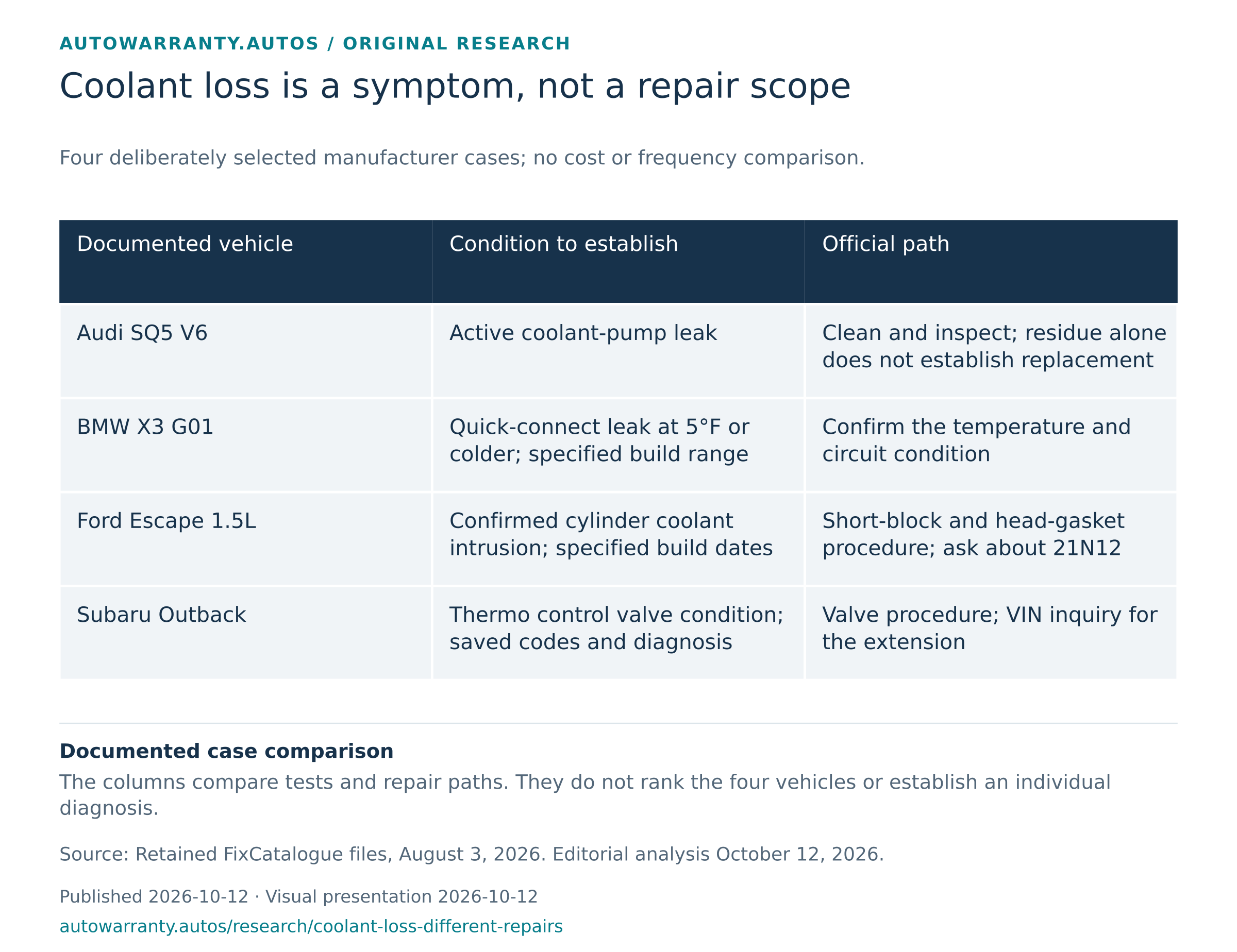
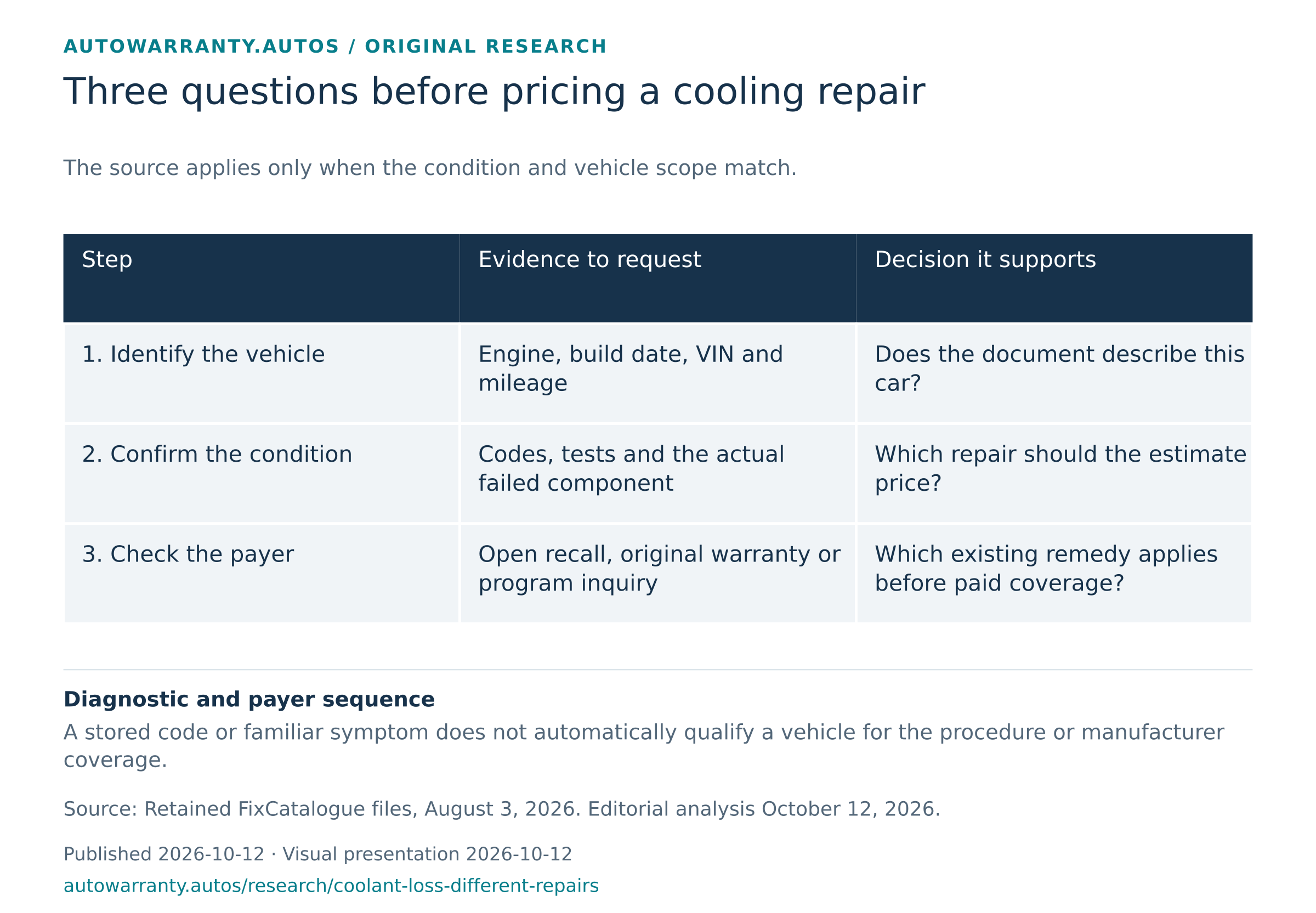
Four selected manufacturer cooling cases show why coolant loss cannot identify one repair to price. The confirmed condition and applicable procedure have to define the job before a benchmark can describe it.

AutoWarranty.Autos analysis

Population: Four selected problem files, not a fleet sample or a prevalence study
Source snapshot: FixCatalogue source generated 2026-08-03; original case reviews retained

  • Coolant loss is a symptom, not a repair scopeSVGPNG
  • Three questions before pricing a cooling repairSVGPNG
Read the reasoning and conclusion →

Problem-library audit

The Record Type Changes the Repair and Coverage Question

Main conclusion: Read the remedy and its eligibility rules before deciding who may pay

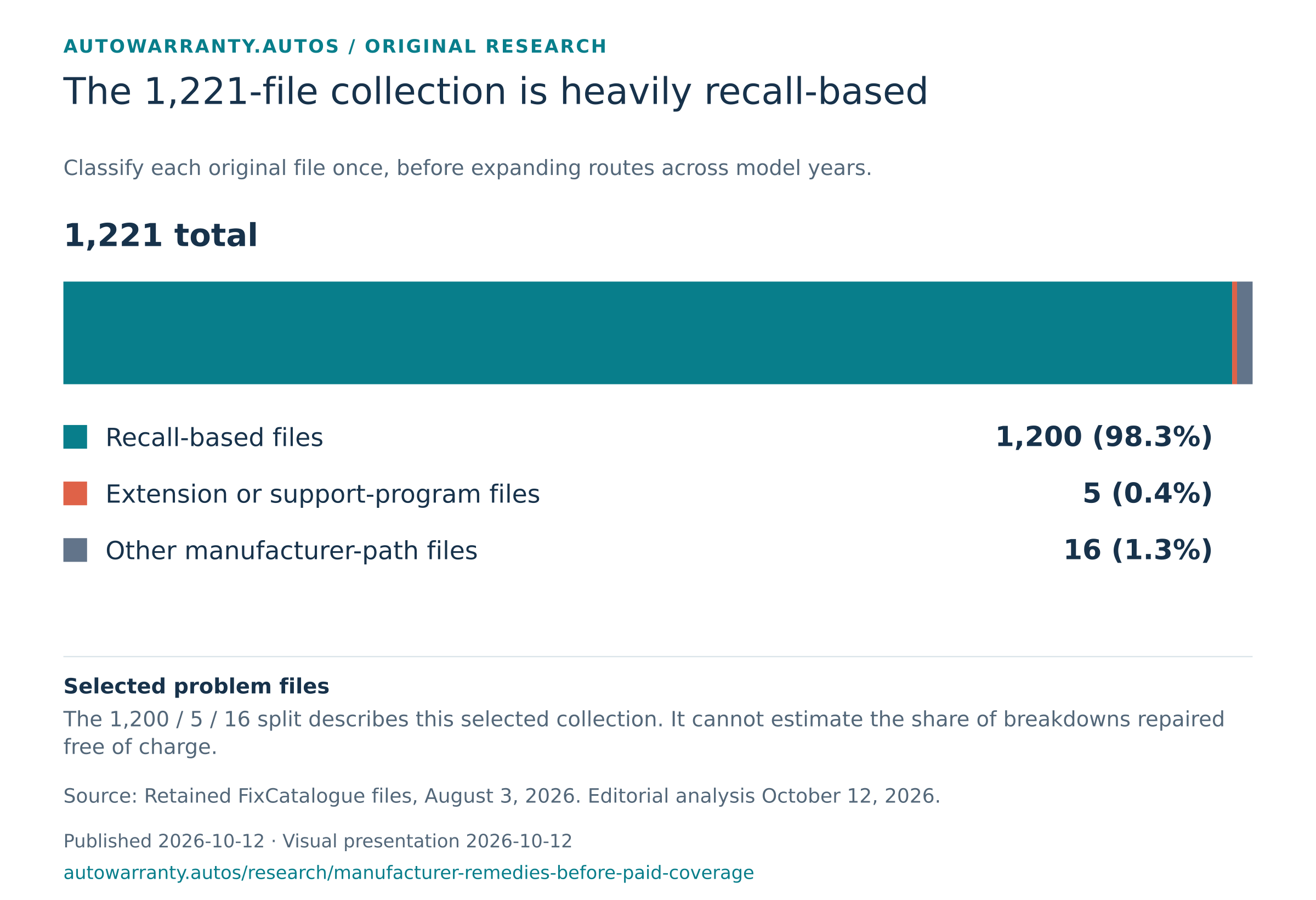
The practical finding from AutoWarranty's selected 1,221-file audit is that record types are not interchangeable. Recalls, qualifying programs and service bulletins create different eligibility and payment questions.

AutoWarranty.Autos analysis

Population: 1,221 selected problem files; repeated campaigns across models are retained
Source snapshot: 2026-08-03T20:46:23Z

  • The 1,221-file collection is heavily recall-basedSVGPNG
  • Look closer at the 21 non-recall filesSVGPNG
Read the reasoning and conclusion →

Cost-model experiment

Location Changes the Labor Budget Even When the Repair Stays the Same

Main conclusion: A repair budget needs both the job and the local labor rate

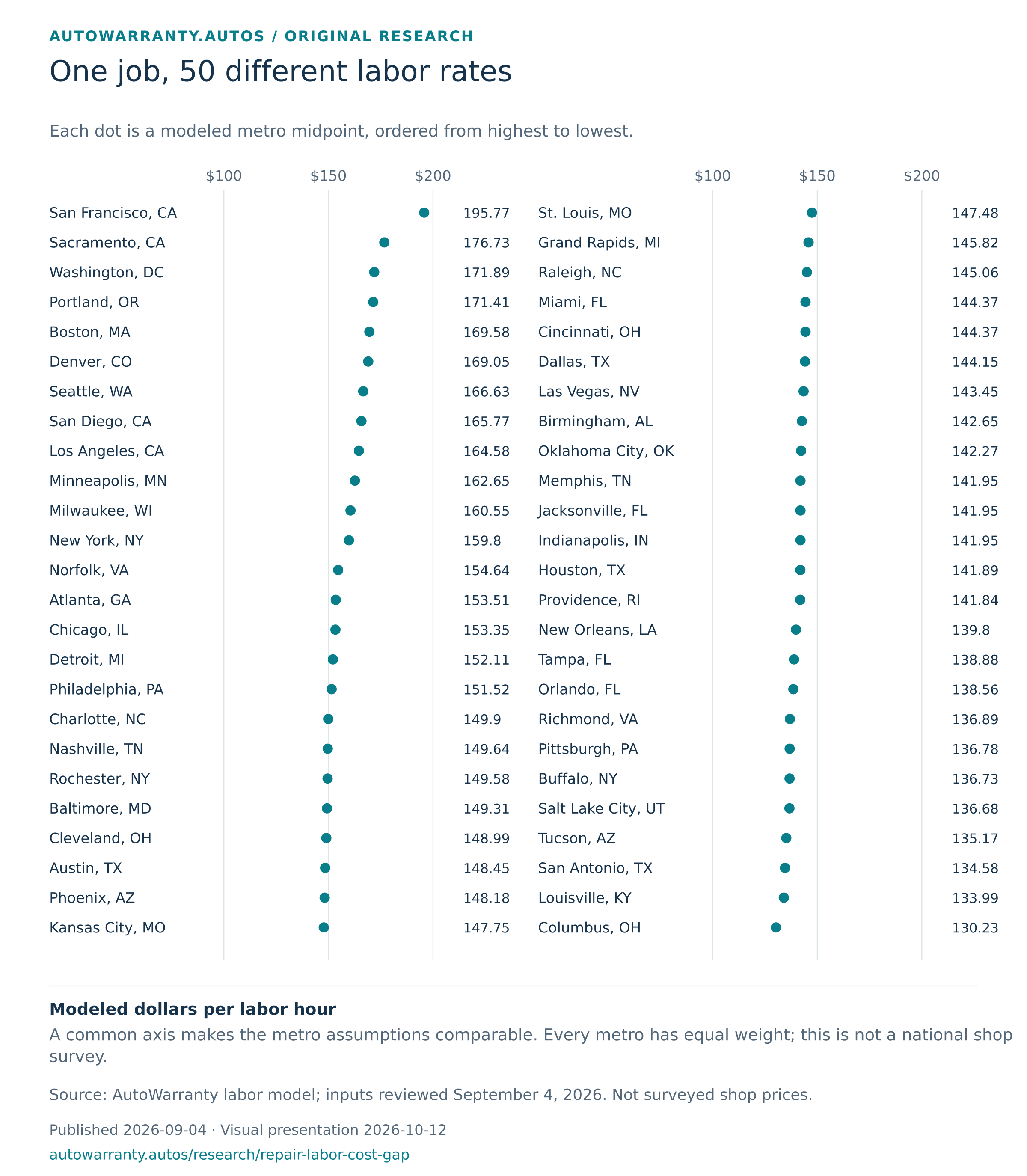
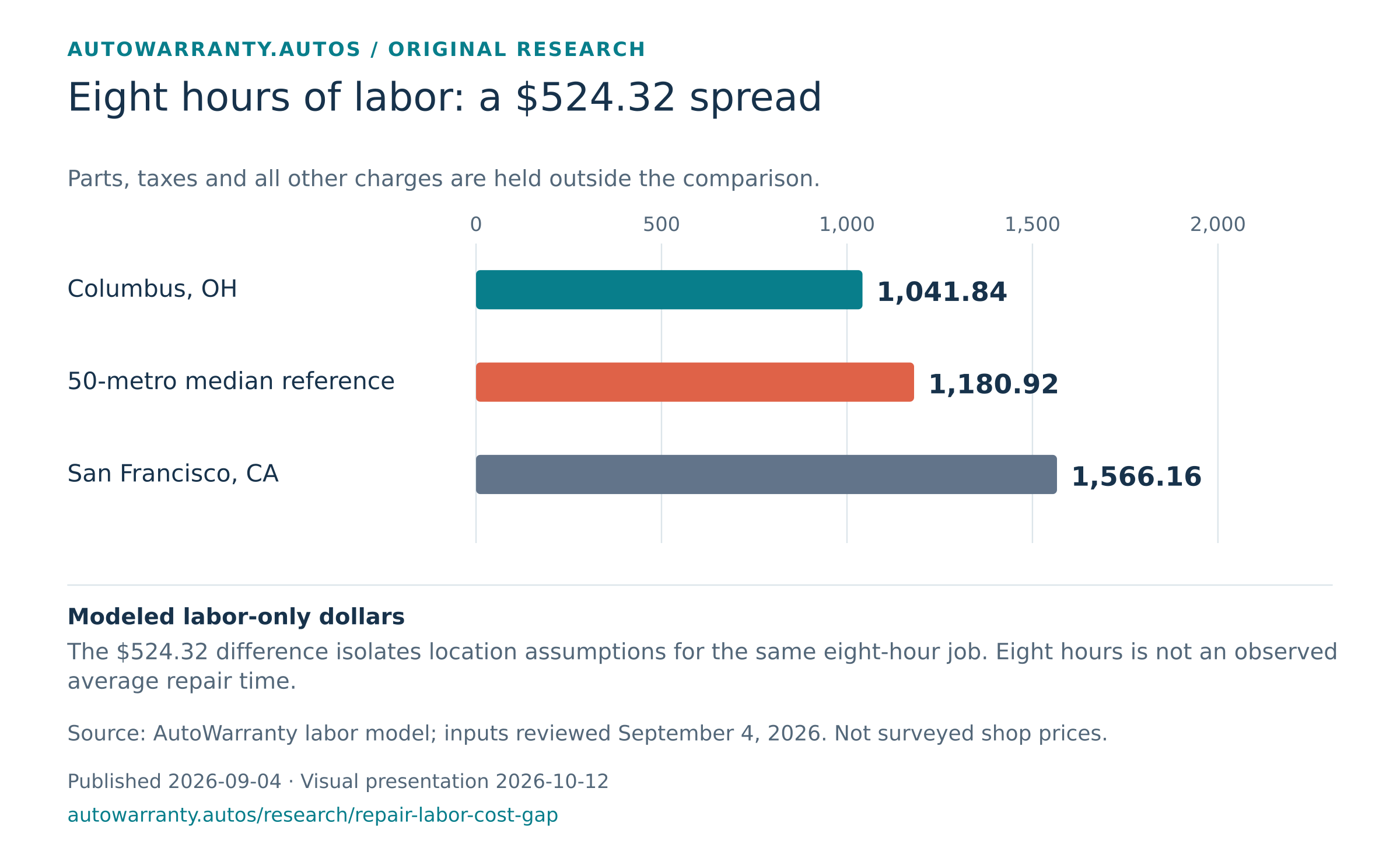
AutoWarranty's fixed eight-hour, 50-metro model shows that location assumptions can change a labor budget by $524.32 without changing the repair. A local rate check belongs in a vehicle repair budget.

AutoWarranty.Autos analysis

Population: 50 metros · fixed eight-hour scenario · no parts or tax
Source snapshot: Labor model reviewed 2026-09-04
  • One job, 50 different labor ratesSVGPNG
  • Eight hours of labor: a $524.32 spreadSVGPNG
Read the reasoning and conclusion →

Public-record audit

A Zero Complaint Count Is Not a Complete Vehicle Check

Main conclusion: A zero complaint count is an incomplete basis for judging a car

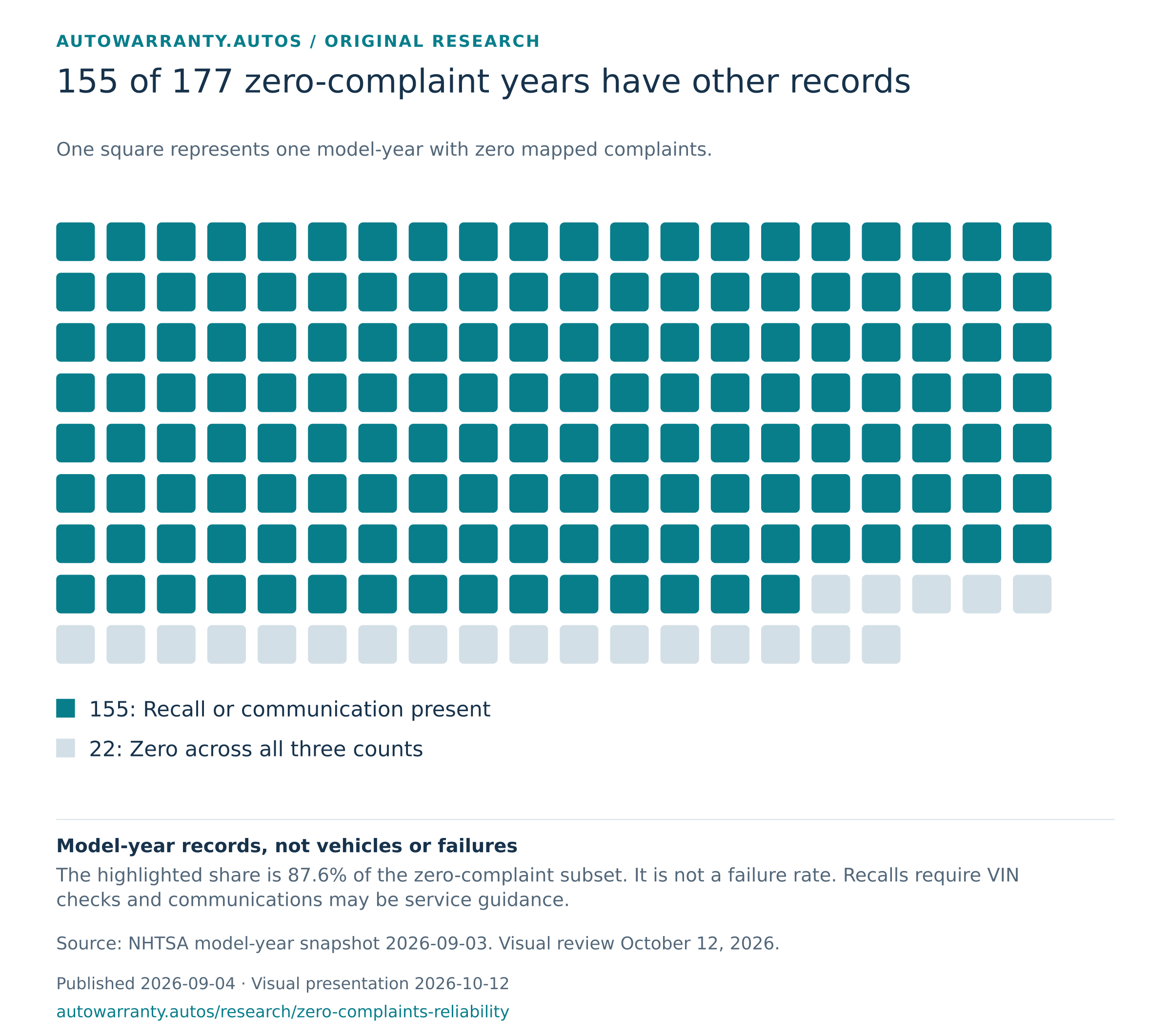
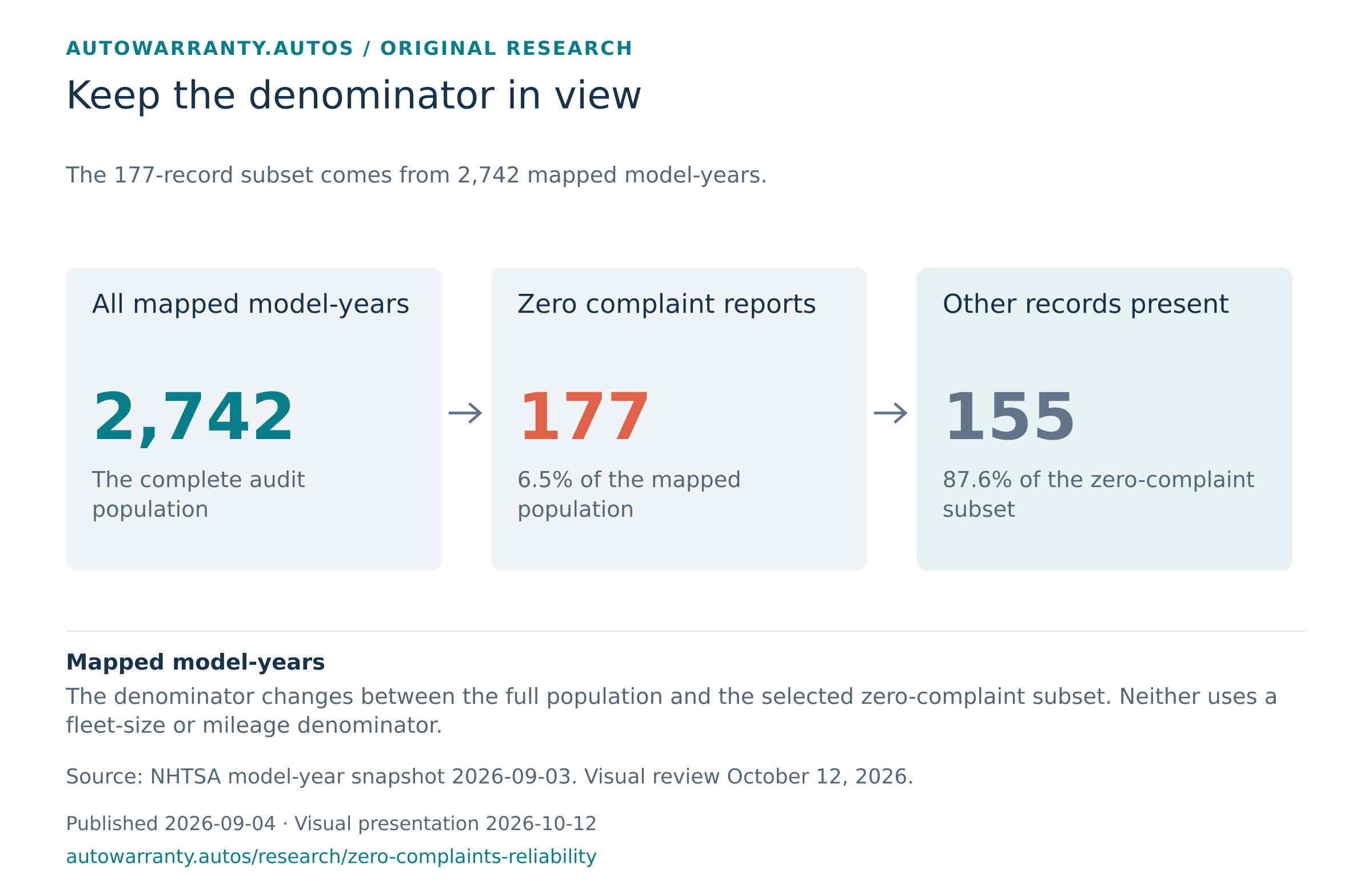
A zero complaint count cannot stand in for a complete vehicle-record check. In AutoWarranty's mapped snapshot, 155 of 177 zero-complaint model-years still had recall or manufacturer-communication records to read.

AutoWarranty.Autos analysis

Population: 2,742 mapped model-years · 323 models
Source snapshot: 2026-09-03

  • 155 of 177 zero-complaint years have other recordsSVGPNG
  • Keep the denominator in viewSVGPNG
Read the reasoning and conclusion →

Source-coverage audit

The Model Name Alone Is Too Broad for Vehicle-Specific Advice

Main conclusion: Confirm the exact version before treating model-level advice as specific

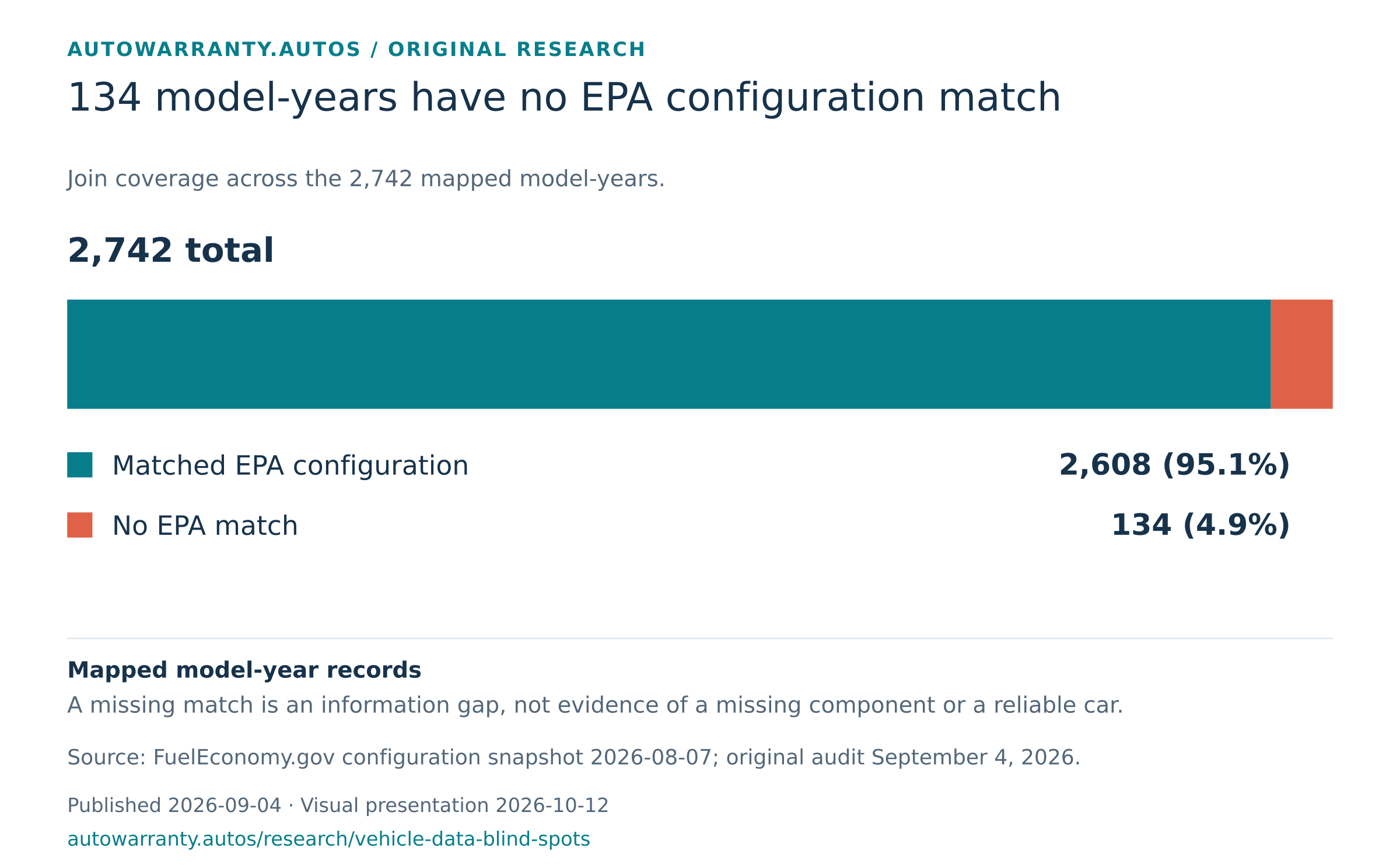
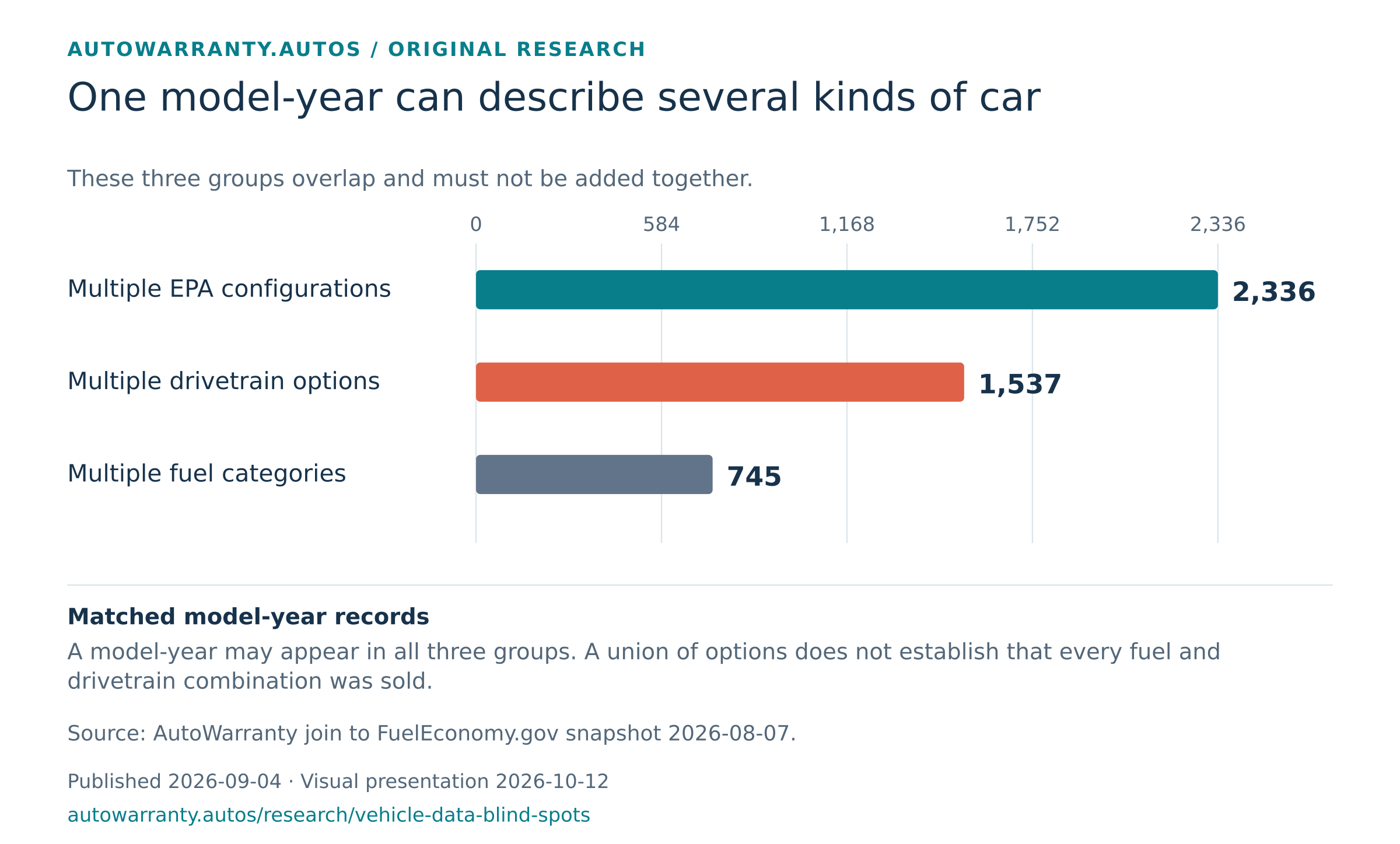
In AutoWarranty's matched database, nearly nine in ten model-years contain multiple EPA source configurations. A model name organizes the research; the exact version determines which equipment-specific advice can apply.

AutoWarranty.Autos analysis

Population: 2,742 model-years joined to EPA and a public source index
Source snapshot: 2026-08-07

  • 134 model-years have no EPA configuration matchSVGPNG
  • One model-year can describe several kinds of carSVGPNG
Read the reasoning and conclusion →