Main conclusion
Diagnosis must establish the job before a repair price becomes useful
The cases demonstrate why a familiar symptom is not enough to choose a replacement part. The relevant vehicle, condition and manufacturer procedure change the work being considered. A cooling-system benchmark becomes useful only after the estimate's job matches the confirmed condition.
Evidence scope: Four selected problem files, not a fleet sample or a prevalence study. Source snapshot: FixCatalogue source generated 2026-08-03; original case reviews retained. The interpretation below uses these retained inputs.
The columns compare tests and repair paths. They do not rank the four vehicles or establish an individual diagnosis.
Retained FixCatalogue files, August 3, 2026. Editorial analysis October 12, 2026.
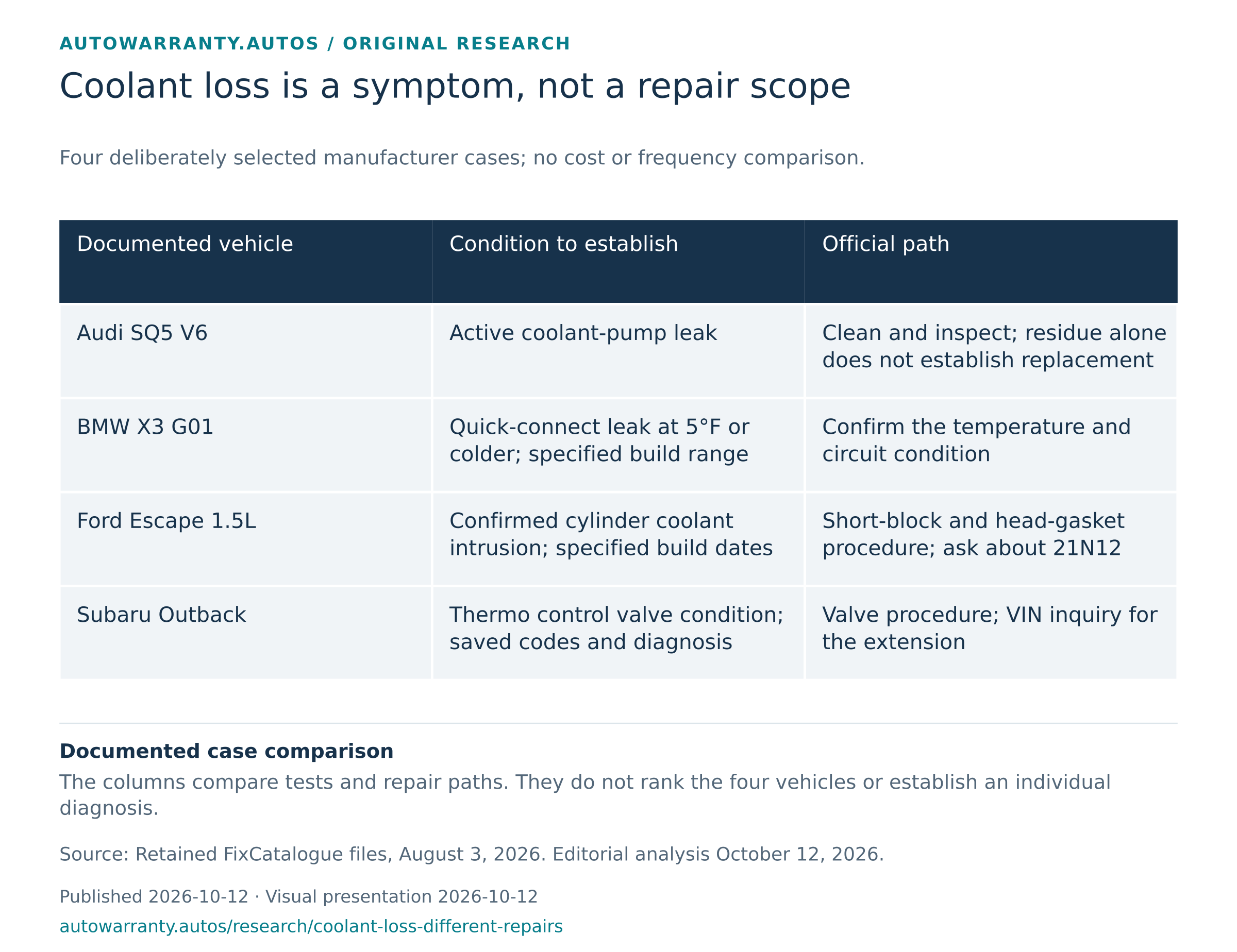
Read the chart as a table
| Documented vehicle | Condition to establish | Official path |
|---|---|---|
| Audi SQ5 V6 | Active coolant-pump leak | Clean and inspect; residue alone does not establish replacement |
| BMW X3 G01 | Quick-connect leak at 5°F or colder; specified build range | Confirm the temperature and circuit condition |
| Ford Escape 1.5L | Confirmed cylinder coolant intrusion; specified build dates | Short-block and head-gasket procedure; ask about 21N12 |
| Subaru Outback | Thermo control valve condition; saved codes and diagnosis | Valve procedure; VIN inquiry for the extension |
Analysis
What the differences between the four cases establish
The selected documents describe an external pump leak, a quick-connect leak in extreme cold, cylinder coolant intrusion and a thermo control valve sensor condition. Those are different diagnostic questions despite their shared cooling-system context. Using a pump or thermostat price for all four would assume the failed part before the procedure has established it.
The conditions also limit the use of the documents. Audi's residue check does not automatically establish an active pump leak; BMW's case includes build and temperature limits; Ford's qualifying condition can require short-block and head-gasket work; Subaru's codes still require diagnosis. The source is useful because it defines the test and scope, not because its existence diagnoses another car.
This comparison supports a sequence: establish the vehicle and condition, identify the applicable procedure, then ask which estimate and payer match that procedure. Four purposively selected cases cannot tell us how common each condition is, which vehicle is more reliable, or what a completed repair would cost.
Finding 01
Price the confirmed repair, not just the symptom
The Audi SQ5 file concerns a V6 coolant-pump leak. The BMW X3 file concerns quick-connect leaks in extreme cold on a limited build range. Ford's Escape file concerns coolant intrusion on specified 1.5L EcoBoost vehicles. Subaru's Outback file concerns a thermo control valve sensor condition. Those records do not support using one replacement part as the answer to all cooling complaints.
We selected the four files because they illustrate different diagnostic and repair decisions. Each appears once in this comparison even if its record covers several model years. The visual comparison shows the selected conditions and repair paths, not frequency, cost or risk.
A stored code or familiar symptom does not automatically qualify a vehicle for the procedure or manufacturer coverage.
Retained FixCatalogue files, August 3, 2026. Editorial analysis October 12, 2026.
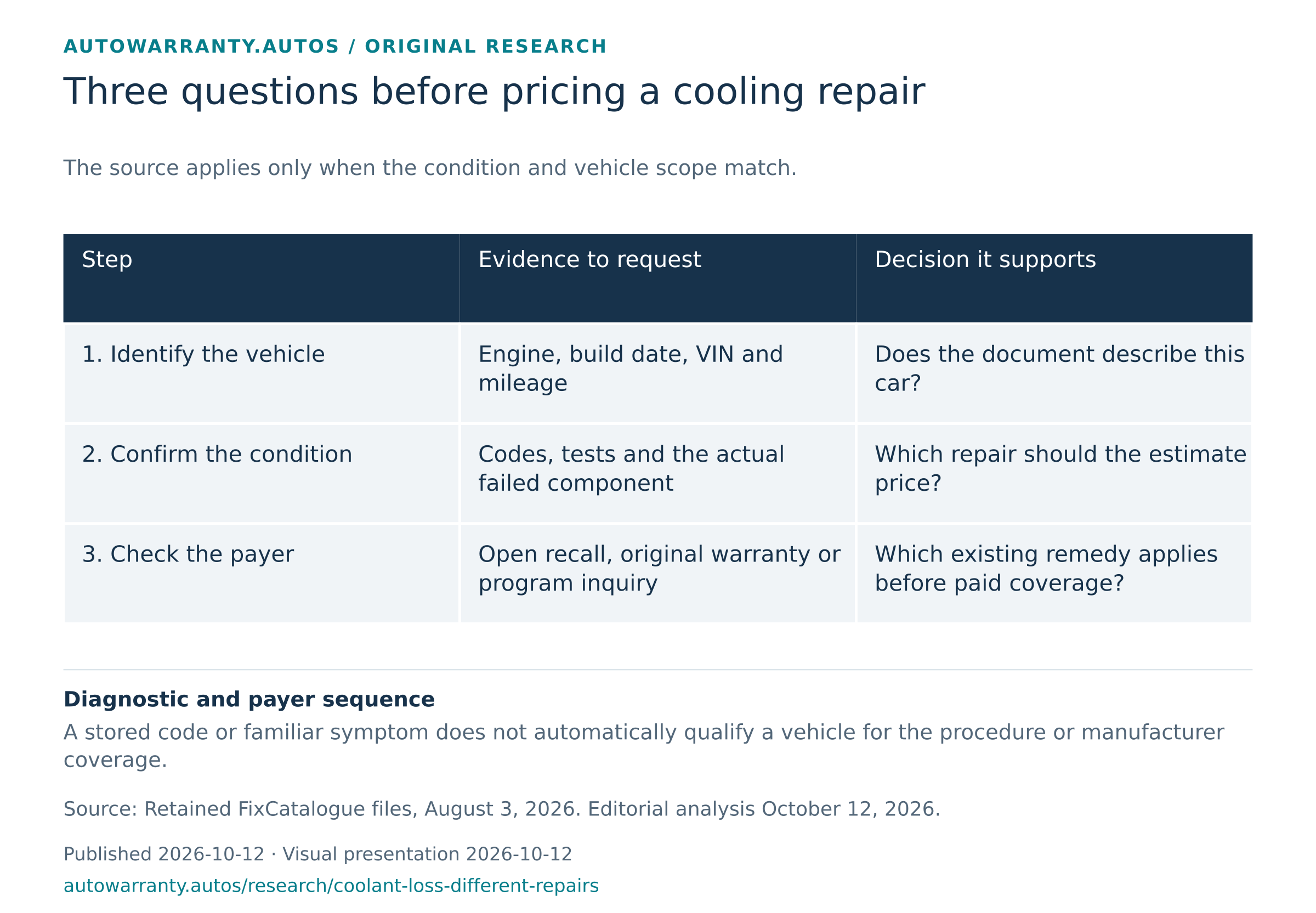
Read the chart as a table
| Step | Evidence to request | Decision it supports |
|---|---|---|
| 1. Identify the vehicle | Engine, build date, VIN and mileage | Does the document describe this car? |
| 2. Confirm the condition | Codes, tests and the actual failed component | Which repair should the estimate price? |
| 3. Check the payer | Open recall, original warranty or program inquiry | Which existing remedy applies before paid coverage? |
Finding 02
The scope can change the entire estimate
Audi's bulletin distinguishes an active leak from a small trace that does not by itself establish pump failure. BMW's documented condition includes both a production-date limit and very cold temperatures. Ask the technician to explain how those conditions fit the vehicle before treating the source as its diagnosis.
On Ford's confirmed qualifying condition, the published procedure specifies short-block and head-gasket replacement. That is a different job from changing a radiator, thermostat or pump. On Subaru's valve condition, a stored code requires diagnosis rather than automatic parts replacement.
Finding 03
A manufacturer program changes the payer question
Ford's 21N12 customer program and Subaru's thermo control valve extension create eligibility questions separate from an independent service contract. Subaru's published extension is 15 years or 150,000 miles for eligible vehicles and the covered condition. Confirm the VIN, start date, mileage and current program status with the manufacturer.
A bulletin is a documented service instruction, not a general promise of free work. A newly purchased contract also generally excludes an existing fault. Ask about the existing manufacturer remedy before using a future claim to justify a plan purchase.
Conclusion
Ask the estimate to name the confirmed condition
Before comparing cooling repair totals, ask which test confirmed the fault and why the proposed part and procedure fit the vehicle. Then check any applicable manufacturer remedy separately by VIN and condition. The conclusion is to price a diagnosed job; the four cases do not establish a common repair, a typical price or a fleet-wide risk.
Explore the research and press resources →For reporting and citation
An interpretation you can quote
Four selected manufacturer cooling cases show why coolant loss cannot identify one repair to price. The confirmed condition and applicable procedure have to define the job before a benchmark can describe it.
AutoWarranty.Autos analysis
The numeric finding behind this interpretation
Four manufacturer-documented cooling cases lead to different tests, repair scopes and payer questions. Coolant loss identifies a symptom; it does not price the repair.
AutoWarranty.Autos analysis
- Population
- Four selected problem files, not a fleet sample or a prevalence study
- Source snapshot
- FixCatalogue source generated 2026-08-03; original case reviews retained
- Analysis and presentation
- 2026-10-12; original publication 2026-10-12
The wording above is a suggested attributed quotation from our analysis. Link to this report and keep its population and assumptions with the finding.
Read the documented examples
Manufacturer diagnostic bulletin
Coolant loss from the V6 coolant pump
Audi SQ5 · 2018, 2019, 2020, 2021, 2022, 2023, 2024
Repeated coolant loss on a V6 SQ5 needs an active-leak check before any pump replacement.
- Affected scope
- 2018 to 2024 Audi SQ5. V6 TFSI engine. All bulletin criteria and the exact leak location must match
- Manufacturer check or remedy
- Have the cooling system inspected under Audi's published procedure. It combines a pressure test with a pump vacuum-line check and allows replacement only after the leak source is confirmed.
Safety and eligibility limits in this source
- A red temperature warning appears or the engine overheats
- Coolant is escaping rapidly, steam is present or the reservoir empties
- The engine runs roughly and warning lights flash
- Residue in the pump drip cup by itself is not proof that the pump must be replaced.
- Never open a pressurized or hot cooling system.
Manufacturer documented
Coolant-line leak in extreme cold
BMW X3 · 2019
Low coolant or a fresh puddle at 5°F (minus 15°C) or colder appears in BMW's quick-connect O-ring bulletin.
- Affected scope
- BMW G01 X3 vehicles built through March 31, 2019. Confirmed coolant leak at or below 5°F (minus 15°C). Engine-specific hose attachments in the bulletin must be followed
- Manufacturer check or remedy
- A BMW technician should confirm the leak under the bulletin conditions, test the high and low temperature circuits, then replace the engine-specific coolant lines listed in the attachment.
Safety and eligibility limits in this source
- A red temperature warning appears or the engine overheats
- Coolant is escaping rapidly or either reservoir is empty
- Steam is visible or the heater suddenly blows cold while the engine temperature rises
- Never open either cooling circuit while hot or pressurized.
Manufacturer documented
Coolant intrusion into the cylinders
Ford Escape · 2017, 2018, 2019
Low coolant paired with white exhaust or a rough cold start appears in Ford's documented 1.5L coolant-intrusion procedure.
- Affected scope
- 2017 to 2019 Ford Escape. 1.5L EcoBoost engine. Specific build dates apply and should be checked against the bulletin
- Manufacturer check or remedy
- A Ford technician follows the published pressure and inspection procedure. Where the condition is confirmed and the vehicle meets the criteria, the bulletin specifies short block and head gasket replacement.
Safety and eligibility limits in this source
- The temperature warning appears or the engine overheats
- Coolant is rapidly disappearing
- The engine is shaking severely or the warning light is flashing
- Coverage is VIN specific. A bulletin does not by itself promise a free repair.
- Never open a hot cooling system.
Warranty extension published
Thermo control valve warning codes
Subaru Outback · 2020, 2021, 2022
A check-engine light with P2682 or a P26A-series code appears in Subaru's thermo-control-valve diagnostic record.
- Affected scope
- 2020 to 2022 Subaru Outback. The extension also lists specified Legacy, Forester and Crosstrek model years. VIN eligibility must be confirmed through Subaru
- Manufacturer check or remedy
- Ask a Subaru retailer to read the stored codes, check the VIN for the active extension and follow the service-manual thermo control valve replacement procedure when the condition is confirmed.
Safety and eligibility limits in this source
- A red temperature warning appears, the gauge shows overheating or steam is visible
- Coolant is rapidly disappearing or leaking onto hot components
- The engine runs roughly, loses power severely or cannot maintain a safe speed
- The procedure involves the cooling system, fuel delivery pipe and one-time-use gaskets. It is intended for trained technicians.
- Never open a hot cooling system. A code match is not confirmation that the valve is the only fault.
Behind the numbers
How we worked it out
- Select the four named cooling files from the retained August 3, 2026 source snapshot.
- Keep one row per original problem ID. Preserve each file's covered years, affected scope, original review date and primary citations.
- Compare the official diagnostic or repair path and manufacturer-coverage question. Do not infer repair prices from these documents.
- Keep these case descriptions separate from AutoWarranty's generic parts and labor benchmarks.
What these figures can't tell you
- This is a purposive case selection, not all cooling faults or a representative vehicle sample.
- There is no fleet-size, mileage, failure-frequency or observed repair-bill denominator.
- Model years do not establish VIN eligibility, and programs or remedies may change after the source review.
- A symptom or code match cannot establish the diagnosis; follow the applicable professional procedure and safety instructions.
The download has 4 data rows plus a header, generated from the same inputs as this page. Dates and units are listed in the columns or sources below. A blank field means the information wasn't available.
CSV column definitions
source_problem_idmakemodelcovered_yearsaffected_scopedocumented_conditionmanufacturer_checkrepair_or_coverage_questionevidence_labeloriginal_review_datesource_record_pathprimary_citations
Each row is one selected problem file. Covered years are the file's scope, not counts of affected vehicles. Diagnostic and coverage summaries are interpretations of the linked manufacturer documents.
Sources and corrections
- Audi SQ5: complete source record · source or review date August 2, 2026
- TSB 19-23-39 / 2070349/1 · source or review date May 17, 2023
- BMW X3: complete source record · source or review date August 2, 2026
- SIB 17 03 20 · source or review date May 7, 2020
- Ford Escape: complete source record · source or review date August 2, 2026
- TSB 19-2139 · source or review date Nov 21, 2019
- 21N12 · source or review date Jun 9, 2022
- Subaru Outback: complete source record · source or review date August 2, 2026
- Subaru Bulletin 09-119-24 · source or review date Apr 4, 2024
- Subaru Bulletin 09-80-21 · source or review date Feb 28, 2022
First published 2026-10-12. Visuals, analysis and conclusions reviewed 2026-10-12. Publication and presentation dates do not refresh the underlying snapshots. If you spot a problem, email me@autowarranty.autos with the page, data row and a source we can check.
Our calculations and explanatory charts may be cited with a link to this report. Underlying data retains its source terms. Download availability is not a grant of third-party content rights.