Main conclusion
Break-even follows the permitted payment rather than the invoice total
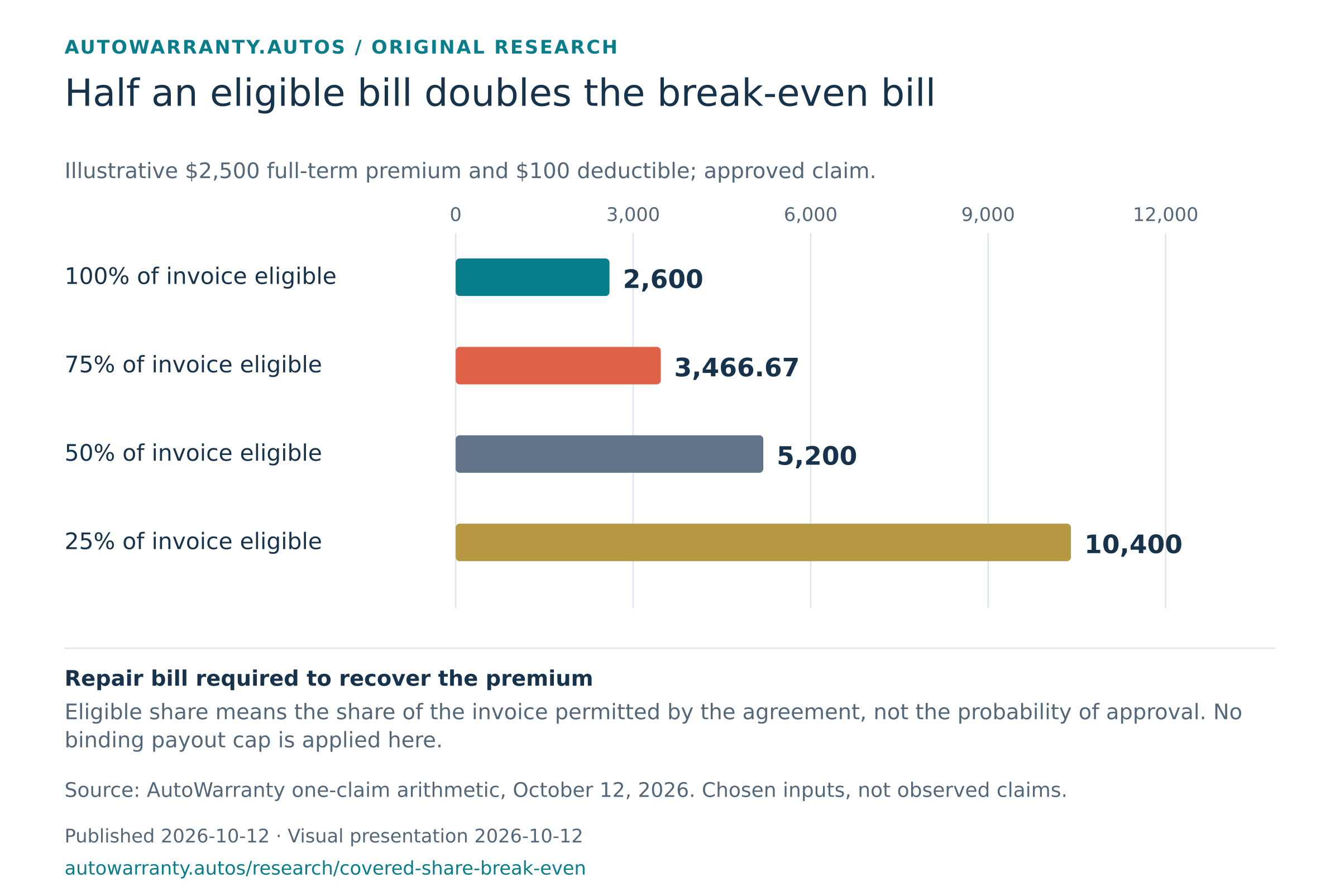
A large repair bill can produce the same payment as a smaller bill when less of it is eligible. In the fixed example, $2,600 at full eligibility and $5,200 at half eligibility both leave a $2,500 payment after the deductible. A binding cap can prevent that payment from reaching the premium at all.
Evidence scope: 48 illustrative premium, deductible and eligible-share combinations; no claim probabilities. Source snapshot: Scenario analysis published 2026-10-12. The interpretation below uses these retained inputs.
Eligible share means the share of the invoice permitted by the agreement, not the probability of approval. No binding payout cap is applied here.
AutoWarranty one-claim arithmetic, October 12, 2026. Chosen inputs, not observed claims.
Read the chart as a table
| Record or scenario | Repair bill required to recover the premium |
|---|---|
| 100% of invoice eligible | 2,600 |
| 75% of invoice eligible | 3,466.67 |
| 50% of invoice eligible | 5,200 |
| 25% of invoice eligible | 10,400 |
Analysis
What the change in eligible share explains
Without a binding cap, the threshold is the premium plus the deductible divided by the eligible fraction. Halving the fraction doubles the invoice needed to generate the same payment. This relationship explains why an expensive repair cannot establish a saving until the agreement's permitted portion of that bill is known.
The response is not a fixed dollar increase for each reduction in eligibility. With the same chosen premium and deductible, the threshold is about $3,466.67 at 75% eligibility, $5,200 at 50% and $10,400 at 25%. Smaller eligible shares raise the threshold more sharply because the same target payment must come from less of the invoice. These shares remain assumptions, not measured contract outcomes.
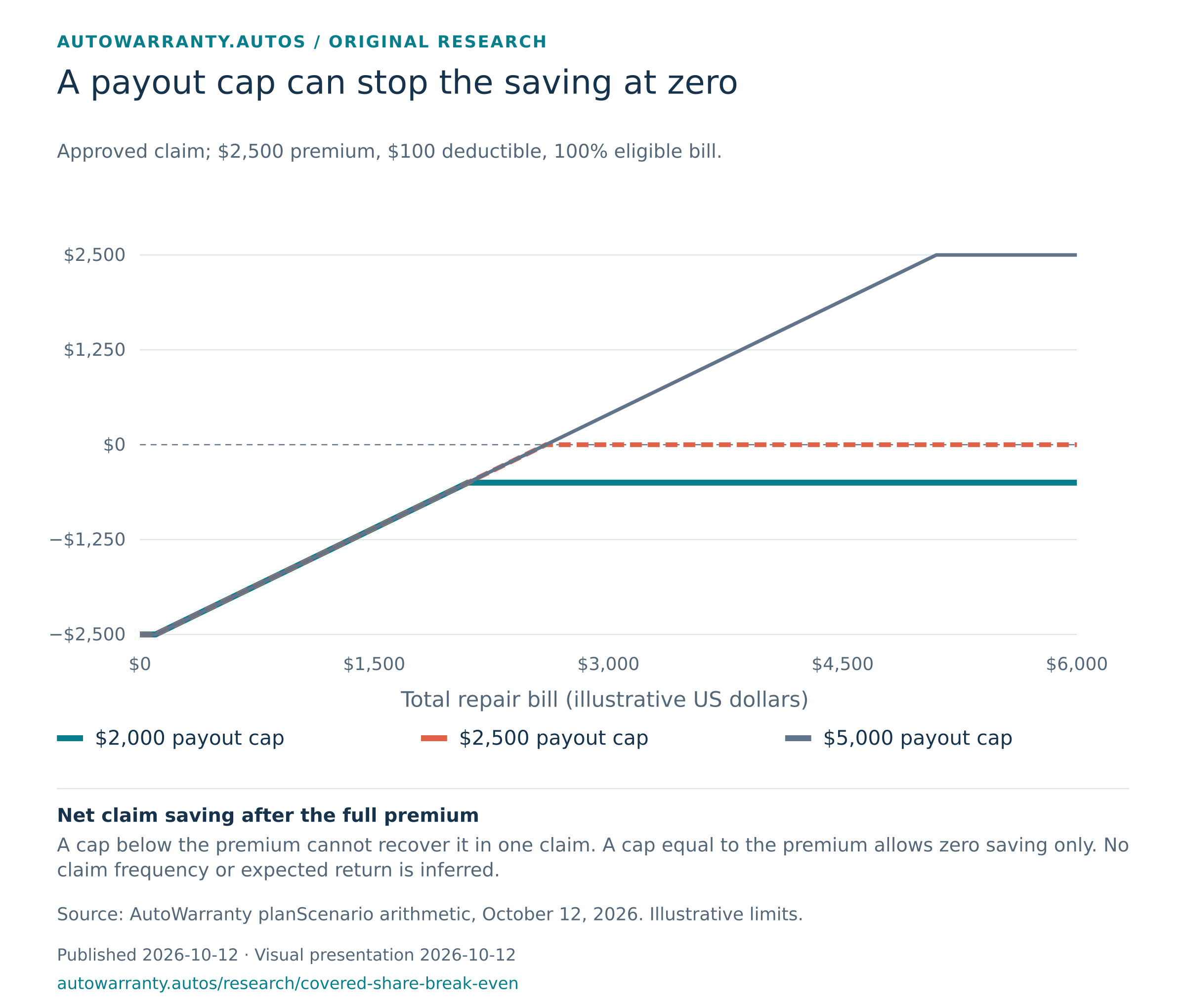
A payout cap creates a different boundary. If the applicable maximum payment is below the premium, increasing the invoice cannot make this single claim recover that premium. A cap equal to the premium can produce zero saving only. The cap therefore changes whether break-even is reachable, while the eligible share changes the invoice required when it is reachable.
The scenario separates arithmetic from the ownership decision. It assumes an approved claim and chosen terms; it does not estimate repair frequency, approval probability or multiple-claim outcomes. A driver can value protection against a difficult bill without expecting this particular one-claim example to generate a saving.
Finding 01
Use the part of the bill the contract would pay
The first comparison is between the full contract price and the reimbursement a claim could produce. A large invoice is not enough on its own. Some of its lines may concern excluded components, a rate shortfall or other costs outside the agreement.
In the fixed example, a $2,600 fully eligible repair leaves $2,500 after a $100 deductible. That payment recovers the assumed $2,500 premium. At 50% eligibility, a $5,200 bill produces the same $2,500 payment. The remaining bill stays with the owner.
The eligible percentage describes a share of the invoice. It is not a chance that the claim will be approved. The examples assume an approved claim and deduct the $100 after applying the eligible share.
A cap below the premium cannot recover it in one claim. A cap equal to the premium allows zero saving only. No claim frequency or expected return is inferred.
AutoWarranty planScenario arithmetic, October 12, 2026. Illustrative limits.
Read the chart as a table
| Repair bill | $2,000 payout cap | $2,500 payout cap | $5,000 payout cap |
|---|---|---|---|
| 0 | -2500 | -2500 | -2500 |
| 1000 | -1600 | -1600 | -1600 |
| 2600 | -500 | 0 | 0 |
| 5000 | -500 | 0 | 2400 |
| 6000 | -500 | 0 | 2500 |
Finding 02
A payout ceiling can prevent recovery of the premium
If the applicable maximum payout is $2,000, one claim cannot recover a $2,500 premium, whatever the total invoice. The most the example can pay is $500 less than the plan cost.
A $2,500 payout cap can reach a zero-saving break-even point, but it cannot produce a positive saving on this single claim. A higher cap can permit a saving if an eligible repair happens and the reimbursement exceeds the premium.
An agreement may set limits per component, per claim or over its full term. The relevant input is the limit still available for this particular scenario after any earlier claims.
Finding 03
The calculation does not decide whether to buy
A driver may value protection against a difficult bill even when a single-claim example does not recover the premium. That preference is different from a prediction that the plan will save money.
For the price comparison, use every required premium payment over the same coverage period. With a denied claim, reimbursement is zero. With no repair, the owner still pays the premium. Multiple claims need their own deductibles and limits rather than being added to this one-claim calculation.
Try a different assumption
See what the claim could actually pay
Keep the illustrative full-term premium at $2,500 and deductible at $100. Eligible share describes the bill, not the chance of claim approval.
Reimbursement = min(cap, max(0, bill × eligible share − deductible)) for an approved claim. The approved-claim break-even bill is $5,200.00 with these inputs. This does not predict a repair or determine coverage.
Conclusion
Compare the full premium with a plausible permitted payment
For a saving claim, start with the full required premium over the coverage period and calculate the permitted payment after the eligible share, deductible and applicable limit. Do not use the gross invoice as the reimbursement. If the available one-claim cap is below the premium, this scenario cannot break even. That mathematical boundary does not settle the broader decision about risk, benefits or cash flow.
Explore the research and press resources →For reporting and citation
An interpretation you can quote
In AutoWarranty's illustrative one-claim scenario, halving the eligible share doubles the break-even repair bill from $2,600 to $5,200. The payment permitted by the agreement determines the comparison with the premium.
AutoWarranty.Autos analysis
The numeric finding behind this interpretation
With an illustrative $2,500 full-term premium and $100 deductible, a single approved repair breaks even at $2,600 when the entire invoice is eligible, or $5,200 when half is eligible. A payout cap below the premium makes that one-claim recovery impossible.
AutoWarranty.Autos analysis
- Population
- 48 illustrative premium, deductible and eligible-share combinations; no claim probabilities
- Source snapshot
- Scenario analysis published 2026-10-12
- Analysis and presentation
- 2026-10-12; original publication 2026-10-12
The wording above is a suggested attributed quotation from our analysis. Link to this report and keep its population and assumptions with the finding.
Behind the numbers
How we worked it out
- Cross three full-term premiums ($1,500, $2,500 and $4,000), four deductibles ($0, $100, $250 and $500), and four eligible bill shares (100%, 75%, 50% and 25%).
- For a positive eligible share and no binding cap, divide premium plus deductible by the eligible fraction.
- Apply the payout cap after the deductible in the visual scenario. A cap below the premium makes single-claim break-even impossible; a cap equal to the premium permits zero saving only.
- These are chosen scenario inputs. They are not a price survey, quotes from Chaiz or a sample of actual claims.
What these figures can't tell you
- Eligible share, approval and caps depend on the actual agreement and failure; this calculation does not determine them.
- Failure probability, multiple claims, rental benefits, finance timing and personal liquidity are not modeled.
- The $2,500 price and $100 deductible are illustrative, not an offer for any vehicle.
The download has 48 data rows plus a header, generated from the same inputs as this page. Dates and units are listed in the columns or sources below. A blank field means the information wasn't available.
CSV column definitions
full_term_premium_usdassumed_deductible_usdassumed_eligible_bill_percentsingle_claim_break_even_bill_usd_without_binding_capevidence_type
Each row is one chosen input combination. Eligible percent is a share of the bill, not approval probability. Values use a deductible after the eligible share and no binding payout cap.
Sources and corrections
- Cost inputs, source dates and confidence definitions · source or review date 2026-09-04
- FTC warranties and service contracts · source or review date 2026-10-12
First published 2026-10-12. Visuals, analysis and conclusions reviewed 2026-10-12. Publication and presentation dates do not refresh the underlying snapshots. If you spot a problem, email me@autowarranty.autos with the page, data row and a source we can check.
Our calculations and explanatory charts may be cited with a link to this report. Underlying data retains its source terms. Download availability is not a grant of third-party content rights.