Main conclusion
An estimate should be judged by its inputs and applicability
A calculated total can look specific while combining a broad parts band, assumed hours and modeled local labor. The 24/20 split makes that distinction visible in our library. Model-specific individual-repair ranges cover eight named models, so the evidence behind one category cannot be assumed to apply equally to every car.
Evidence scope: 44 repair categories in our current library; a content audit, not a market survey. Source snapshot: Library audited 2026-10-12; benchmark source dated 2026-06-18. The interpretation below uses these retained inputs.
The three groups are mutually exclusive and sum to 44. The audit does not measure estimator accuracy or repair frequency.
AutoWarranty site-data audit, October 12, 2026; benchmark date June 18, 2026.
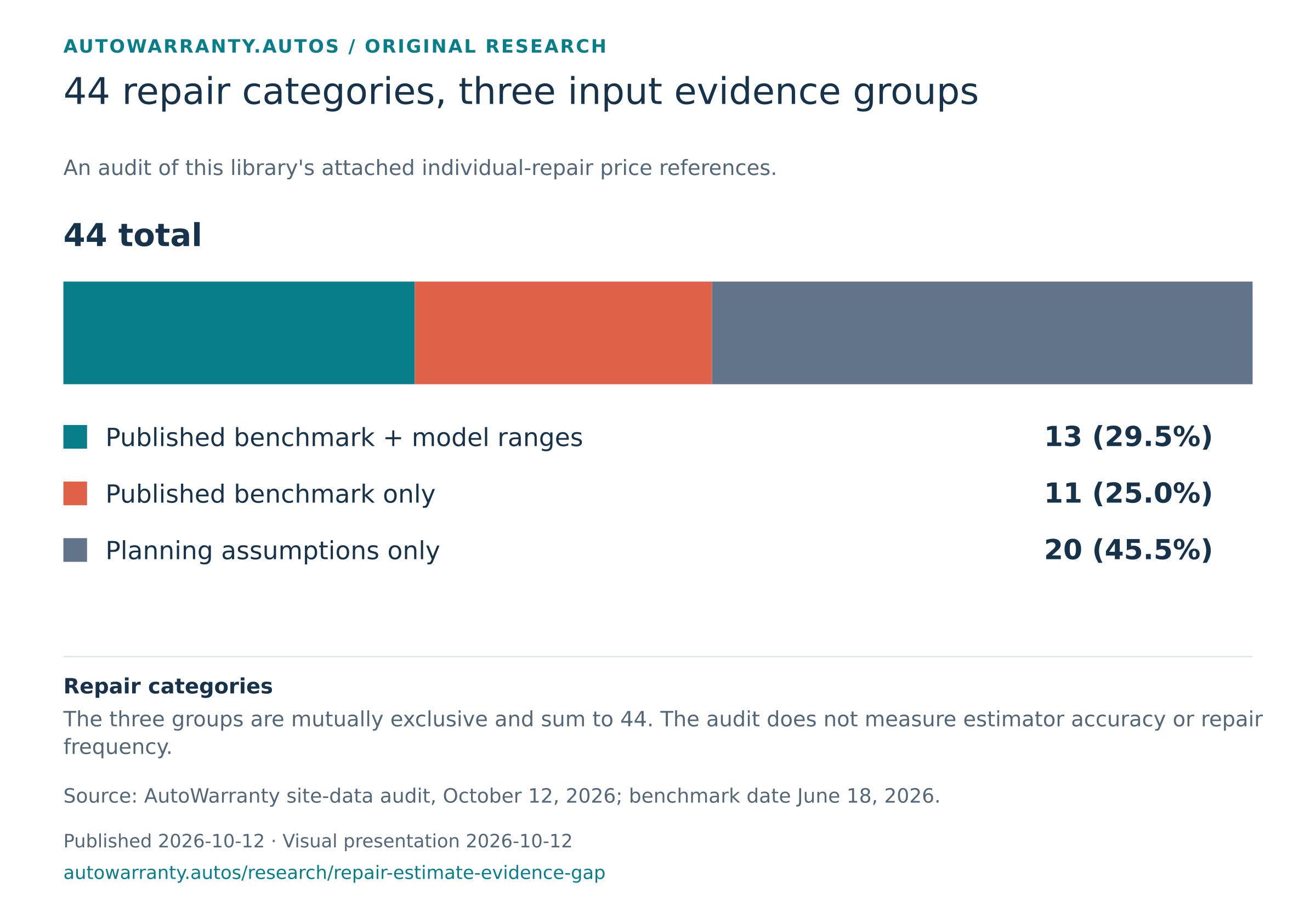
Read the chart as a table
| Record or scenario | Repair categories |
|---|---|
| Published benchmark + model ranges | 13 |
| Published benchmark only | 11 |
| Planning assumptions only | 20 |
Analysis
Why numerical detail does not establish vehicle-specific evidence
The estimator can calculate a detailed total from several uncertain inputs. Arithmetic makes the inputs consistent with one another; it does not make the parts band, labor hours or rate an observed quote. This is why the audit follows the source attached to each category rather than judging evidence from the number of digits in the answer.
The 13 published categories with model ranges and 11 published categories without them also answer different questions. A model-level range provides a more specific reference than a generic benchmark, but its nameplate scope can still span engines, drivetrains and years. The eight-model coverage concerns individual-repair price keys, not the separate annual repair-budget references or public-record coverage.
In category terms, 20 of 44 estimates, or 45.5%, use planning assumptions without an attached published benchmark. Only 13 of 44, or 29.5%, have any retained model-specific individual-repair range. The count describes the input library; it does not prove that 45.5% of estimates are wrong. Its practical use is to identify where vehicle-specific confirmation is still doing more of the work.
The consequence is to identify which inputs need confirmation before using the total for a decision. A written estimate should establish the failed component, the proposed procedure and the work included. This library audit cannot measure quote accuracy or establish that the same evidence gaps exist in another estimator.
Finding 01
A price range can combine evidence and assumptions
Twenty-four of the 44 categories carry a published benchmark in the current data. Thirteen of those also have at least one model-specific repair-price range. The other 20 categories use broader parts and labor assumptions without an attached published benchmark.
That partition describes the estimator's inputs. It is not a measure of how often those repairs happen, or a claim that the same evidence gaps exist in other estimators. Published benchmarks also remain estimates rather than a bill for an exact VIN.
The generic price calculation combines the parts band, assumed hours and modeled local labor rate. A detailed-looking total can therefore carry more assumptions than its precision suggests.
This concerns individual-repair price keys. Separate annual repair-budget references are outside the audit. A model range is not an exact trim or VIN quote.
AutoWarranty individual-repair range keys, October 12, 2026.
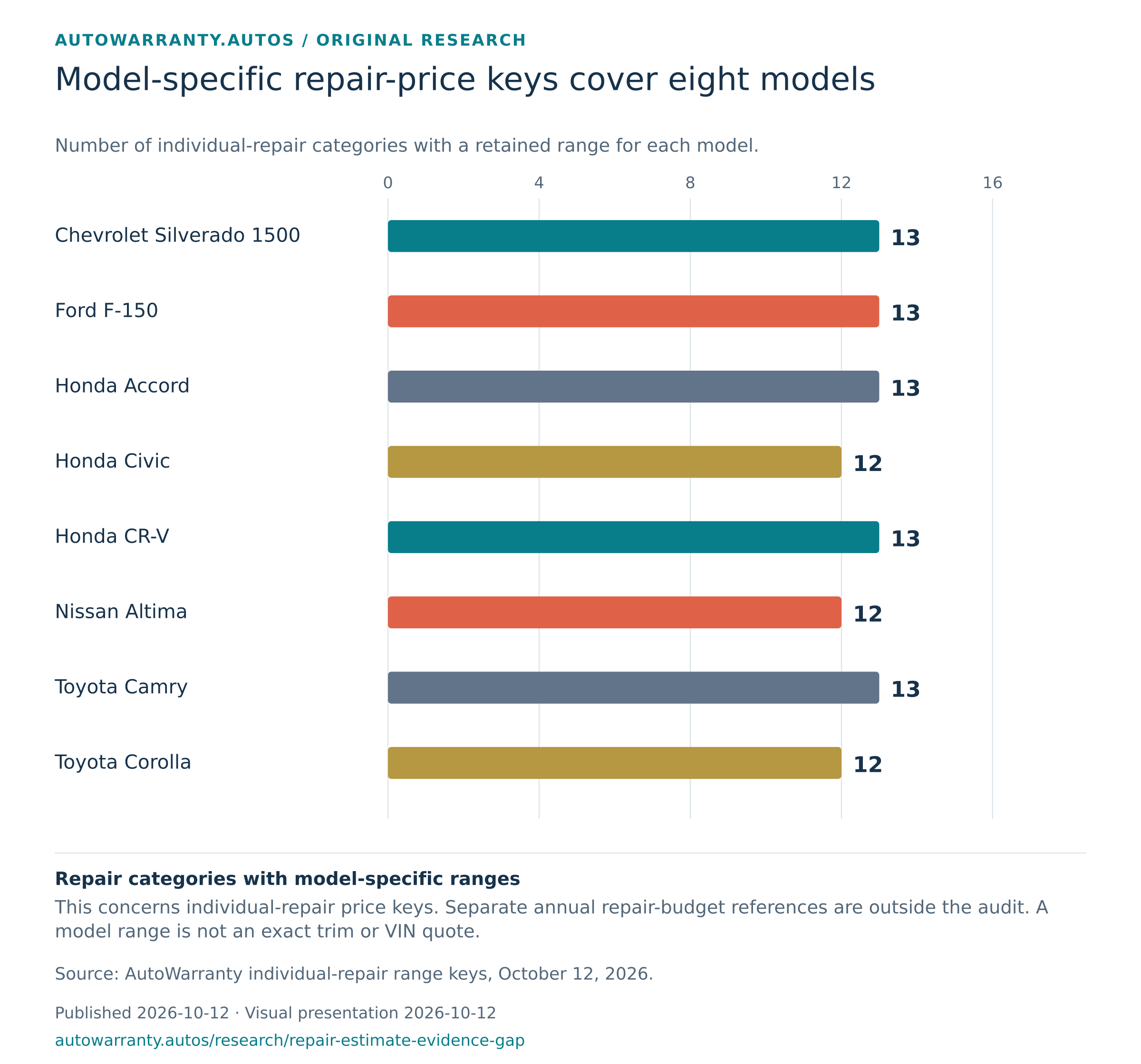
Read the chart as a table
| Record or scenario | Repair categories with model-specific ranges |
|---|---|
| Chevrolet Silverado 1500 | 13 |
| Ford F-150 | 13 |
| Honda Accord | 13 |
| Honda Civic | 12 |
| Honda CR-V | 13 |
| Nissan Altima | 12 |
| Toyota Camry | 13 |
| Toyota Corolla | 12 |
Finding 02
Model-specific repair ranges cover eight models
The retained model-range keys cover Chevrolet Silverado 1500, Ford F-150, Honda Accord, Honda Civic, Honda CR-V, Nissan Altima, Toyota Camry and Toyota Corolla. Coverage varies by repair within that group.
Other vehicles can still have public records, configuration details and separate annual repair-budget references. This audit concerns the model-specific price ranges for individual repairs, not every kind of cost information on the site.
Where a model-level range is available, it applies to the nameplate source scope. It does not establish a year-specific invoice or a quote for every engine, drivetrain and trim sold under that name.
Finding 03
Ask what could change the quoted job
Use the benchmark to prepare questions, then obtain a written estimate for the vehicle. Confirm the failed assembly, replacement part, approved hours, diagnosis, fluids and calibration. A source that prices a complete assembly may not describe a smaller manufacturer-directed repair.
For journalism, identify an estimate as generic, model-level or specific to a documented quote. Preserve its source date and geographic assumptions. A national estimate and a shop invoice answer different questions.
Conclusion
Use a planning estimate to identify what the shop must confirm
Treat a broad range as a budgeting reference and attach its evidence level, source date and vehicle scope. Before authorizing a repair or making a vehicle-specific cost claim, confirm the job and obtain a written estimate. A detailed total is useful when its inputs fit the vehicle; its numerical precision alone does not establish that fit.
Explore the research and press resources →For reporting and citation
An interpretation you can quote
A precise-looking repair total can still be built from broad assumptions. AutoWarranty's 44-category audit finds 20 categories without an attached published benchmark, making input evidence more informative than the number of digits in the estimate.
AutoWarranty.Autos analysis
The numeric finding behind this interpretation
In AutoWarranty's 44-category repair library, 24 categories have attached published benchmarks and 20 use planning assumptions. Model-specific individual-repair price keys cover eight models.
AutoWarranty.Autos analysis
- Population
- 44 repair categories in our current library; a content audit, not a market survey
- Source snapshot
- Library audited 2026-10-12; benchmark source dated 2026-06-18
- Analysis and presentation
- 2026-10-12; original publication 2026-10-12
The wording above is a suggested attributed quotation from our analysis. Link to this report and keep its population and assumptions with the finding.
Behind the numbers
How we worked it out
- Read each of the 44 repair records once from the current site-data snapshot.
- Mark a published benchmark only when a benchmark object is attached; count model-range coverage from each record's vehicleTotals keys.
- Partition categories into published with model ranges, published without model ranges, and assumptions only.
- Count distinct model-range keys across the library. Do not infer market-wide coverage or accuracy from the audit.
What these figures can't tell you
- This is an audit of AutoWarranty's selected library, not all available cost sources.
- Model-range presence does not guarantee exact configuration applicability or quote accuracy.
- Annual maintenance and repair-budget references are outside this individual-repair audit.
The download has 44 data rows plus a header, generated from the same inputs as this page. Dates and units are listed in the columns or sources below. A blank field means the information wasn't available.
CSV column definitions
repair_slugrepair_namesystempublished_benchmark_attachednumber_of_model_range_keysconfidencebenchmark_urlbenchmark_source_date
Published benchmark attached uses 1 for yes and 0 for no. Model-range keys count named models with a retained range for this repair. Counts describe the library, not breakdowns.
Sources and corrections
- Cost inputs, source dates and confidence definitions · source or review date 2026-09-04
- Published RepairPal benchmark source · source or review date 2026-06-18
First published 2026-10-12. Visuals, analysis and conclusions reviewed 2026-10-12. Publication and presentation dates do not refresh the underlying snapshots. If you spot a problem, email me@autowarranty.autos with the page, data row and a source we can check.
Our calculations and explanatory charts may be cited with a link to this report. Underlying data retains its source terms. Download availability is not a grant of third-party content rights.