Main conclusion
A long time limit is one condition of coverage rather than the whole answer
The printed year limit cannot be used on its own to judge eligibility. Two Honda documents state no mileage limit, but still restrict time and the covered condition. The other selected documents also combine years with mileage and vehicle or diagnostic boundaries. These are archived terms, not current approvals for individual cars.
Evidence scope: Five cited manufacturer programs; archived document terms, not a current eligibility check. Source snapshot: Primary documents checked 2026-10-12; document dates retained. The interpretation below uses these retained inputs.
Time, mileage, diagnosed condition and start basis must be read together. Ford's special over-limit window ended November 30, 2022.
Five cited manufacturer documents; source dates 2020–2024; checked October 12, 2026.
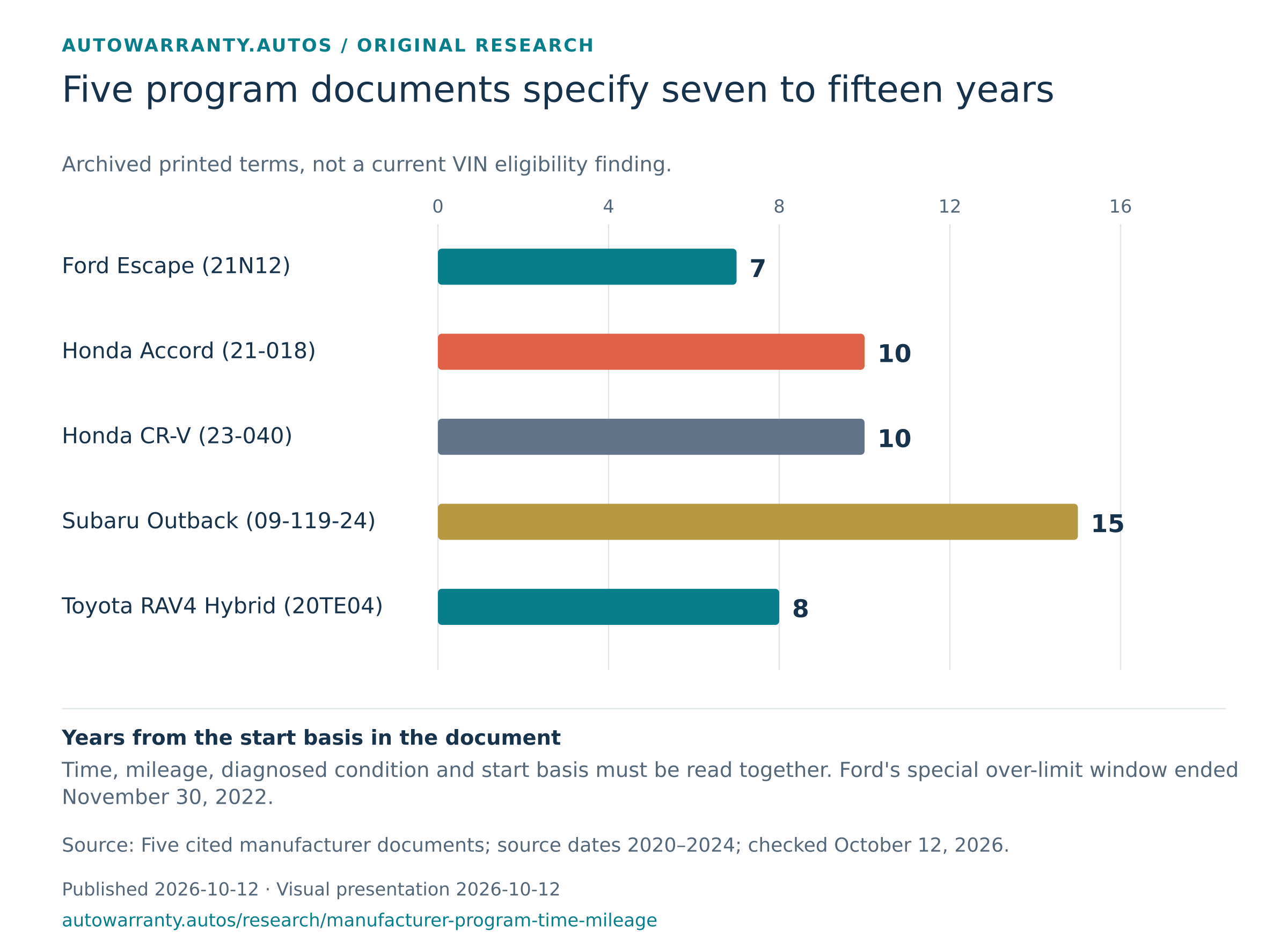
Read the chart as a table
| Record or scenario | Years from the start basis in the document |
|---|---|
| Ford Escape (21N12) | 7 |
| Honda Accord (21-018) | 10 |
| Honda CR-V (23-040) | 10 |
| Subaru Outback (09-119-24) | 15 |
| Toyota RAV4 Hybrid (20TE04) | 8 |
Analysis
Why the clock and the covered condition belong together
A program measured from original purchase or warranty start uses a different clock from the date a second owner bought the car. A remaining-year calculation therefore needs the start basis before it needs the advertised number of years. When the document also sets a mileage threshold, both limits must be considered together.
No mileage limit removes one boundary without removing the others. The two Honda documents still specify a time period and a particular A/C condition. Subaru's printed 15-year/150,000-mile limit and the selected Toyota and Ford terms likewise concern defined vehicles and faults. Reading the duration as general coverage for a whole system would broaden the printed terms.
Document history can create an additional limit. Ford's cited special over-limit window ended November 30, 2022; an October 2026 analysis cannot reopen it. A current manufacturer inquiry is needed because a program may have changed, been completed or not apply to the VIN. The five selected files cannot establish a typical manufacturer coverage period.
Finding 01
The years alone do not describe the coverage
The selected Ford 21N12 document describes a one-time repair for seven years or 84,000 miles from the warranty start date, whichever occurs first. Toyota's 20TE04 describes eight years from first use or 100,000 miles. Subaru's thermo control valve document states fifteen years or 150,000 miles.
Honda's selected Accord condenser and CR-V compressor-shaft-seal extensions each state ten years from original purchase without a mileage limit. They still require the eligible vehicle and specified condition. No mileage limit is not unrestricted coverage for every fault in the system.
These are terms printed in five cited documents. They do not establish that a particular car remains eligible today, or describe all programs offered by those manufacturers.
The earlier applicable time or mileage limit controls where both are stated. The underlying VIN, condition and document restrictions still apply.
Honda, Ford, Subaru and Toyota primary documents; checked October 12, 2026.
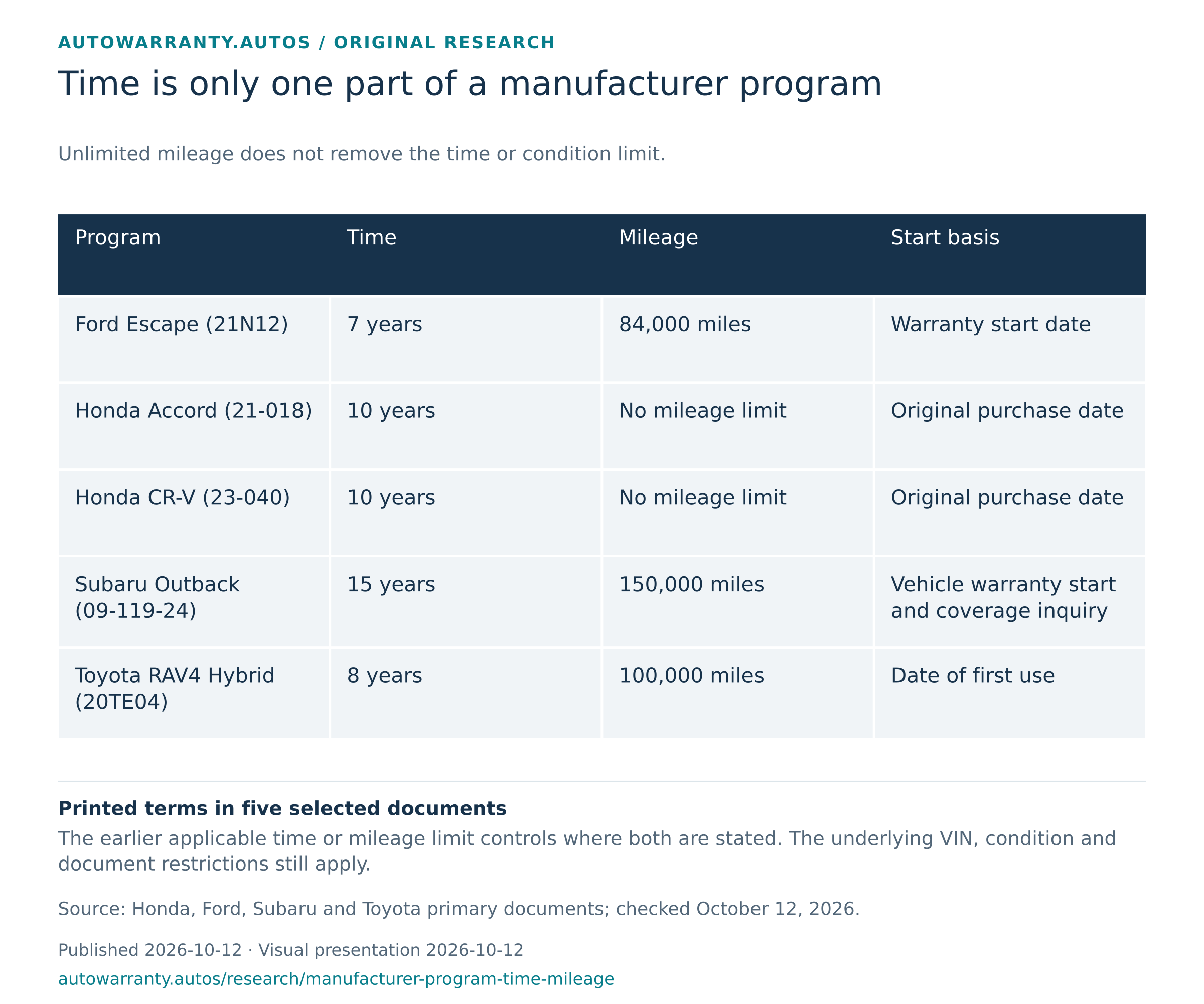
Read the chart as a table
| Program | Time | Mileage | Start basis |
|---|---|---|---|
| Ford Escape (21N12) | 7 years | 84,000 miles | Warranty start date |
| Honda Accord (21-018) | 10 years | No mileage limit | Original purchase date |
| Honda CR-V (23-040) | 10 years | No mileage limit | Original purchase date |
| Subaru Outback (09-119-24) | 15 years | 150,000 miles | Vehicle warranty start and coverage inquiry |
| Toyota RAV4 Hybrid (20TE04) | 8 years | 100,000 miles | Date of first use |
Finding 02
The covered cause and component can be narrower than the symptom
The Accord condenser document addresses factory-defect leaks and excludes foreign-object damage. The CR-V document addresses the shaft seal on specified 1.5T vehicles. A warm A/C vent by itself cannot distinguish those conditions from an unrelated compressor, hose or other leak.
Subaru requires a vehicle coverage inquiry for the specified thermo control valve condition. Toyota requires verification of the covered refueling condition. Ford's cited notice also contains a special over-limit window that ended November 30, 2022; it should not be presented as a current blanket extension.
Finding 03
Check the existing remedy before pricing the remaining gap
Ask the manufacturer or authorized retailer to confirm the VIN, relevant start date, current mileage and diagnosed condition. Keep that answer separate from a new independent contract quote.
A confirmed manufacturer remedy can change who pays for one specific fault. It does not predict other repairs or automatically remove the value of protection for different eligible failures. Compare the remaining gap after understanding the existing program.
Conclusion
Ask for a current answer tied to the VIN and diagnosed condition
Use the archived document to prepare the inquiry: identify its start basis, time and mileage limits, covered fault and vehicle scope. Ask the manufacturer for current eligibility using the VIN and diagnosis. A long printed duration is relevant evidence for that check, but it is not a promise of payment or a new coverage clock for a later owner.
Explore the research and press resources →For reporting and citation
An interpretation you can quote
A long manufacturer-program duration is only one eligibility condition. AutoWarranty's review of five archived programs shows why the start date, mileage rule, covered fault and current VIN inquiry must be read together.
AutoWarranty.Autos analysis
The numeric finding behind this interpretation
Five manufacturer programs cited in AutoWarranty's selected files print time limits from seven to fifteen years. Two Honda extensions state no mileage limit, but each program still depends on its condition, start date and vehicle eligibility.
AutoWarranty.Autos analysis
- Population
- Five cited manufacturer programs; archived document terms, not a current eligibility check
- Source snapshot
- Primary documents checked 2026-10-12; document dates retained
- Analysis and presentation
- 2026-10-12; original publication 2026-10-12
The wording above is a suggested attributed quotation from our analysis. Link to this report and keep its population and assumptions with the finding.
Read the documented examples
Manufacturer documented
Coolant intrusion into the cylinders
Ford Escape · 2017, 2018, 2019
Low coolant paired with white exhaust or a rough cold start appears in Ford's documented 1.5L coolant-intrusion procedure.
- Affected scope
- 2017 to 2019 Ford Escape. 1.5L EcoBoost engine. Specific build dates apply and should be checked against the bulletin
- Manufacturer check or remedy
- A Ford technician follows the published pressure and inspection procedure. Where the condition is confirmed and the vehicle meets the criteria, the bulletin specifies short block and head gasket replacement.
Safety and eligibility limits in this source
- The temperature warning appears or the engine overheats
- Coolant is rapidly disappearing
- The engine is shaking severely or the warning light is flashing
- Coverage is VIN specific. A bulletin does not by itself promise a free repair.
- Never open a hot cooling system.
Warranty extension published
A/C condenser refrigerant leak
Honda Accord · 2018, 2019, 2020
Loss of cold air can fall under Honda's condenser-leak warranty extension when the VIN qualifies and inspection confirms the source.
- Affected scope
- 2018 to 2020 Honda Accord. All trim levels. VIN status must be checked
- Manufacturer check or remedy
- Ask for VIN eligibility under Bulletin 21-018 and confirmation that the condenser, rather than another A/C component, is leaking.
Safety and eligibility limits in this source
- The compressor makes grinding noises or smoke appears
Warranty extension published
A/C compressor shaft seal leak
Honda CR-V · 2017, 2018, 2019, 2020, 2021, 2022
Warm air that worsens over time is one pattern Honda connects to a compressor shaft-seal leak on eligible 1.5T vehicles.
- Affected scope
- 2017 to 2022 Honda CR-V. 1.5T engine. VIN confirmation required
- Manufacturer check or remedy
- Ask a Honda dealer to check VIN eligibility and inspect the compressor shaft seal under Service Bulletin 23-040 before authorizing broader A/C work.
Safety and eligibility limits in this source
- The compressor is grinding, smoking or repeatedly seizing
- The refrigerant circuit is pressurized and is not an appropriate DIY repair.
Warranty extension published
Thermo control valve warning codes
Subaru Outback · 2020, 2021, 2022
A check-engine light with P2682 or a P26A-series code appears in Subaru's thermo-control-valve diagnostic record.
- Affected scope
- 2020 to 2022 Subaru Outback. The extension also lists specified Legacy, Forester and Crosstrek model years. VIN eligibility must be confirmed through Subaru
- Manufacturer check or remedy
- Ask a Subaru retailer to read the stored codes, check the VIN for the active extension and follow the service-manual thermo control valve replacement procedure when the condition is confirmed.
Safety and eligibility limits in this source
- A red temperature warning appears, the gauge shows overheating or steam is visible
- Coolant is rapidly disappearing or leaking onto hot components
- The engine runs roughly, loses power severely or cannot maintain a safe speed
- The procedure involves the cooling system, fuel delivery pipe and one-time-use gaskets. It is intended for trained technicians.
- Never open a hot cooling system. A code match is not confirmation that the valve is the only fault.
Customer support program published
Fuel gauge does not read full after refueling
Toyota RAV4 Hybrid · 2019, 2020
A gauge that stays below full after refueling is the clearest sign in Toyota's RAV4 Hybrid fuel-tank program; fill amount still needs to be checked.
- Affected scope
- Certain 2019 to 2020 Toyota RAV4 Hybrid vehicles. Campaign and production VIN criteria apply. The program does not apply to the non-hybrid RAV4
- Manufacturer check or remedy
- Ask a Toyota dealer to check the VIN against 20TE04 and follow T-SB-0109-20. A qualifying vehicle may need its tank, sender gauge or both replaced after the condition is verified.
Safety and eligibility limits in this source
- Fuel is visibly leaking or the smell of fuel is strong
- The vehicle stalls, loses propulsion or will not restart safely
- The remaining fuel level is uncertain and the vehicle may run out before reaching a safe location
- A matching model year alone does not establish eligibility or identify the required part.
- Do not keep topping off after the nozzle clicks. Stop immediately if fuel spills or a strong fuel smell develops.
Behind the numbers
How we worked it out
- Use the five non-recall files assigned to an extension or customer-program group in the retained collection.
- Read their primary manufacturer documents and record the printed years, mileage limit, start basis and key condition or eligibility boundary.
- Treat no mileage limitation as a distinct value, not zero miles or infinite coverage for every cause.
- Keep archived document terms separate from current VIN eligibility. Preserve publication dates and identify the Ford notice's expired special over-limit window.
What these figures can't tell you
- The five files are a selected library subset, not a survey of all manufacturer programs.
- A program may be superseded, completed or unavailable for a particular VIN; a current manufacturer inquiry is necessary.
- Time and mileage thresholds are not assurances of payment, and the covered component and failure condition remain decisive.
The download has 5 data rows plus a header, generated from the same inputs as this page. Dates and units are listed in the columns or sources below. A blank field means the information wasn't available.
CSV column definitions
source_problem_idmakemodelprogram_referencepublished_year_limitpublished_mileage_limittime_start_basiscondition_and_eligibility_notesource_document_datedocument_checked_dateprimary_document_url
Each row is one selected cited program. Printed terms are historical document facts, not a live VIN eligibility determination. No-mileage-limit entries retain their separate time limit and condition rules.
Sources and corrections
- TSB 19-2139 · source or review date Nov 21, 2019
- 21N12 · source or review date Jun 9, 2022
- Service Bulletin 21-018 · source or review date May 28, 2021
- Service Bulletin 23-040 · source or review date May 19, 2023
- Subaru Bulletin 09-119-24 · source or review date Apr 4, 2024
- Subaru Bulletin 09-80-21 · source or review date Feb 28, 2022
- Customer Support Program 20TE04 · source or review date Oct 29, 2020
- T-SB-0109-20 Rev1 · source or review date Mar 3, 2021
First published 2026-10-12. Visuals, analysis and conclusions reviewed 2026-10-12. Publication and presentation dates do not refresh the underlying snapshots. If you spot a problem, email me@autowarranty.autos with the page, data row and a source we can check.
Our calculations and explanatory charts may be cited with a link to this report. Underlying data retains its source terms. Download availability is not a grant of third-party content rights.