Main conclusion
Confirm the exact version before treating model-level advice as specific
Multiple configurations are the usual pattern in the matched portion of this database: 2,336 of 2,608 model-years, or 89.6%. A model-year summary can therefore combine equipment from several possible versions. The summary helps identify what to verify; it does not identify the configuration of an individual vehicle.
Evidence scope: 2,742 model-years joined to EPA and a public source index. Source snapshot: 2026-08-07. The interpretation below uses these retained inputs.
A missing match is an information gap, not evidence of a missing component or a reliable car.
FuelEconomy.gov configuration snapshot 2026-08-07; original audit September 4, 2026.
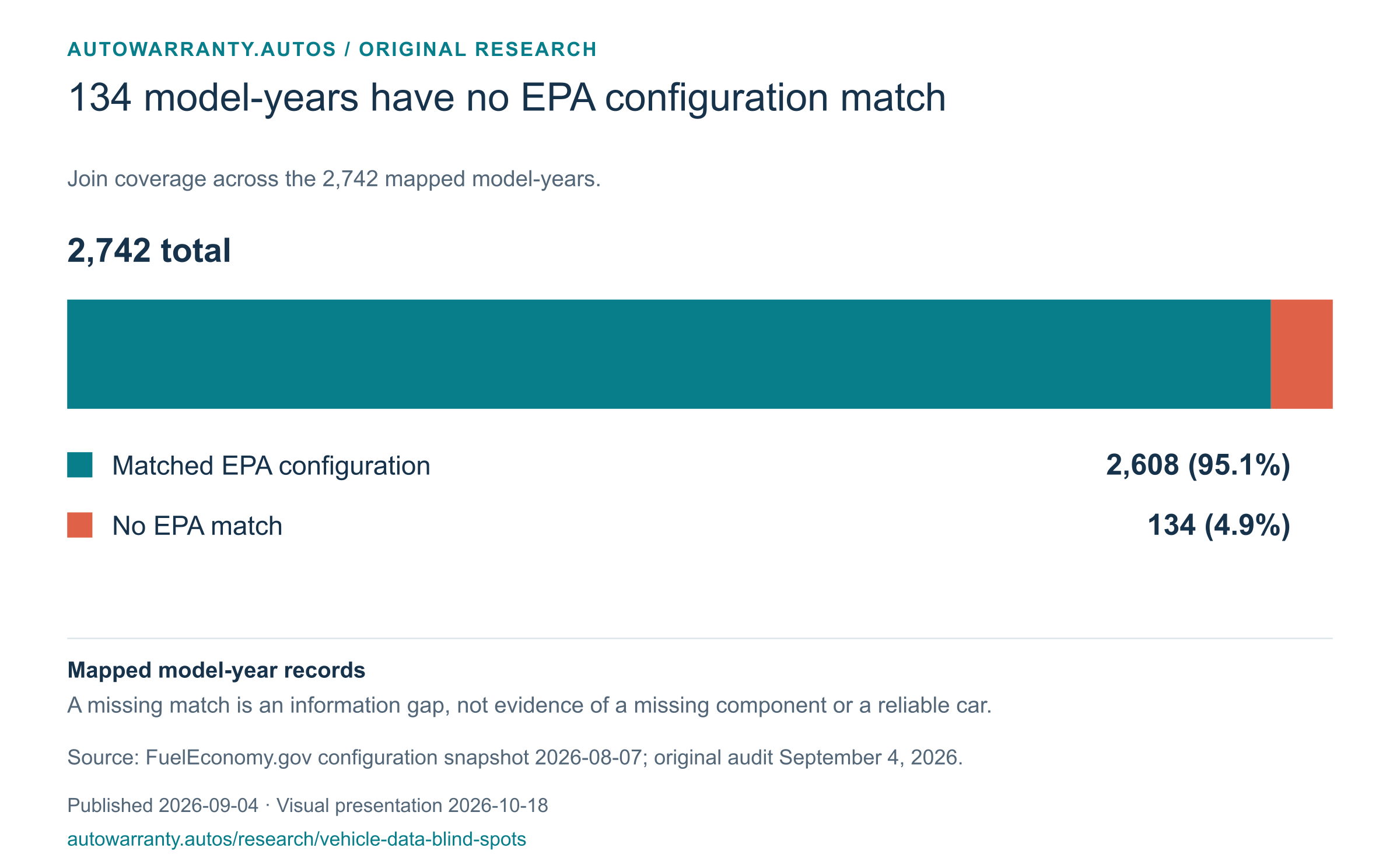
Read the chart as a table
| Record or scenario | Mapped model-year records |
|---|---|
| Matched EPA configuration | 2,608 |
| No EPA match | 134 |
Embed this chart with its source note
The embed includes the chart, its source dates and a link to the method. It contains no tracking scripts.
<iframe src="https://autowarranty.autos/research/vehicle-data-blind-spots/embed" title="AutoWarranty research chart" width="100%" height="900" loading="lazy" style="border:0" referrerpolicy="no-referrer"></iframe>Analysis
Why configuration matching changes the meaning of the advice
The issue is applicability. A model name can organize research while still combining gasoline and hybrid versions, different drivetrains or other equipment. In the matched records, 745 model-years have multiple fuel categories and 1,537 have multiple drivetrain options. Those differences explain why advice about a particular system needs a more precise vehicle description.
The groups overlap, and source configurations are not unique trim counts. A combined list of fuel and drivetrain options also does not prove that every possible pairing was sold. Constructing a car from that combined list can attach equipment or repair examples to a version that does not have them. Confirming the actual version resolves that question before the advice is used.
A high match rate does not resolve the version question. EPA details are available for 95.1% of the 2,742 mapped model-years, but 89.6% of those matched records contain multiple configurations. The first percentage describes source coverage; the second describes how broad the matched information remains. Finding a source and identifying the individual car are separate steps.
The 134 unmatched model-years introduce a separate information gap. Missing EPA details should remain unconfirmed rather than being borrowed from an adjacent year. The absence of a match cannot establish the absence of equipment or better reliability. Together, the findings support a practical rule: verify identity and source fit before drawing a vehicle-specific conclusion.
Finding 01
Two versions of the same model can need different repairs
We could match EPA vehicle details to 2,608 of our 2,742 model-years, or 95.1%. For the other 134, we leave those details unconfirmed instead of assuming the engine or drivetrain matches another year.
2,336 matched model-years contain multiple EPA configurations, and 745 include more than one fuel category. Those are overlapping groups, not counts to add together. A model-year can include gasoline and hybrid versions, or front-wheel-drive and all-wheel-drive versions.
Your car may not have every expensive part listed for its model. We filter repair examples by the available vehicle details, but you should still confirm your engine and drivetrain before using an estimate.
A model-year may appear in all three groups. A union of options does not establish that every fuel and drivetrain combination was sold.
AutoWarranty join to FuelEconomy.gov snapshot 2026-08-07.

Read the chart as a table
| Record or scenario | Matched model-year records |
|---|---|
| Multiple EPA configurations | 2,336 |
| Multiple drivetrain options | 1,537 |
| Multiple fuel categories | 745 |
Finding 02
Check your exact version before using the estimate
Our EPA summary brings together different versions sold in a model year. A turbocharger on that list means at least one version has one, not necessarily yours. It also doesn't mean every listed fuel type was sold with every listed drivetrain.
Where vehicle details are missing, the calculator labels its broader model-family estimate and leaves out repairs that depend on unconfirmed equipment. You may see fewer examples as a result.
Hydrogen-car owners need an extra check. Our library doesn't include fuel-cell-stack or hydrogen-system repair costs, so the remaining examples won't cover everything on the car. Get a specialist estimate and confirm whether the contract covers those systems.
Finding 03
A missing problem page isn't a clean bill of health
We found FixCatalogue model-page links for 226 of our 323 models, and issue-page links for 1,713 model-years. Those counts tell us where we can link you for more reading. They don't tell us how many of a car's possible problems have been documented.
A missing link can simply mean a model uses a different name or its page wasn't in the sitemap we checked. It doesn't make the car more reliable. Several links can also refer to the same campaign across different years.
Before you compare plans, confirm your car's engine, fuel type and drivetrain. If it has an expensive hybrid system or turbocharger, check that the contract covers it. Our sources help you prepare those questions; the VIN, service history and actual contract fill in details a model-level estimate can't.
Conclusion
Research the version that will be owned
Start with the actual year, engine, fuel type and drivetrain, then use manufacturer records or build information to confirm the details. Apply equipment-specific guides and coverage questions to that version. Where a source does not identify the version, treat it as background until its applicability can be checked. This is a conclusion about research fit, not a ranking of vehicles or a prediction of repairs.
Explore the research and press resources →For reporting and citation
An interpretation you can quote
In AutoWarranty's matched database, nearly nine in ten model-years contain multiple EPA source configurations. A model name organizes the research; the exact version determines which equipment-specific advice can apply.
AutoWarranty.Autos analysis
The numeric finding behind this interpretation
AutoWarranty's configuration audit leaves 134 of 2,742 model-years without an EPA match. Another 2,336 contain multiple configurations, making the model name alone too broad for an exact repair estimate.
AutoWarranty.Autos analysis
- Population
- 2,742 model-years joined to EPA and a public source index
- Source snapshot
- 2026-08-07
- Analysis and presentation
- 2026-10-18; original publication 2026-09-04
The wording above is a suggested attributed quotation from our analysis. Link to this report and keep its population and assumptions with the finding.
Behind the numbers
How we worked it out
- Join EPA by exact mapped make/model/year keys. Separate unmatched years from matched years with multiple configurations.
- Use the existing normalized model-path matcher for FixCatalogue and count files within an exact indexed year.
- Fuel and configuration counts overlap. Preserve one CSV row per site model-year so each group can be recomputed.
- Audit the packaged snapshots. Live source coverage can change; new imports require review.
What these figures can't tell you
- EPA summaries are not exact VIN records or a determination of contract eligibility.
- Link counts do not measure prevalence, severity or unique campaigns across years.
- The FixCatalogue layer in this audit is its sitemap, not its complete database.
The download has 2,742 data rows plus a header, generated from the same inputs as this page. Dates and units are listed in the columns or sources below. A blank field means the information wasn't available.
CSV column definitions
makemodelmodel_yearepa_matched: 1 = yes; 0 = noepa_configurationsfuel_categoriesdrive_categoriesfixcatalogue_model_matched: 1 = yes; 0 = noindexed_issue_routesepa_snapshotindex_snapshot
Read each column with the units, population and limits stated in this study. A count describes the specified records; it does not establish a rate or probability.
Sources and corrections
- EPA configuration download · source or review date 2026-08-07
- FixCatalogue public sitemap · source or review date 2026-09-03
- NHTSA bulk data and definitions · source or review date 2026-10-18
First published 2026-09-04. Visuals, analysis and conclusions reviewed 2026-10-18. Publication and presentation dates do not refresh the underlying snapshots. The historical link audit now explicitly reads the retained sitemap index, keeping it separate from the full migrated problem records. If you spot a problem, email me@autowarranty.autos with the page, data row and a source we can check.
Our calculations and explanatory charts may be cited with a link to this report. Underlying data retains its source terms. Download availability is not a grant of third-party content rights.