Main conclusion
A recall headline must distinguish campaign IDs from their appearances
Several files can legitimately describe where one campaign appears across model scopes. They remain useful as separate applicability records, but counting each as a new campaign repeats the underlying identifier. The 771-ID total applies only to the identifiers cited in this selected collection.
Evidence scope: 1,200 selected recall files; campaign references extracted from their evidence fields. Source snapshot: Retained problem source generated 2026-08-03. The interpretation below uses these retained inputs.
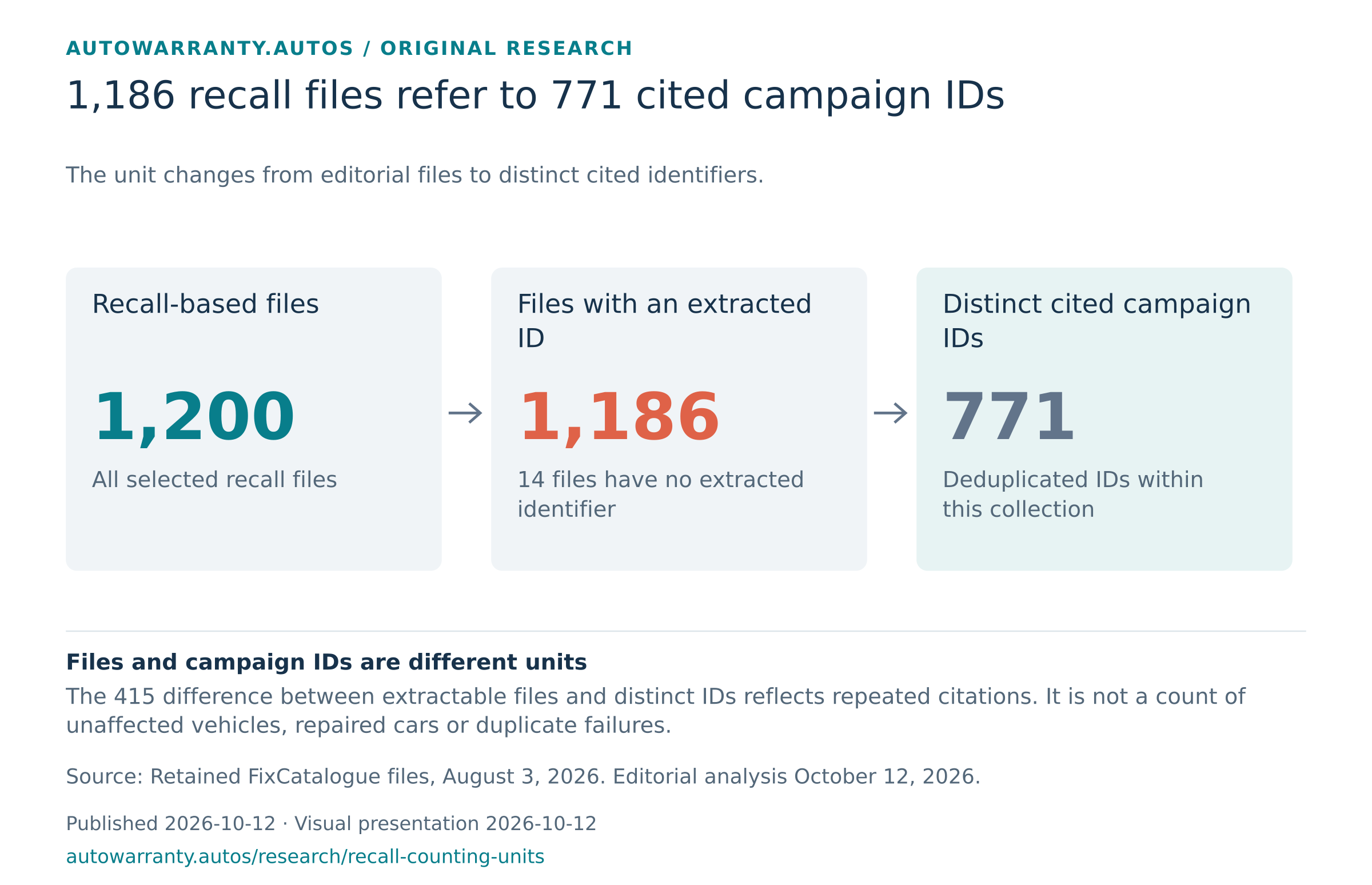
The 415 difference between extractable files and distinct IDs reflects repeated citations. It is not a count of unaffected vehicles, repaired cars or duplicate failures.
Retained FixCatalogue files, August 3, 2026. Editorial analysis October 12, 2026.
Read the chart as a table
| Record or scenario | Files and campaign IDs are different units |
|---|---|
| Recall-based files | 1,200 |
| Files with an extracted ID | 1,186 |
| Distinct cited campaign IDs | 771 |
Analysis
Why both counts can be correct while describing different things
A manufacturer campaign may apply to more than one model or year. Editorial files preserve those scopes so readers can find the relevant record. Repeated campaign citations are therefore meaningful for navigation and applicability, but they do not establish additional independent campaigns.
This collection contains 1,200 recall-based files. Of those, 1,186 have extractable IDs under the method, and their cited IDs deduplicate to 771. Fourteen files remain without an extracted identifier. Reporting either file count as the unique-campaign total would skip the deduplication and extraction boundaries that define that claim.
The repetition is not confined to one unusual campaign: 205 of the 771 cited IDs, or 26.6%, appear in more than one retained file. That explains why changing the counting unit can alter the headline materially. The percentage is about repeated citations in this collection, not the share of vehicles recalled or the share of all NHTSA campaigns affecting several models.
Deduplication should follow the question. Count distinct campaign IDs for a campaign-reference audit, preserve make/model/year entries when describing source applicability, and use a VIN inquiry for the individual vehicle. This partial collection cannot replace the site's separate complete NHTSA model-year aggregates or establish the global number of recalls.
Finding 01
A file count is not a unique campaign count
The retained library contains 1,200 recall problem files. Our reference-field parser identifies a standard NHTSA campaign ID in 1,186 of them. Those references reduce to 771 distinct IDs; 14 files remain outside that extraction because their reference fields do not contain the required ID pattern.
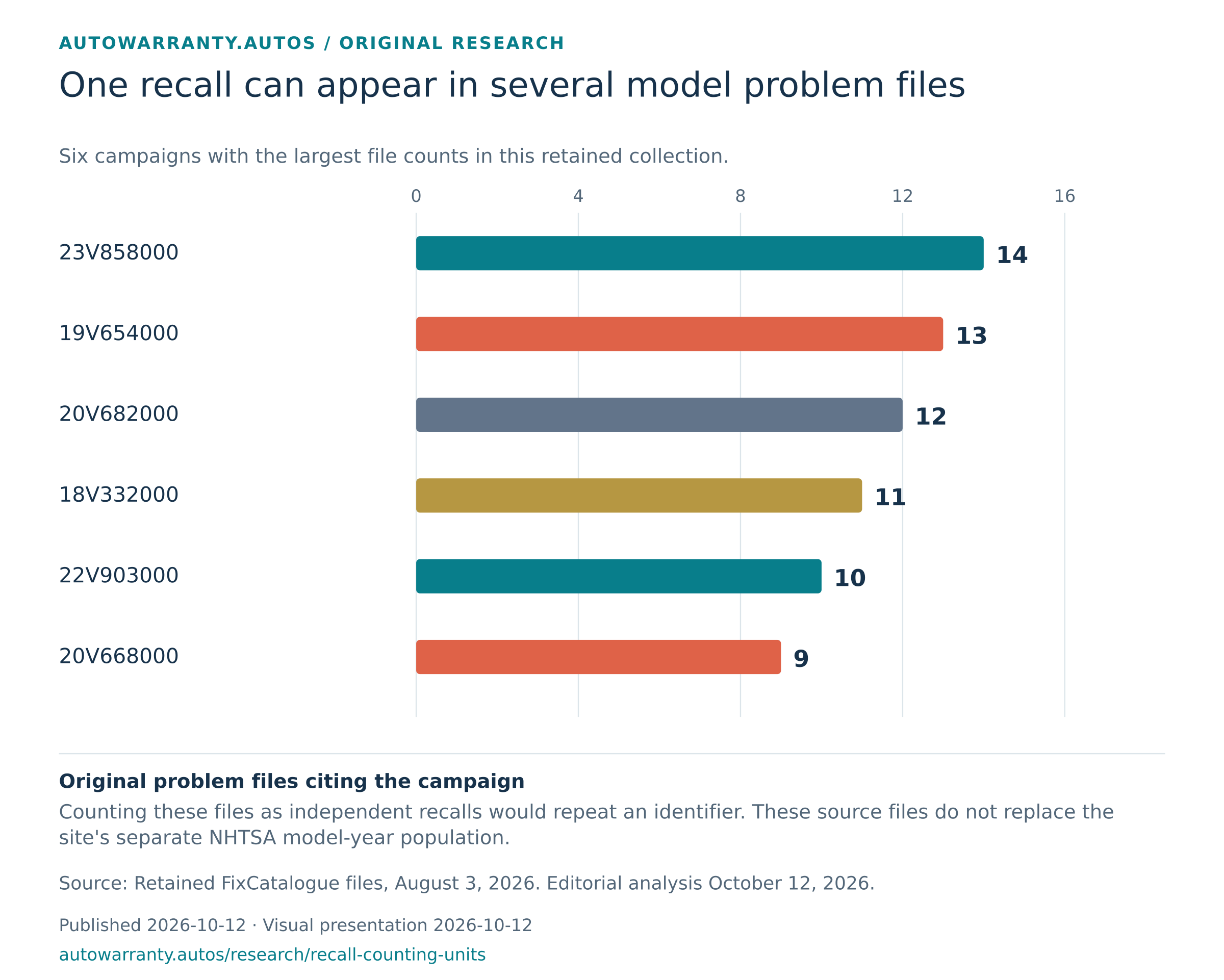
Two hundred and five of the identified IDs appear in more than one problem file. A campaign spanning several model scopes can produce separate reading pages without creating separate defects or independent campaigns.
The 415-entry difference between extractable files and distinct IDs is a counting result within this collection. It is not a count of duplicate failures, unresolved repairs or affected vehicles.
Counting these files as independent recalls would repeat an identifier. These source files do not replace the site's separate NHTSA model-year population.
Retained FixCatalogue files, August 3, 2026. Editorial analysis October 12, 2026.
Read the chart as a table
| Record or scenario | Original problem files citing the campaign |
|---|---|
| 23V858000 | 14 |
| 19V654000 | 13 |
| 20V682000 | 12 |
| 18V332000 | 11 |
| 22V903000 | 10 |
| 20V668000 | 9 |
Finding 02
Covered years can repeat the same campaign again
Campaign 23V858000 appears across 14 model scopes in the selected source. Each file can also cover several model years. A table that adds its year-level occurrences without deduplicating campaign IDs answers a different question from a table of unique campaigns.
This matters in a make or model overview. If the page sums campaign counts across years, label that total as recall/model-year entries. Only call the result unique campaigns when the underlying IDs have actually been deduplicated across the stated population.
Finding 03
Neither counting unit establishes reliability
A unique campaign can cover a large population or a narrow build range, and a model-level count does not identify whether an individual VIN has an open remedy. Separate those questions from the arithmetic.
For reporting, name the population, date and counting unit in the same sentence as the number. Do not use this selected source collection to rank manufacturers by safety, defect frequency or unresolved recalls.
Conclusion
State the counting unit before comparing recall totals
For a unique-campaign claim, deduplicate the cited IDs and keep the 14 unmatched files visible. For an applicability claim, retain the separate model scopes and label them as entries. Neither unit is a failure count or a VIN eligibility result. Clear units prevent a larger editorial file count from being mistaken for more unique campaigns.
Explore the research and press resources →For reporting and citation
An interpretation you can quote
One recall campaign can produce several useful model records without becoming several recalls. In AutoWarranty's selected collection, 1,186 files with extractable identifiers refer to 771 distinct campaign IDs.
AutoWarranty.Autos analysis
The numeric finding behind this interpretation
Within AutoWarranty's selected recall collection, 1,186 files with extractable identifiers refer to 771 distinct campaign IDs. Repeated files and model-year appearances are different counting units from unique recall campaigns.
AutoWarranty.Autos analysis
- Population
- 1,200 selected recall files; campaign references extracted from their evidence fields
- Source snapshot
- Retained problem source generated 2026-08-03
- Analysis and presentation
- 2026-10-12; original publication 2026-10-12
The wording above is a suggested attributed quotation from our analysis. Link to this report and keep its population and assumptions with the finding.
Behind the numbers
How we worked it out
- Select the 1,200 files classified as recalls in the retained source.
- Extract case-insensitive IDs matching two digits, V and six digits from evidence reference fields; normalize to uppercase and deduplicate within each file.
- Count distinct referenced IDs across extractable files. Keep the 14 unmatched files visible rather than guessing their identifiers.
- For the secondary figure, count original problem files citing each campaign. Do not count those files as vehicles, failures or independent campaigns.
What these figures can't tell you
- The selected library is not the complete NHTSA recall database.
- Fourteen files lack an extractable reference under the method and are not included in the 771-ID figure.
- Different IDs can concern related conditions; this method deduplicates identifiers, not defect mechanisms.
- No VIN status, fleet-size denominator, completion rate or failure probability is available from these counts.
The download has 1,200 data rows plus a header, generated from the same inputs as this page. Dates and units are listed in the columns or sources below. A blank field means the information wasn't available.
CSV column definitions
source_problem_idmakemodelcovered_yearsextractable_cited_campaign_idscampaign_id_foundoriginal_review_date
Each row is one selected recall file, not a unique campaign or failure. 14 rows have no extractable campaign ID. Count distinct nonblank IDs to reproduce the campaign total.
Sources and corrections
- Retained problem-file source and scope · source or review date 2026-08-03
- NHTSA bulk recall data and definitions · source or review date 2026-08-03
- NHTSA campaign 23V858000 · source or review date Dec 18, 2023
First published 2026-10-12. Visuals, analysis and conclusions reviewed 2026-10-12. Publication and presentation dates do not refresh the underlying snapshots. If you spot a problem, email me@autowarranty.autos with the page, data row and a source we can check.
Our calculations and explanatory charts may be cited with a link to this report. Underlying data retains its source terms. Download availability is not a grant of third-party content rights.