Model-year warranty research

Is an Extended Warranty Worth It for a 2019 Chevrolet Bolt EV?

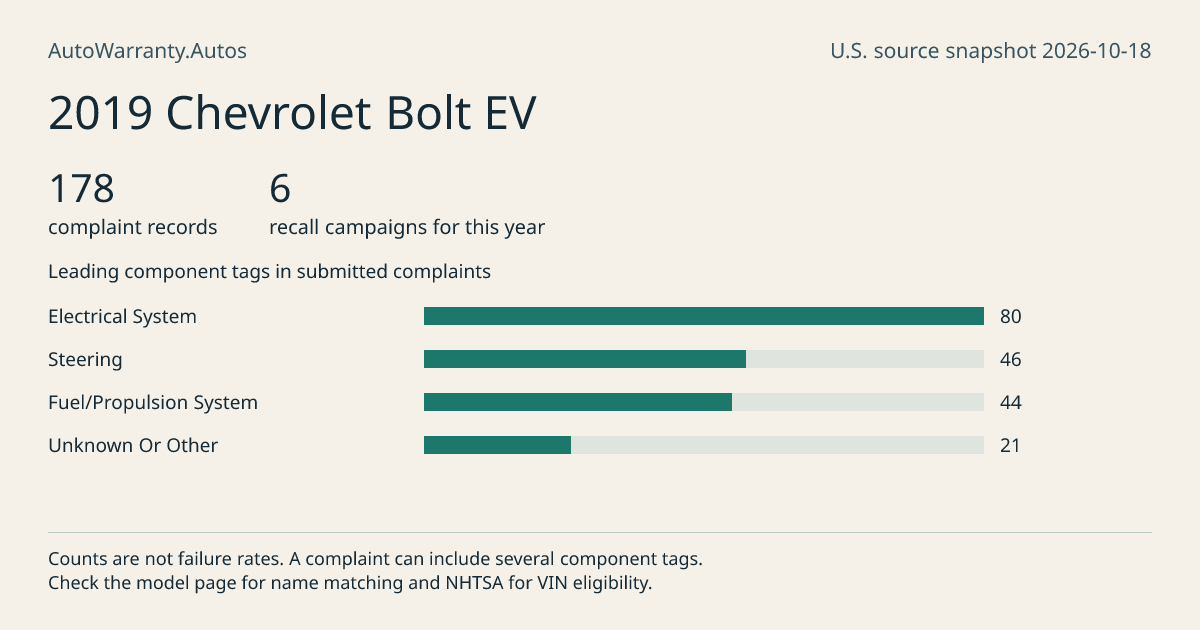
Review estimated repair costs, owner complaints, recalls and manufacturer communications for this model year. The records describe submitted cases; they do not tell you how likely a failure is.

Run the worth-it calculator for this car →
178complaint reports
6recall campaigns
628manufacturer communications
6leading reported component tags
2019 Chevrolet Bolt EV: submitted complaint records, vehicle recall campaigns and available complaint component tags. Counts are not failure rates.
Published source snapshot. Check the record scope below before applying these counts to your vehicle.

Source: NHTSA vehicle records, recall and complaint snapshot 2026-10-18. Manufacturer communications retain their separately dated source snapshot. Counts are submitted records, not failure probabilities. One vehicle can appear in several campaigns.

Complaint model names counted: BOLT EV. Recall model names counted: BOLT EV. Complaint records are deduplicated by ODI number; vehicle recalls are counted by distinct campaign number for this year.

Model-year records

What the 2019 record can and cannot say

The 2019 record contains 178 submitted complaints. The median across this model's matched years is 89 reports. Neither number accounts for vehicle sales or time on the road. Source names: BOLT EV. NHTSA source snapshot: 2026-10-18.

Electrical System is the most common displayed component tag, with 80 reports (44.9% of this year's submitted complaints). One complaint can name several components. The share describes reports, not the probability of a failure.

EV traction battery replacement has the highest arithmetic midpoint for parts in the applicable planning estimates, at $16,000 before labor. A paid plan can help only if the component and cause qualify; check existing manufacturer coverage first.

Follow or share this source snapshot

Follow this model in an RSS reader. The feed follows published snapshots, with no promised daily schedule. It does not send safety alerts or check your VIN.

Open the model-year chart · How the feeds work

Embed this model card

Copy this HTML. The image links to the source page and keeps its limits visible.

<a href="https://autowarranty.autos/models/chevrolet/bolt-ev/2019" rel="nofollow"><img src="https://autowarranty.autos/models/chevrolet/bolt-ev/2019/share.png?v=2026-10-18" width="1200" height="630" alt="2019 Chevrolet Bolt EV: submitted records, not failure rates" style="max-width:100%;height:auto"></a>

Problem research and repair guidance

2019 Chevrolet Bolt EV: symptoms, affected vehicles and documented fixes

Match the symptom and the exact vehicle scope before arranging work. The imported catalogue is an editorial index of source documents, not an independent safety authority. Recall text is checked against NHTSA; each record links to the evidence that supports its scope and remedy.

4documented issue files
4vehicle systems

4 recall files · 0 other manufacturer files. These are editorial file counts, not distinct campaign totals, failure rates or a complete recall history.

ELECTRICAL SYSTEM

Official safety recall2017, 2018, 2019Campaign 21V560000

ELECTRICAL SYSTEM:PROPULSION SYSTEM:TRACTION BATTERY: recall 21V560000

A battery fire increases the risk of injury.

General Motors LLC (GM) is recalling certain 2017-2019 Chevrolet Bolt EV vehicles previously recalled under NHTSA recall number 20V-701. The high voltage battery could catch fire when charged to full or nearly full capacity.

Condition in the official record

General Motors LLC (GM) is recalling certain 2017-2019 Chevrolet Bolt EV vehicles previously recalled under NHTSA recall number 20V-701. The high voltage battery could catch fire when charged to full or nearly full capacity.

Which vehicles the source covers
  • NHTSA model names: BOLT EV. Model years: 2017, 2018, 2019.
  • NHTSA campaign 21V560000
  • The complete campaign lists 57,414 potentially affected units across all listed vehicles.
  • A make, model and year match does not establish VIN eligibility.

Safety recall eligibility is based on the VIN and campaign scope, not ordinary warranty mileage. Check the complete VIN even when the vehicle is outside its original warranty.

Component in the source: ELECTRICAL SYSTEM:PROPULSION SYSTEM:TRACTION BATTERY

Published recall remedy

Owners are advised to take the following interim steps: Activate either the Hill Top Reserve (2017 and 2018 models) or Target Charge Level (2019 models) feature in their vehicle to limit the charge level to 90%, charge their vehicle more frequently, avoid depleting the battery to 70 miles range remaining, park outside after charging, and do not charge the vehicle indoors overnight. Defective battery modules will be replaced by GM, free of charge. Interim notification letters notifying owners of the safety risk were mailed on August 13, 2021. Owner notification letters were mailed on August 13, 2021. Owners may contact the Bolt EV Concierge Team at 1-833-382-4389. GM's number for this recall is N212343880.

Consequence in the NHTSA record: A battery fire increases the risk of injury.

Official recall remedyManufacturer or authorized dealer · Confirm with the dealer

Owners are advised to take the following interim steps: Activate either the Hill Top Reserve (2017 and 2018 models) or Target Charge Level (2019 models) feature in their vehicle to limit the charge level to 90%, charge their vehicle more frequently, avoid depleting the battery to 70 miles range remaining, park outside after charging, and do not charge the vehicle indoors overnight. Defective battery modules will be replaced by GM, free of charge. Interim notification letters notifying owners of the safety risk were mailed on August 13, 2021. Owner notification letters were mailed on August 13, 2021. Owners may contact the Bolt EV Concierge Team at 1-833-382-4389. GM's number for this recall is N212343880.

Limit: Confirm VIN eligibility and current remedy instructions with the manufacturer.

Check the complete VINVIN lookup · Before arranging repairs

Check the 17-character VIN at NHTSA.gov/recalls and ask the manufacturer whether this campaign remains open for the vehicle.

Limit: The model-year list is not proof that an individual vehicle is affected.

Evidence for this issue

LATCHES/LOCKS/LINKAGES

Official safety recall2019, 2020Campaign 20V184000

LATCHES/LOCKS/LINKAGES:DOORS:LATCH: recall 20V184000

If the rear door opens while driving, or the door handle fails to open the rear door, there is an increased risk of injury to the rear passengers.

General Motors LLC (GM) is recalling certain 2019-2020 Chevrolet Bolt EV vehicles. The door-handle cable inside the rear doors may be too long, allowing contact with the window when it is opened, possibly damaging the cable. A damaged cable may cause the rear door to open unintentionally when the rear window is opened. Additionally, it may cause the rear inside door handle to not work.

Condition in the official record

General Motors LLC (GM) is recalling certain 2019-2020 Chevrolet Bolt EV vehicles. The door-handle cable inside the rear doors may be too long, allowing contact with the window when it is opened, possibly damaging the cable. A damaged cable may cause the rear door to open unintentionally when the rear window is opened. Additionally, it may cause the rear inside door handle to not work.

Which vehicles the source covers
  • NHTSA model names: BOLT EV. Model years: 2019, 2020.
  • NHTSA campaign 20V184000
  • The complete campaign lists 897 potentially affected units across all listed vehicles.
  • A make, model and year match does not establish VIN eligibility.

Safety recall eligibility is based on the VIN and campaign scope, not ordinary warranty mileage. Check the complete VIN even when the vehicle is outside its original warranty.

Component in the source: LATCHES/LOCKS/LINKAGES:DOORS:LATCH

Published recall remedy

GM will notify owners, and dealers will replace the rear inside door-handle cables, free of charge. The recall began April 17, 2020. Owners may contact Chevrolet customer service at 1-800-222-1020. GM's number for this recall is A202298320.

Consequence in the NHTSA record: If the rear door opens while driving, or the door handle fails to open the rear door, there is an increased risk of injury to the rear passengers.

Official recall remedyManufacturer or authorized dealer · Confirm with the dealer

GM will notify owners, and dealers will replace the rear inside door-handle cables, free of charge. The recall began April 17, 2020. Owners may contact Chevrolet customer service at 1-800-222-1020. GM's number for this recall is A202298320.

Limit: Confirm VIN eligibility and current remedy instructions with the manufacturer.

Check the complete VINVIN lookup · Before arranging repairs

Check the 17-character VIN at NHTSA.gov/recalls and ask the manufacturer whether this campaign remains open for the vehicle.

Limit: The model-year list is not proof that an individual vehicle is affected.

Evidence for this issue

SERVICE BRAKES, HYDRAULIC

Official safety recall2018, 2019Campaign 18V576000

SERVICE BRAKES, HYDRAULIC:FOUNDATION COMPONENTS:DISC:CALIPER: recall 18V576000

A reduction of braking performance can increase the risk of a crash.

General Motors LLC (GM) is recalling certain 2018-2019 Chevrolet Equinox, Impala, Cruze, Volt and Bolt EV vehicles, GMC Terrain vehicles, Buick Lacrosse and Regal vehicles, Cadillac XTS and XTS Professional vehicles and 2018 Chevrolet Malibu vehicles. The rear brake caliper pistons may have an insufficient coating causing gas pockets to form, potentially reducing rear brake performance.

Condition in the official record

General Motors LLC (GM) is recalling certain 2018-2019 Chevrolet Equinox, Impala, Cruze, Volt and Bolt EV vehicles, GMC Terrain vehicles, Buick Lacrosse and Regal vehicles, Cadillac XTS and XTS Professional vehicles and 2018 Chevrolet Malibu vehicles. The rear brake caliper pistons may have an insufficient coating causing gas pockets to form, potentially reducing rear brake performance.

Which vehicles the source covers
  • NHTSA model names: BOLT EV. Model years: 2018, 2019.
  • NHTSA campaign 18V576000
  • The complete campaign lists 210,628 potentially affected units across all listed vehicles.
  • A make, model and year match does not establish VIN eligibility.

Safety recall eligibility is based on the VIN and campaign scope, not ordinary warranty mileage. Check the complete VIN even when the vehicle is outside its original warranty.

Component in the source: SERVICE BRAKES, HYDRAULIC:FOUNDATION COMPONENTS:DISC:CALIPER

Published recall remedy

GM will notify owners, and dealers will bleed the vehicle's brake system, free of charge. The recall began October 11, 2018. Owners may contact Buick customer service at 1-800-521-7300, Cadillac customer service at 1-800-458-8006, Chevrolet customer service at 1-800-222-1020, or GMC customer service at 1-800-462-8782. GM's number for this recall is 18279.

Consequence in the NHTSA record: A reduction of braking performance can increase the risk of a crash.

Official recall remedyManufacturer or authorized dealer · Confirm with the dealer

GM will notify owners, and dealers will bleed the vehicle's brake system, free of charge. The recall began October 11, 2018. Owners may contact Buick customer service at 1-800-521-7300, Cadillac customer service at 1-800-458-8006, Chevrolet customer service at 1-800-222-1020, or GMC customer service at 1-800-462-8782. GM's number for this recall is 18279.

Limit: Confirm VIN eligibility and current remedy instructions with the manufacturer.

Check the complete VINVIN lookup · Before arranging repairs

Check the 17-character VIN at NHTSA.gov/recalls and ask the manufacturer whether this campaign remains open for the vehicle.

Limit: The model-year list is not proof that an individual vehicle is affected.

Evidence for this issue

STRUCTURE

Official safety recall2017, 2018, 2019, 2020, 2021, 2022, 2023Campaign 22V930000

STRUCTURE:BODY:ROOF AND PILLARS: recall 22V930000

A vehicle fire can increase the risk of injury.

General Motors, LLC (GM) is recalling certain 2017-2023 Chevrolet Bolt EV vehicles. After a crash with seat belt pretensioner deployment, the pretensioner exhaust may ignite carpet fibers near the B-pillar, causing a fire.

Condition in the official record

General Motors, LLC (GM) is recalling certain 2017-2023 Chevrolet Bolt EV vehicles. After a crash with seat belt pretensioner deployment, the pretensioner exhaust may ignite carpet fibers near the B-pillar, causing a fire.

Which vehicles the source covers
  • NHTSA model names: BOLT EV. Model years: 2017, 2018, 2019, 2020, 2021, 2022, 2023.
  • NHTSA campaign 22V930000
  • The complete campaign lists 111,242 potentially affected units across all listed vehicles.
  • A make, model and year match does not establish VIN eligibility.

Safety recall eligibility is based on the VIN and campaign scope, not ordinary warranty mileage. Check the complete VIN even when the vehicle is outside its original warranty.

Component in the source: STRUCTURE:BODY:ROOF AND PILLARS

Published recall remedy

Dealers will install metal foil at the carpet near the pretensioner exhaust, and install a pretensioner cover as necessary, free of charge. Owner notification letters were mailed between January 23, 2023 and April 25, 2023. Owners may contact Chevrolet customer service at 1-800-222-1020. GM's number for this recall is N222383790.

Consequence in the NHTSA record: A vehicle fire can increase the risk of injury.

Official recall remedyManufacturer or authorized dealer · Confirm with the dealer

Dealers will install metal foil at the carpet near the pretensioner exhaust, and install a pretensioner cover as necessary, free of charge. Owner notification letters were mailed between January 23, 2023 and April 25, 2023. Owners may contact Chevrolet customer service at 1-800-222-1020. GM's number for this recall is N222383790.

Limit: Confirm VIN eligibility and current remedy instructions with the manufacturer.

Check the complete VINVIN lookup · Before arranging repairs

Check the 17-character VIN at NHTSA.gov/recalls and ask the manufacturer whether this campaign remains open for the vehicle.

Limit: The model-year list is not proof that an individual vehicle is affected.

Evidence for this issue

Confirm who pays before authorizing work

A recall remedy follows the campaign and VIN eligibility. A service bulletin provides diagnosis or repair instructions; it does not by itself promise payment. Manufacturer warranty extensions and support programs have their own conditions.

Compare recalls, bulletins and warranty extensions →

Keep a current problem separate from future coverage

These files do not supply a shop quote. Ask for a diagnosis and written estimate, then check recall remedies or existing coverage. A new vehicle service contract generally excludes pre-existing conditions.

Prepare a useful description for the mechanic →

Each file retains its original source review date. Historical remedy wording can change; check the current manufacturer notice and NHTSA VIN lookup for your vehicle. The separately dated NHTSA counts elsewhere on this page use a different dataset and scope.

Read the evidence for this vehicle

What can the data tell you about 2019 Chevrolet Bolt EV?

No model-specific individual-repair price keys are retained for Chevrolet Bolt EV in this library. Generic parts and labor estimates, public records and separate annual cost references may still be available.

Individual-repair price scopeGeneric inputs

Model-level range presence is a source-coverage check. It does not confirm that a repair fits every engine or model year.

EPA configuration match1 source row

This model year can include different equipment. Use the VIN and original specifications to identify the actual configuration.

Documented repair pathsCheck the source

Recall and communication counts describe records. They cannot establish a breakdown probability or current VIN status.

Price-key audit reviewed October 18, 2026; EPA source snapshot 2026-08-07. Individual-repair ranges and annual repair-budget references are different datasets.

Source: NHTSA vehicle records, recall and complaint snapshot 2026-10-18. Manufacturer communications retain their separately dated source snapshot. Counts are submitted records, not failure probabilities. One vehicle can appear in several campaigns.

Complaint model names counted: BOLT EV. Recall model names counted: BOLT EV. Complaint records are deduplicated by ODI number; vehicle recalls are counted by distinct campaign number for this year.

Sources and methods

What each source tells you

NHTSA records: 178 submitted complaints, 6 recalls and 628 manufacturer communications. These are report counts, not failure probabilities.

EPA vehicle details: 1 matched fuel-economy configurations help us leave out repairs for equipment this model year does not have.

Repair-cost estimates: We model 18 applicable repairs beyond normal wear items, using published benchmarks where available plus parts and independent-shop labor assumptions. These ranges are not dealer quotes, repair-shop quotes or invoices.

Read the full research and repair-cost methodology.
Vehicle configuration

2019 EPA specification range

The official dataset contains 1 matched configurations for this model year. The range reflects trim and drivetrain choices, not changes to the complaint count.

Vehicle classSmall station wagon
Fuel choicesElectric
Drive layoutsFront-wheel drive
Engine rangeNo combustion engine
EPA efficiency119 MPGe; 238 miles electric range
Transmission typesAutomatic

EPA figures vary by configuration. Confirm the exact engine, drive layout and fuel system from the VIN or original window sticker. Source: FuelEconomy.gov vehicle data, updated 2026-08-07.

Estimated repair bills

Major repair cost range

These ranges combine parts and labor benchmarks with modeled independent-shop rates for 50-metro reference. These are national repair benchmarks and planning assumptions, not published prices for this exact vehicle. We filter repairs using the available model-year specifications; a shop must confirm the engine, equipment and diagnosed job.

RepairSystemEstimated range
EV traction battery replacementEV Powertrain$8,270 to $29,375
EV drive unit replacementEV Powertrain$3,952 to $17,281
EV onboard charger replacementEV Powertrain$1,635 to $8,187
EV thermal management repairEV Powertrain$1,008 to $6,187
Strut and control arm repairSuspension$1,053 to $4,545
Infotainment display or head unit replacementElectrical and Electronic$722 to $4,467
Steering rack replacementSteering$2,232 to $2,681
Electronic control module replacementElectrical and Electronic$604 to $3,210
AC evaporator replacementClimate control$1,223 to $2,079
Radiator replacementCooling System$1,316 to $1,628